SmarterEd

Aussie Maths & Science Teachers: Save your time with SmarterEd

  • Login
  • Get Help
  • About

Rectilinear Figures, SM-Bank 025

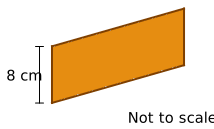
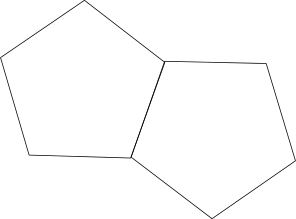
Martha cut a piece of material in half as shown below.
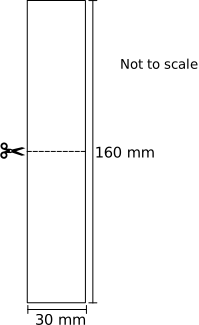
 

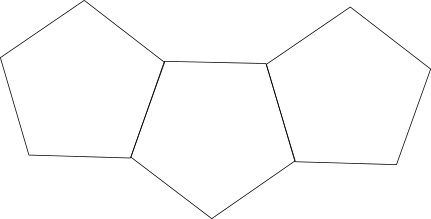
She then placed the one half on top of the other half, as shown below.
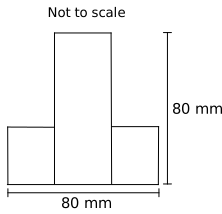
What is the perimeter of the newly formed shape in millimetres?  (2 marks)

--- 4 WORK AREA LINES (style=lined) ---

Show Answers Only

\(320\ \text{mm}\)

Show Worked Solution

\(\text{Calculating the perimeter from the top down:}\)
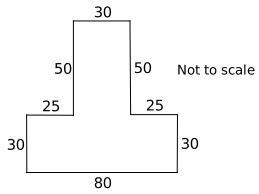
\(\text{Perimeter}\)

\(=30+2\times 50+2\times 25+2\times 30+80\)

\(=320\ \text{mm}\)
Filed Under: Rectilinear Figures Tagged With: num-title-ct-core, smc-4840-15-Irregular shapes

Rectilinear Figures, SM-Bank 024

A rectangle has a length of 12 cm and a width of 7 cm.

A square has the same perimeter as this rectangle.

What is the side length of this square in centimetres?  (2 marks)

--- 4 WORK AREA LINES (style=lined) ---

Show Answers Only

\(9.5\ \text{cm}\)

Show Worked Solution

\(\text{Perimeter of Rectangle}\)

\(=2\times 12 +2\times 7\)

\(=38\ \text{cm}\)

\(\text{Side length of square}\)

\(=\dfrac{38}{4}\)

\(=9.5\ \text{cm}\)

Filed Under: Rectilinear Figures Tagged With: num-title-ct-core, smc-4840-10-Plane shapes

Rectilinear Figures, SM-Bank 023 MC

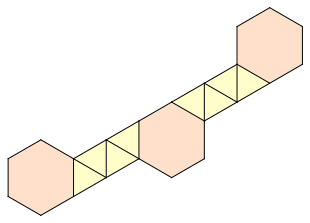
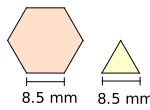
A hexagon with equal sides and an equilateral triangle are drawn below.

3 identical hexagons and 8 identical equilateral triangles are connected as shown in the diagram below.

What is the perimeter of the larger shape?

  1. \(76.5\ \text{mm}\)
  2. \(93.5\ \text{mm}\)
  3. \(153\ \text{mm}\)
  4. \(187\ \text{mm}\)
Show Answers Only

\(D\)

Show Worked Solution

\(\text{Perimeter}\)

\(=\text{Number of sides}\times 8.5\)

\(=22\times 8.5\)

\(=187\ \text{mm}\)
\(\Rightarrow D\)

Filed Under: Rectilinear Figures Tagged With: num-title-ct-core, smc-4840-15-Irregular shapes

Rectilinear Figures, SM-Bank 022

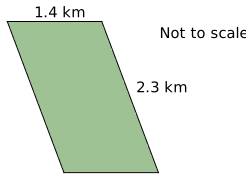
Joyce is walking her dog around a paddock in the shape of a parallelogram.

If she walks the dog around the paddock in the morning and the afternoon, how many kilometres do they walk each day?  (2 marks)

--- 4 WORK AREA LINES (style=lined) ---

Show Answers Only

\(14.8\ \text{km}\)
Show Worked Solution

\(\text{Perimeter of paddock}\)
\(=2\times 1.4+2\times 2.3\)
\(=7.4\ \text{km}\)
\(\text{Total distance walked each day}\)

\(=2\times 7.4\)

\(=14.8\ \text{km}\)

Filed Under: Rectilinear Figures Tagged With: num-title-ct-core, smc-4840-10-Plane shapes

Rectilinear Figures, SM-Bank 021 MC

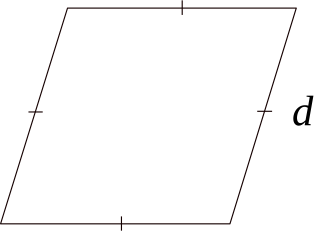
The rhombus below has a side length \(\large d\).

Which expression cannot be used for the perimeter?
  1. \(2\times (d+d)\)
  2. \(d\times 4\)
  3. \(d\times d\)
  4. \(d+d+2d\)
Show Answers Only

\(C\)

Show Worked Solution

\(\text{Perimeter}=4\times d=4d\)

\(\text{Options A, B and D}=4d\)

\(\text{Option C}=d\times d=d^2\ne 4d\)

\(\Rightarrow C\)

Filed Under: Rectilinear Figures Tagged With: num-title-ct-core, smc-4840-10-Plane shapes

Rectilinear Figures, SM-Bank 020

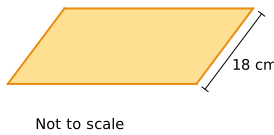
Tatiana is cutting a piece of material in the shape of a parallelogram for a sewing project.

The longer sides are one and two-thirds times the length of the shorter sides.

What is the perimeter of the piece of material?  (2 marks)

--- 4 WORK AREA LINES (style=lined) ---

Show Answers Only

\(96\ \text{cm}\)

Show Worked Solution
\(\text{Longer side}\) \(=\dfrac{5}{3}\times 18\)
  \(=30\ \text{cm}\)


\(\therefore\ \text{Perimeter}\) \(=2\times 18 +2\times 30\)
  \(=96\ \text{cm}\)

Filed Under: Rectilinear Figures Tagged With: num-title-ct-core, smc-4840-10-Plane shapes

Rectilinear Figures, SM-Bank 019

Fumiko is laying pavers that are shaped like a parallelogram.

 
The longer sides are 3.5 times the length of the shorter sides.

What is the perimeter of one of the pavers?  (2 marks)

--- 4 WORK AREA LINES (style=lined) ---

Show Answers Only

\(72\ \text{cm}\)

Show Worked Solution
\(\text{Longer side}\) \(=8\times 3.5\)
  \(=28\ \text{cm}\)


\(\therefore\ \text{Perimeter}\) \(=2\times 8 +2\times 28\)
  \(=72\ \text{cm}\)

Filed Under: Rectilinear Figures Tagged With: num-title-ct-core, smc-4840-10-Plane shapes

Rectilinear Figures, SM-Bank 018

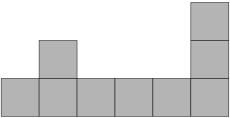
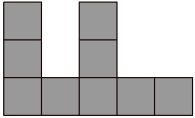
What is the perimeter of the shape below given each square has a side length of 2 cm?  (2 marks)

--- 4 WORK AREA LINES (style=lined) ---

Show Answers Only

\(40\ \text{cm}\)

Show Worked Solution

\(\text{Starting from bottom right moving clockwise.}\)

\(\text{Perimeter}\) \(=12+2+2+2+2+2+6+4+2+6\)
  \(=40\ \text{cm}\)

Filed Under: Rectilinear Figures Tagged With: num-title-ct-core, smc-4840-15-Irregular shapes

Rectilinear Figures, SM-Bank 017

A rectangular parking lot has a perimeter of 80 metres.

Each short side has a length of 10 metres.

What is the length of the long side?  (2 marks)

--- 4 WORK AREA LINES (style=lined) ---

Show Answers Only

\(30\ \text{m}\)

Show Worked Solution

\(\text{Let}\ \ d=\text{long side of parking lot}\)

\(2\times d + (2\times 10)\) \(=80\)
\(2d\) \(=80-20\)
\(2d\) \(=60\)
\(\therefore\ d\) \(=30\ \text{m}\)

Filed Under: Rectilinear Figures Tagged With: num-title-ct-core, smc-4840-10-Plane shapes

Rectilinear Figures, SM-Bank 016

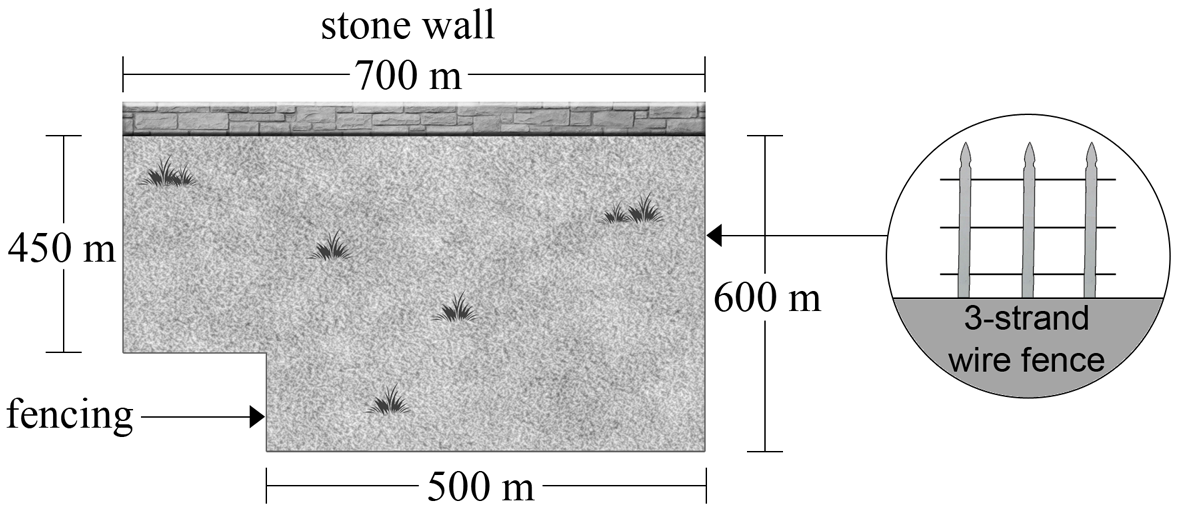
A farmer uses an existing stone wall and fencing to create a large grazing paddock for his sheep, as shown in the diagram below.

The fencing has 3-strand wiring which is also shown below. 

How many kilometres of wire will be required?  (2 marks)

--- 4 WORK AREA LINES (style=lined) ---

Show Answers Only

\(5.7\ \text{km}\)

Show Worked Solution

\(\text{Fencing required}\)

\(=3\times (450 + 200 + 150 + 500 + 600)\)

\(=3\times 1900\)

\(=5700\ \text{m}=5.7\ \text{km}\)

Filed Under: Rectilinear Figures Tagged With: num-title-ct-core, smc-4840-15-Irregular shapes

Rectilinear Figures, SM-Bank 015

The length of this rectangle is one and a half times its height.
 

The perimeter of the rectangle is 40 centimetres.

What are the dimensions of the rectangle?  (2 marks)

--- 4 WORK AREA LINES (style=lined) ---

Show Answers Only

\(\text{Height}=8\ \text{cm}\)

\(\text{Length}=12\ \text{cm}\)

Show Worked Solution
\(\text{Let}\ \ \ x\) \(=\text{height}\)
\(\dfrac{3}{2}x\) \(=\text{length}\)
\(2\times \Big(x +\dfrac{3}{2}x\Big)\) \(= 40\)
\(2\times \Big(\dfrac{5x}{2}\Big)\) \(= 40\)
\(5x\) \(= 40\)
\(x\) \(= 8\)
\(\therefore\ \text{Height}\) \(= 8\ \text{cm}\)
\(\therefore\ \text{Length}\) \(=\dfrac{3}{2}\times 8\)
  \(=12\ \text{cm}\)

Filed Under: Rectilinear Figures Tagged With: num-title-ct-core, smc-4840-10-Plane shapes

Rectilinear Figures, SM-Bank 014

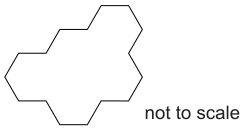
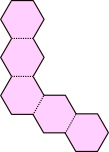
Ronald places 5 identical hexagonal tiles side-by-side to make the pattern pictured below.


Each tile has a perimeter of 24 cm and is in the shape of a regular hexagon.

What is the perimeter of the large shape, in centimetres?  (2 marks)

--- 4 WORK AREA LINES (style=lined) ---

Show Answers Only

\(64\ \text{cm}\)

Show Worked Solution
\(\text{Length of 1 side}\) \(=\dfrac{24}{6}\)
  \(=4\ \text{cm}\)


\(\therefore\ \text{Perimeter}\) \(=16\times 4\)
  \(=64\ \text{cm}\)

Filed Under: Rectilinear Figures Tagged With: num-title-ct-core, smc-4840-15-Irregular shapes

Rectilinear Figures, SM-Bank 013

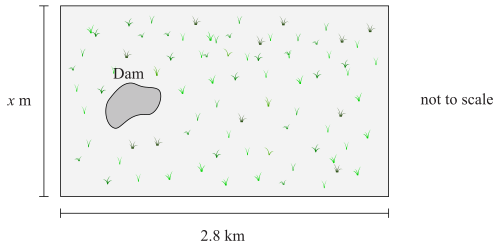
Aragorn is fencing a paddock on his property. The total length of fencing he requires is 8.2 kilometres.

The length of the paddock is 2.8 kilometres.


How wide is the paddock?

Write your answer, in kilometres to one decimal place?  (2 marks)

--- 4 WORK AREA LINES (style=lined) ---

Show Answers Only

\(1.3\ \text{km}\)

Show Worked Solution

\(\text{Express as a perimeter equation:}\)

\(2\times 2.8 + 2x\) \(= 8.2\)
\(2x\) \(= 8.2-5.6\)
\(2x\) \(= 2.6\)
\(\therefore x\) \(=1.3\ \text{km}\)

\(\therefore\ \text{Side length is }1.3\ \text{km}\)

Filed Under: Rectilinear Figures Tagged With: num-title-ct-core, smc-4840-10-Plane shapes

Rectilinear Figures, SM-Bank 012

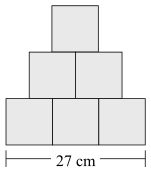
Penelope made a shape using 6 identical squares.


What is the perimeter of the shape?  (2 marks)

--- 4 WORK AREA LINES (style=lined) ---

Show Answers Only

\(108\ \text{cm}\)

Show Worked Solution
\(\text{Length of 1 side}\) \(=\dfrac{27}{3}\)
  \(=9\ \text{cm}\)


\(\therefore\ \text{Perimeter}\)

\(= (10\times 9) + (4\times 4.5)\)

\(= 90 + 18\)

\(=108\ \text{cm}\)

Filed Under: Rectilinear Figures Tagged With: num-title-ct-core, smc-4840-15-Irregular shapes

Rectilinear Figures, SM-Bank 011

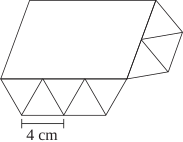
This shape is made from eight equilateral triangles and one large parallelogram.


Each side of all the small triangles is 4 cm long.

What is the perimeter of the shape?  (2 marks)

--- 4 WORK AREA LINES (style=lined) ---

Show Answers Only

\(48\ \text{cm}\)

Show Worked Solution

\(\text{Perimeter from the top left corner (clockwise)}\)

\(=12+4+4+4+4+8+4+8\)

\(=48\ \text{cm}\)

Filed Under: Rectilinear Figures Tagged With: num-title-ct-core, smc-4840-15-Irregular shapes

Rectilinear Figures, SM-Bank 010

A rectangle has a length of 25 cm and a width of 20 cm.

A square has the same perimeter as this rectangle.

What is the side length of this square in centimetres?  (2 marks)

--- 4 WORK AREA LINES (style=lined) ---

Show Answers Only

\(22.5\ \text{cm}\)

Show Worked Solution
\(\text{Perimeter of rectangle}\) \(= (2\times 25) + (2\times 20)\)
  \(=90\ \text{cm}\)


\(\therefore\ \text{Side length of square}\) \(=\dfrac{90}{4}\)
  \(=22.5\ \text{cm}\)

Filed Under: Rectilinear Figures Tagged With: num-title-ct-core, smc-4840-10-Plane shapes

Rectilinear Figures, SM-Bank 009 MC

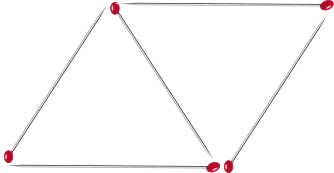
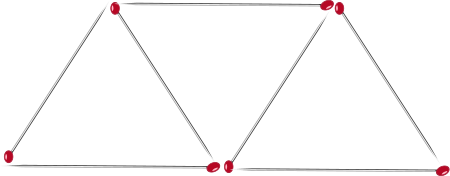
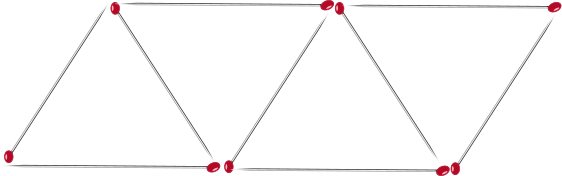
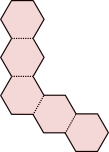
A regular hexagon is drawn below.

5 identical hexagons are connected as shown in the diagram below.

What is the perimeter of the larger shape?

  1. \(110\ \text{cm}\)
  2. \(121\ \text{cm}\)
  3. \(132\ \text{cm}\)
  4. \(165\ \text{cm}\)
Show Answers Only

\(B\)

Show Worked Solution
\(\text{Perimeter}\) \(=\text{Number of sides}\times 5.5\)
  \(=22\times 5.5\)
  \(=121\ \text{cm}\)

\(\Rightarrow B\)

Filed Under: Rectilinear Figures Tagged With: num-title-ct-core, smc-4840-15-Irregular shapes

Rectilinear Figures, SM-Bank 008 MC

 
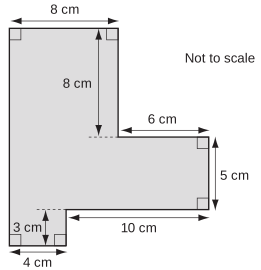
What is the perimeter of this shape?

  1. \(44\ \text{cm}\)
  2. \(47\ \text{cm}\)
  3. \(60\ \text{cm}\)
  4. \(146\ \text{cm}\)
Show Answers Only

\(C\)

Show Worked Solution

\(\text{Perimeter (clockwise from top left corner)}\)

\(= 8 + 8 + 6 + 5 + 10 + 3 + 4 + 16\)

\(= 60\ \text{cm}\)

\(\Rightarrow C\)

Filed Under: Rectilinear Figures Tagged With: num-title-ct-core, smc-4840-15-Irregular shapes

Rectilinear Figures, SM-Bank 007 MC

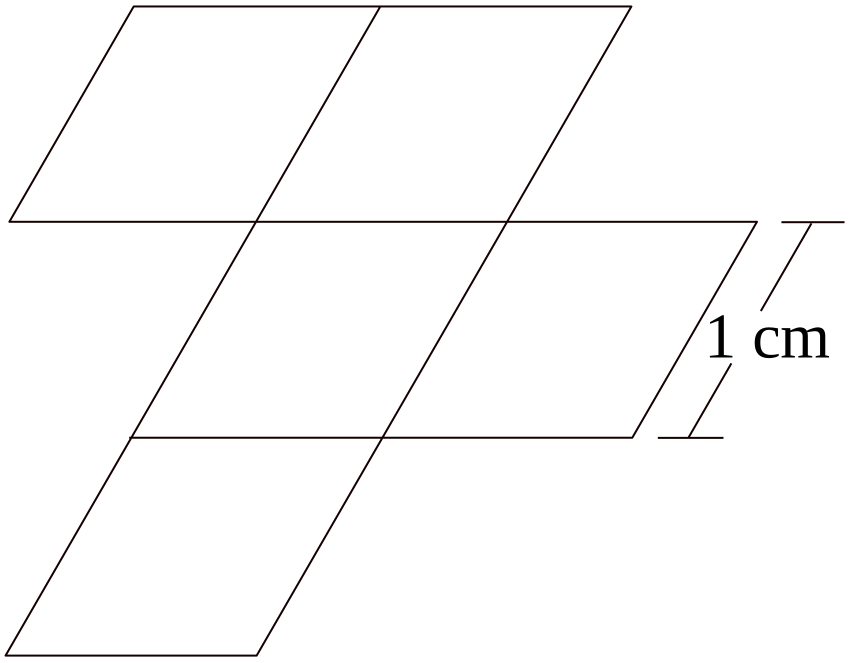
A shape, pictured below, is made with 5 rhombuses.


What is the perimeter of the shape?

  1. \(10\ \text{cm}\)
  2. \(14\ \text{cm}\)
  3. \(12\ \text{cm}\)
  4. \(20\ \text{cm}\)
Show Answers Only

\(C\)

Show Worked Solution

\(\text{All sides of a rhombus are equal}\)

\(\text{Perimeter}\) \(=12\times 1\)
  \(=12\ \text{cm}\)

\(\Rightarrow C\)

Filed Under: Rectilinear Figures Tagged With: num-title-ct-core, smc-4840-15-Irregular shapes

Rectilinear Figures, SM-Bank 006

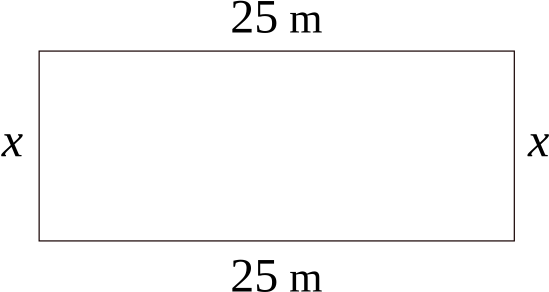
A rectangular car park is shown below with a perimeter of 70 m.


What is the length of the short side \(\large x\)?  (2 marks)

--- 4 WORK AREA LINES (style=lined) ---

Show Answers Only

\(10\ \text{m}\)

Show Worked Solution
\(\text{Perimeter}\) \(=25 + 25 + x +x\)
\(70\) \(=50 + 2x\)
\(2x\) \(=70-50=20\)
\(\therefore x\) \(=10\ \text{m}\)


Filed Under: Rectilinear Figures Tagged With: num-title-ct-core, smc-4840-10-Plane shapes

Rectilinear Figures, SM-Bank 004

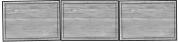
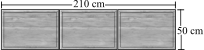
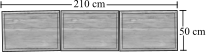
Justin connects three of his restaurant tables together to make one long table.

The view from above the tables is shown below.
 

 Each table is 70 cm long and 50 cm wide.

What is the perimeter of the long table?  (2 marks)

--- 4 WORK AREA LINES (style=lined) ---

Show Answers Only

\(520\ \text{cm}\)

Show Worked Solution

\(\text{Perimeter}\) \(= 2\times (210 + 50)\)
  \(= 2\times 260\)
  \(= 520\ \text{cm}\)

Filed Under: Rectilinear Figures Tagged With: num-title-ct-core, smc-4840-10-Plane shapes

Rectilinear Figures, SM-Bank 003 MC

The table shows the dimensions of four different rectangles in centimetres.

Rectangle Length (cm) Width (cm)
1 9 5
2 10 8
3 14 2
4 18 10

 
Which rectangle has a perimeter of 28 centimetres?

  1. Rectangle 1
  2. Rectangle 2
  3. Rectangle 3
  4. Rectangle 4
Show Answers Only

\(A\)

Show Worked Solution

\(\text{Consider rectangle 1}\)

\(\text{Perimeter}\) \(= 2\times \text{length} + 2\times \text{width}\)
  \(= (2\times 9) + (2\times 5)\)
  \(=28\ \text{cm}\)

  
\(\therefore\ \text{Rectangle 1 has a perimeter of 28 cm.}\)

\(\Rightarrow A\)

Filed Under: Rectilinear Figures Tagged With: num-title-ct-core, smc-4840-10-Plane shapes

Rectilinear Figures, SM-Bank 002 MC

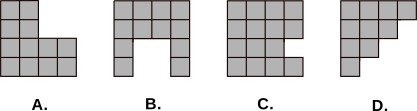
Which one of these shapes has the largest perimeter?
 

Show Answers Only

\(B\)

Show Worked Solution

\(\text{Consider Option B:}\)

\(\text{Perimeter}\) \(=3\times 4+3\times 2+2\times 1\)
  \(=20\ \text{units}\)
   

\(\Rightarrow B\)

Filed Under: Rectilinear Figures Tagged With: num-title-ct-core, smc-4840-15-Irregular shapes

Rectilinear Figures, SM-Bank 001 MC

What is the perimeter of the shape below given each square has a side length of 1 cm?
 

  1. \(8\ \text{cm}\)
  2. \(18\ \text{cm}\)
  3. \(20\ \text{cm}\)
  4. \(36\ \text{cm}\)
Show Answers Only

\(C\)

Show Worked Solution

\(\text{Starting at the bottom right corner and}\)

\(\text{moving clockwise:}\)

\(\text{Perimeter}\) \(=5+3+1+2+1+2+1+2+2+1\)
  \(=20\ \text{cm}\)

\(\Rightarrow C\)

Filed Under: Rectilinear Figures Tagged With: num-title-ct-core, smc-4840-15-Irregular shapes

Linear Relationships, SM-Bank 062

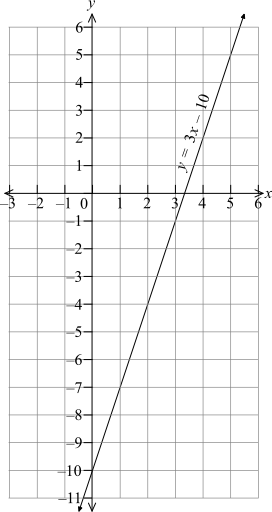
Use the graph of  \(y=3x-10\) below to find the solution to the equation  \(3x-10=-1\).  (2 marks)

--- 1 WORK AREA LINES (style=lined) ---

Show Answers Only

\(x=3\)

Show Worked Solution

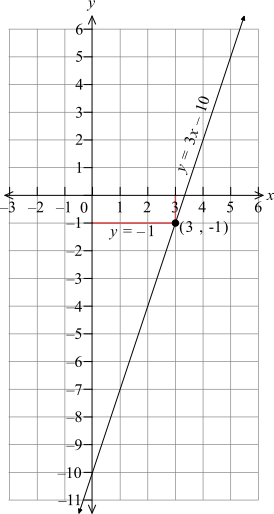
\(\text{To solve }3x-10=-1\ \text{graphically, find the point}\)

\(\text{of intersection of the lines }y=-1\ \text{and }y=3x-10\)

\(\text{i.e. }(3\ ,-1)\)

\(\therefore\ \text{The solution is }x=3\)

Filed Under: Linear Relationships Tagged With: num-title-ct-core, smc-4216-25-Straight lines

Linear Relationships, SM-Bank 061

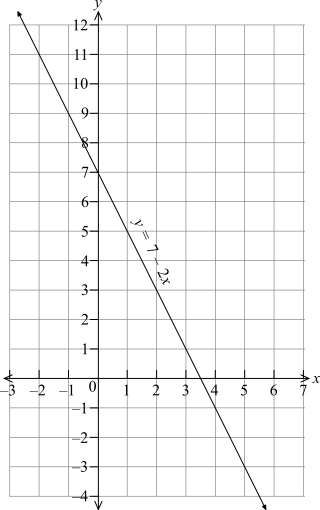
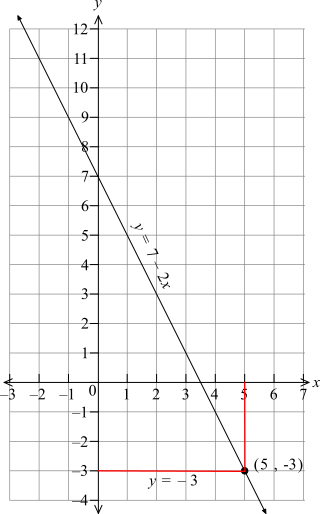
Use the graph of  \(y=7-2x\) below to find the solution to the equation  \(7-2x=-3\).  (2 marks)

--- 1 WORK AREA LINES (style=lined) ---

Show Answers Only

\(x=5\)

Show Worked Solution

\(\text{To solve }7-2x=-3\ \text{graphically, find the point}\)

\(\text{of intersection of the lines }y=-3\ \text{and }y=7-2x\)

\(\text{i.e. }(5\ ,-3)\)

\(\therefore\ \text{The solution is }x=5\)

Filed Under: Linear Relationships Tagged With: num-title-ct-core, smc-4216-25-Straight lines

Linear Relationships, SM-Bank 060

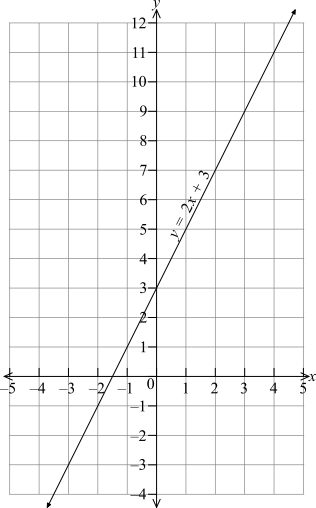
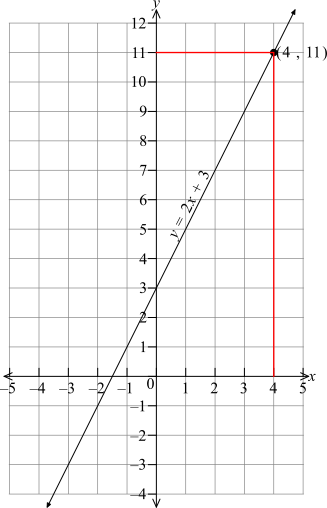
Use the graph of \(y=2x+3\) below to find the solution to the equation \(2x+3=11\).  (2 marks)

--- 1 WORK AREA LINES (style=lined) ---

Show Answers Only

\(x=4\)

Show Worked Solution

\(\text{To solve }2x+3=11\ \text{graphically, find the point}\)

\(\text{of intersection of the lines }y=11\ \text{and }y=2x+3\)

\(\text{i.e. }(4\ ,\ 11)\)

\(\therefore\ \text{The solution is }x=4\)

Filed Under: Linear Relationships Tagged With: num-title-ct-core, smc-4216-25-Straight lines

Linear Relationships, SM-Bank 059

Verify that the points \((1\ ,\ -1)\) and \((-7 ,\ 3)\) lie on the line \(x+2y=-1\)?  (3 marks)

--- 6 WORK AREA LINES (style=lined) ---

Show Answers Only

\(\text{See worked solution}\)

Show Worked Solution

\(\text{Check points by substituting into }x+2y=-1\)

\((1\ ,-1) \longrightarrow\) \(LHS\) \(=1+2\times (-1)\)
    \(=1-2=-1\)
    \(=RHS\)


\((-7 ,\ 3) \longrightarrow\) \(LHS\) \(=-7+2\times 3\)
    \(=-7+6=-1\)
    \(=RHS\)

 
\(\therefore\ (1\ ,-1)\ \text{and }(-7 ,\ 3) \text{ both lie on the line}\ \ x+2y=-1\)

Filed Under: Linear Relationships Tagged With: num-title-ct-core, smc-4216-25-Straight lines

Linear Relationships, SM-Bank 058

Verify that the points \((1\ ,\ 1)\) and \((-2 ,\ 7)\) lie on the line \(y=-2x+3\)?  (3 marks)

--- 7 WORK AREA LINES (style=lined) ---

Show Answers Only

\(\text{See worked solution}\)

Show Worked Solution

\(\text{Check points by substituting into }y=-2x+3\)

\((1\ ,\ 1) \longrightarrow\) \(RHS\) \(=-2\times 1+3\)
    \(=1\)
    \(=LHS\)


\((-2 ,\ 7) \longrightarrow\) \(RHS\) \(=-2\times (-2)+3\)
    \(=7\)
    \(=LHS\)

 
\(\therefore\ (1\ ,\ 1)\ \text{and }(-2 ,\ 7) \text{ both lie on the line}\ \ y=-2x+3\)

Filed Under: Linear Relationships Tagged With: num-title-ct-core, smc-4216-25-Straight lines

Linear Relationships, SM-Bank 057

Verify that the points \((2\ ,\ 5)\) and \((-1 ,-1)\) lie on the line \(y=2x+1\)?  (3 marks)

--- 6 WORK AREA LINES (style=lined) ---

Show Answers Only

\(\text{See worked solution}\)

Show Worked Solution

\(\text{Check points by substituting into }y=2x+1\)

\((2\ ,\ 5) \longrightarrow\) \(RHS\) \(=2\times 2+1\)
    \(=5\)
    \(=LHS\)


\((-1 ,-1) \longrightarrow\) \(RHS\) \(=2\times (-1)+1\)
    \(=-1\)
    \(=LHS\)

 
\(\therefore\ (2\ ,\ 5)\ \text{and }(-1 ,-1) \text{ both lie on the line}\ \ y=2x+1\)

Filed Under: Linear Relationships Tagged With: num-title-ct-core, smc-4216-25-Straight lines

Linear Relationships, SM-Bank 056 MC

Which of the following points lies on the line \(y=2x-4\)?

  1. \((0 , 2)\)
  2. \((-2 , 8)\)
  3. \((2 , -1)\)
  4. \((-1, -6)\)
Show Answers Only

\(D\)

Show Worked Solution

\(\text{Check each option by substituting into }y=2x-4\)

\(\text{Option A:}\ \ \ \) \(2\) \(\ne 2\times 0-4=-4\)
\(\text{Option B:}\) \(8\) \(\ne 2\times (-2)-4=-8\)
\(\text{Option C:}\) \(-1\) \(\ne 2\times 2-4=0\)
\(\text{Option D:}\) \(-6\) \(=2\times (-1)-4=-6\ \ \ \checkmark\)

 
\(\therefore\ (-1, -6) \text{ lies on the line}\ \ y=2x-4\)

\(\Rightarrow D\)

Filed Under: Linear Relationships Tagged With: num-title-ct-core, smc-4216-25-Straight lines

Linear Relationships, SM-Bank 055 MC

Which of the following points lies on the line \(y=10+x\)?

  1. \((3 , 7)\)
  2. \((-2 , 8)\)
  3. \((2 , -8)\)
  4. \((-6, -4)\)
Show Answers Only

\(B\)

Show Worked Solution

\(\text{Check each option by substituting into }y=10+x\)

\(\text{Option A:}\ \ \ \) \(7\) \(\ne 10+3\)
\(\text{Option B:}\) \(8\) \(=10+-2\ \ \ \checkmark\)
\(\text{Option C:}\) \(-8\) \(\ne 10+2\)
\(\text{Option D:}\) \(-4\) \(\ne 10+-6\)

\(\therefore\ (-2, 8) \text{ lies on the line}\ \ y=10+x\)

\(\Rightarrow B\)

Filed Under: Linear Relationships Tagged With: num-title-ct-core, smc-4216-25-Straight lines

Linear Relationships, SM-Bank 054

Renee and Leisa are saving money so they can visit their grandmother on a holiday.

Renee has $100 and plans to save $30 each week.

Leisa has $200 and plans to save $10 each week.

  1. Write an equation to represent

    (i)   Renee's savings  (1 mark)

    --- 1 WORK AREA LINES (style=lined) ---

    (ii)  Leisa's savings  (1 mark)

    --- 1 WORK AREA LINES (style=lined) ---

  2. Complete the following tables of values for the equations above.  (2 marks)

    Renee's savings
    \begin{array} {|l|c|c|c|}
    \hline
    \rule{0pt}{2.5ex}\text{Weeks }(w) \ \rule[-1ex]{0pt}{0pt} &\ \ 0\ \ &\ \ 1\ \   &\ \ 2\ \ &\ \ 3\ \ \\
    \hline
    \rule{0pt}{2.5ex} \text{Savings }(s) \ \rule[-1ex]{0pt}{0pt} &  &   &   &  \\
    \hline
    \end{array}

    \(\ \ \ \ \ \ \ \)

    Leisa's savings
    \begin{array} {|l|c|c|c|}
    \hline
    \rule{0pt}{2.5ex}\text{Weeks }(w) \ \rule[-1ex]{0pt}{0pt} &\ \ 0\ \ &\ \ 1\ \   &\ \ 2\ \ &\ \ 3\ \ \\
    \hline
    \rule{0pt}{2.5ex} \text{Savings }(s) \ \rule[-1ex]{0pt}{0pt} &  &   &   &  \\
    \hline
    \end{array}

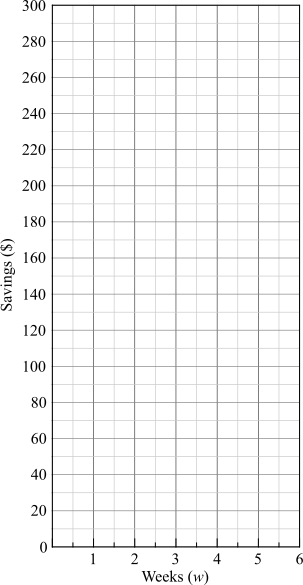
  3. Using the tables of values, graph both equations on the number plane below. Be sure to extend your lines to the end of the grid.  (2 marks)
     

  4. After how many weeks will Renee and Leisa have saved the same amount?  (1 mark)

    --- 1 WORK AREA LINES (style=lined) ---

Show Answers Only

a.    (i)   \(s=100+30w\)

(ii)  \(s=200+10w\)

b.

\(\text{Renee’s savings:   }s=100+30w\)
\begin{array} {|l|c|c|c|}
\hline
\rule{0pt}{2.5ex}\text{Weeks }(w) \ \rule[-1ex]{0pt}{0pt} &\ \ 0\ \ &\ \ 1\ \   &\ \ 2\ \ &\ \ 3\ \ \\
\hline
\rule{0pt}{2.5ex} \text{Savings }(s) \ \rule[-1ex]{0pt}{0pt} & 100 & 130  & 160  &  190\\
\hline
\end{array}

\(\ \ \ \ \ \ \ \)

\(\text{Leisa’s savings:   }s=200+10w\)
\begin{array} {|l|c|c|c|}
\hline
\rule{0pt}{2.5ex}\text{Weeks }(w) \ \rule[-1ex]{0pt}{0pt} &\ \ 0\ \ &\ \ 1\ \   &\ \ 2\ \ &\ \ 3\ \ \\
\hline
\rule{0pt}{2.5ex} \text{Savings }(s) \ \rule[-1ex]{0pt}{0pt} & 200 & 210  & 220  &  230\\
\hline
\end{array}

c.

d.    \(5\ \text{weeks}\)

Show Worked Solution

a.    (i)   \(s=100+30w\)

(ii)  \(s=200+10w\)

b.

\(\text{Renee’s savings:   }s=100+30w\)
\begin{array} {|l|c|c|c|}
\hline
\rule{0pt}{2.5ex}\text{Weeks }(w) \ \rule[-1ex]{0pt}{0pt} &\ \ 0\ \ &\ \ 1\ \   &\ \ 2\ \ &\ \ 3\ \ \\
\hline
\rule{0pt}{2.5ex} \text{Savings }(s) \ \rule[-1ex]{0pt}{0pt} & 100 & 130  & 160  &  190\\
\hline
\end{array}

\(\ \ \ \ \ \ \ \)

\(\text{Leisa’s savings:   }s=200+10w\)
\begin{array} {|l|c|c|c|}
\hline
\rule{0pt}{2.5ex}\text{Weeks }(w) \ \rule[-1ex]{0pt}{0pt} &\ \ 0\ \ &\ \ 1\ \   &\ \ 2\ \ &\ \ 3\ \ \\
\hline
\rule{0pt}{2.5ex} \text{Savings }(s) \ \rule[-1ex]{0pt}{0pt} & 200 & 210  & 220  &  230\\
\hline
\end{array}

c.

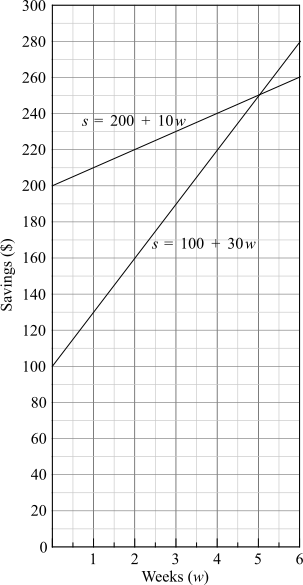
d.   \(\text{Method 1 – Graphically by inspection}\)

\(\text{Lines intersect when }w=5\ \text{and }s=$250\)
 

\(\text{Method 2 – Algebraically}\)

\(\text{Solve }s=100+30w\ \text{ and }s=200+10w\ \text{simultaneously}\)

\(100+30w\) \(=200+10w\)
\(30w-10w\) \(=200-100\)
\(20w\) \(=100\)
\(w\) \(=\dfrac{100}{20}=5\)

\(\therefore\ \text{Amounts are equal after }5 \text{ weeks}.\)

Filed Under: Linear Relationships Tagged With: num-title-ct-core, smc-4216-25-Straight lines

Linear Relationships, SM-Bank 053 MC

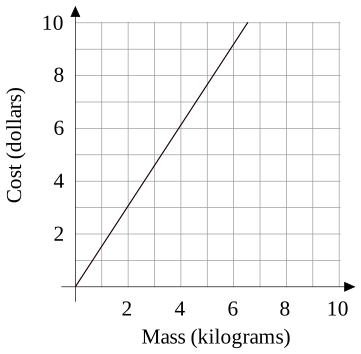
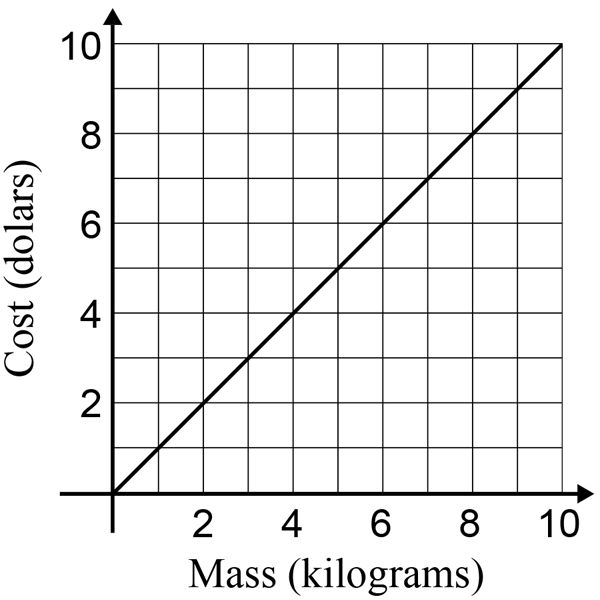
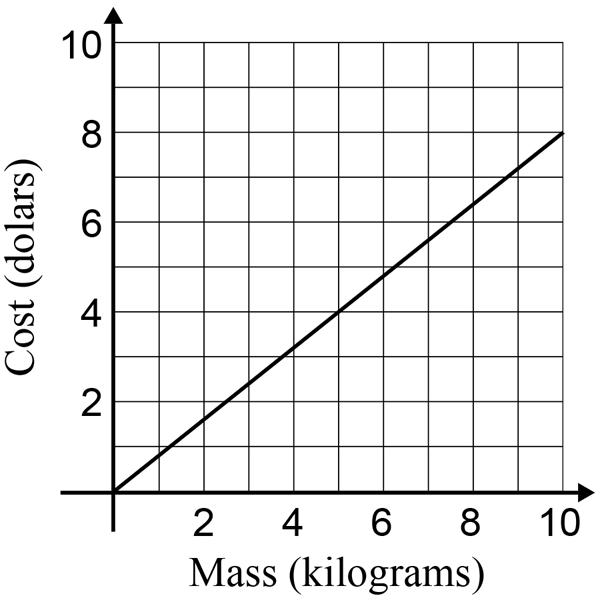
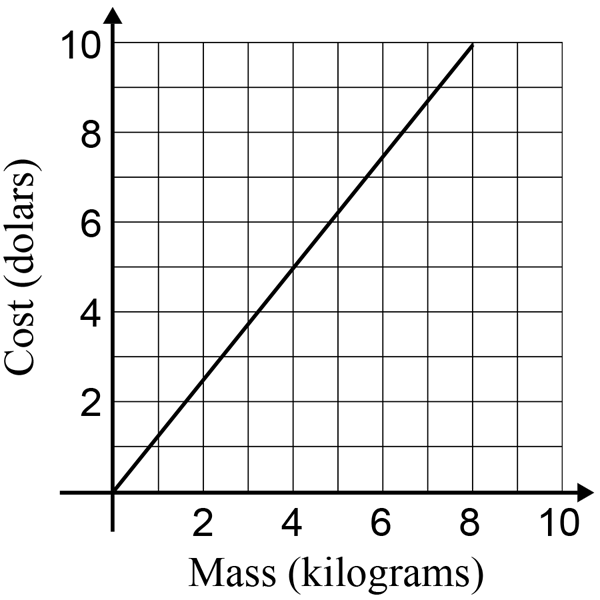
Paddy and Miffy each bought potatoes from the local farmers' market.

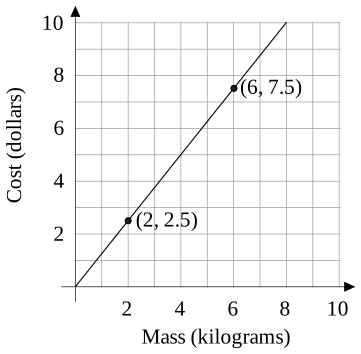
Paddy bought 2 kilograms for $2.50.

Miffy bought 6 kilograms for $7.50.

Which graph best represents the cost of potatoes at the farmers' market?

A.

B.


C. D.
Show Answers Only

\(D\)

Show Worked Solution

\(\Rightarrow D\)

Filed Under: Linear Relationships Tagged With: num-title-ct-core, smc-4216-25-Straight lines

Linear Relationships, SM-Bank 052

Jeremy owns a paddle board hire company. He charges a $20 insurance fee with every hire and $35 for every hour of hire. 

  1. Complete the table of values below, where \(\large h\) represents the number of hours of hire and \(\large w\) represents his total earnings for each hour of hire.  (2 marks)
    \begin{array} {|l|c|c|c|}
    \hline
    \rule{0pt}{2.5ex}\text{Hours }(h) \ \rule[-1ex]{0pt}{0pt} &\ \ 0\ \ &\ \ 2\ \   &\ \ 4\ \ \\
    \hline
    \rule{0pt}{2.5ex} \text{Wage }(w) \ \rule[-1ex]{0pt}{0pt} &  &   & \\
    \hline
    \end{array}
  2. Write an equation to represent Jeremy's wages, using the variables \(h\) and \(w\).  (1 mark)

    --- 1 WORK AREA LINES (style=lined) ---

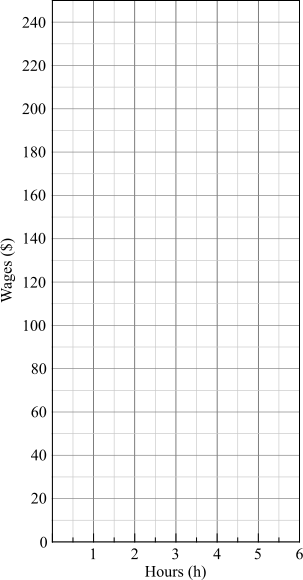
  3. Graph the equation of the line representing Jeremy's wages on the number plane below. Be sure to extend your line to the edge of the grid.  (2 marks)

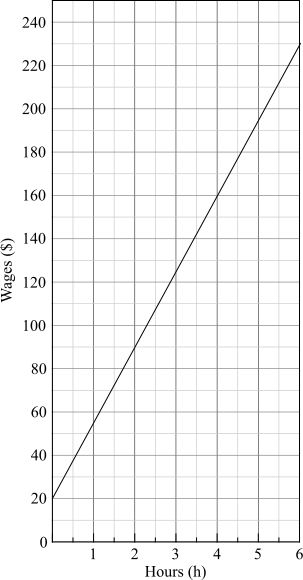
  4. For how many hours would Jeremy have to hire a paddle board to earn $230?   (1 mark)

    --- 1 WORK AREA LINES (style=lined) ---

Show Answers Only

a.

\begin{array} {|l|c|c|c|}
\hline
\rule{0pt}{2.5ex}\text{Hours }(h) \ \rule[-1ex]{0pt}{0pt} &\ \ 0\ \ &\ \ 2\ \   &\ \ 4\ \ \\
\hline
\rule{0pt}{2.5ex} \text{Wage }(w) \ \rule[-1ex]{0pt}{0pt} & 20 & 90  & 160   \\
\hline
\end{array}

 b.    \(w=20+35h\)

c.   

d.    \(6\ \text{hours}\)

Show Worked Solution

a.    \(\text{Table of values}\)

\begin{array} {|l|c|c|c|}
\hline
\rule{0pt}{2.5ex}\text{Hours }(h) \ \rule[-1ex]{0pt}{0pt} &\ \ 0\ \ &\ \ 2\ \   &\ \ 4\ \ \\
\hline
\rule{0pt}{2.5ex} \text{Wage }(w) \ \rule[-1ex]{0pt}{0pt} & 40 & 90  & 160 \\
\hline
\end{array}

 b.    \(w=20+35h\)

c.   

d.    \(\text{Method 1 – Graphically by inspection}\)

\(\text{When }w=230 , h=6\ \text{hours}\)
 

\(\text{Method 2 – Algebraically}\)

   \(w\) \(=20+35h\)
  \(230\) \(=20+35h\)
  \(35h\) \(=230-20\)
  \(35h\) \(=210\)
  \(h\) \(=\dfrac{210}{35}=6\)

\(\therefore\ \text{Jeremy would have to hire a board for }6\text{ hours to earn } $230.\)

Filed Under: Linear Relationships Tagged With: num-title-ct-core, smc-4216-25-Straight lines

Linear Relationships, SM-Bank 051

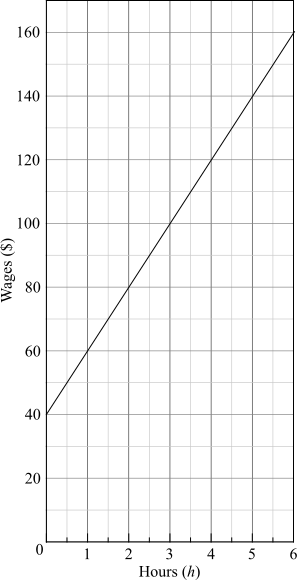
Julie cleans carpets and upholstery. She charges a $40 call-out fee and $20 for every hour it takes to complete a job. 

  1. Complete the table of values below, where \(\large h\) represents the number of hours Julie works and \(\large w\) represents her total wage.  (2 marks)
    \begin{array} {|l|c|c|c|}
    \hline
    \rule{0pt}{2.5ex}\text{Hours }(h) \ \rule[-1ex]{0pt}{0pt} &\ \ 0\ \ &\ \ 1\ \   &\ \ 2\ \ &\ \ 3\ \ \\
    \hline
    \rule{0pt}{2.5ex} \text{Wage }(w) \ \rule[-1ex]{0pt}{0pt} &  &   &   &  \\
    \hline
    \end{array}
  2. Write an equation to represent Julie's wages, using the variables \(h\) and \(w\).  (1 mark)

    --- 1 WORK AREA LINES (style=lined) ---

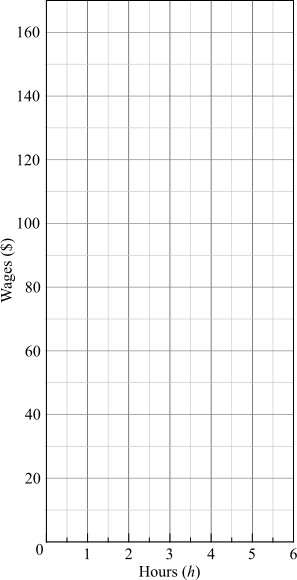
  3. Graph the equation of the line representing Julie's wages on the number plane below. Be sure to extend your line to the edge of the grid.  (2 marks)
     
  4. For how many hours would Julie have to clean to earn $150?   (1 mark)

    --- 1 WORK AREA LINES (style=lined) ---

Show Answers Only

a.

\begin{array} {|l|c|c|c|}
\hline
\rule{0pt}{2.5ex}\text{Hours }(h) \ \rule[-1ex]{0pt}{0pt} &\ \ 0\ \ &\ \ 1\ \   &\ \ 2\ \ &\ \ 3\ \ \\
\hline
\rule{0pt}{2.5ex} \text{Wage }(w) \ \rule[-1ex]{0pt}{0pt} & 40 & 60  & 80  & 100 \\
\hline
\end{array}

 b.    \(w=40+20h\)

c.   

d.    \(5.5\ \text{hours}\)

Show Worked Solution

a.    \(\text{Table of values}\)

\begin{array} {|l|c|c|c|}
\hline
\rule{0pt}{2.5ex}\text{Hours }(h) \ \rule[-1ex]{0pt}{0pt} &\ \ 0\ \ &\ \ 1\ \   &\ \ 2\ \ &\ \ 3\ \ \\
\hline
\rule{0pt}{2.5ex} \text{Wage }(w) \ \rule[-1ex]{0pt}{0pt} & 40 & 60  & 80  & 100 \\
\hline
\end{array}

 b.    \(w=40+20h\)

c.   

d.    \(\text{Method 1 – Graphically by inspection}\)

\(\text{When }w=150 , h=5.5\ \text{hours}\)
 

\(\text{Method 2 – Algebraically}\)

   \(w\) \(=40+20h\)
  \(150\) \(=40+20h\)
  \(20h\) \(=150-40\)
  \(20h\) \(=110\)
  \(h\) \(=\dfrac{110}{20}=5.5\)

\(\therefore\ \text{Julie would have to work for }5.5\text{ hours to earn } $150.\)

Filed Under: Linear Relationships Tagged With: num-title-ct-core, smc-4216-25-Straight lines

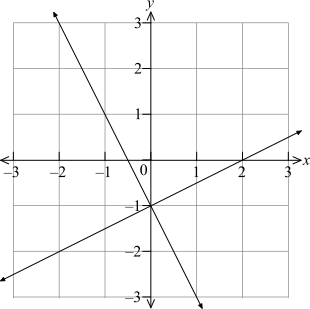
Linear Relationships, SM-Bank 050 MC

Which of the following is not true of the lines on the number plane below?

  1. \(\text{They have the same }y\text{-intercept}\).
  2. \(\text{They both pass through the point}\ (0,-1)\).
  3. \(\text{They constant value in the equations of both lines is }-1\).
  4. \(\text{They both pass through the point}\ (-1,0)\).
Show Answers Only

\(D\)

Show Worked Solution

\(\text{Neither of the lines pass through the point }(-1,0).\)

\(\Rightarrow D\)

Filed Under: Linear Relationships Tagged With: num-title-ct-core, smc-4216-25-Straight lines

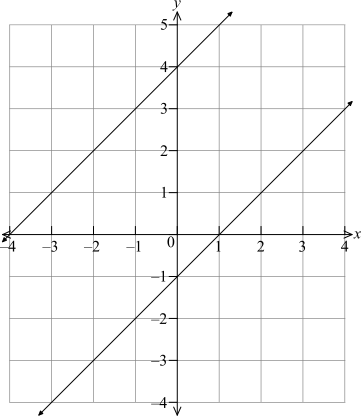
Linear Relationships, SM-Bank 049 MC

What do the lines on the following number plane have in common?

  1. \(\text{They have the same }y\text{-intercept}\).
  2. \(\text{They are parallel to each other}\).
  3. \(\text{They both pass through the origin}\).
  4. \(\text{They are perpendicular to each other}\).
Show Answers Only

\(B\)

Show Worked Solution

\(\text{The lines are parallel}.\)

\(\Rightarrow B\)

Filed Under: Linear Relationships Tagged With: num-title-ct-core, smc-4216-25-Straight lines

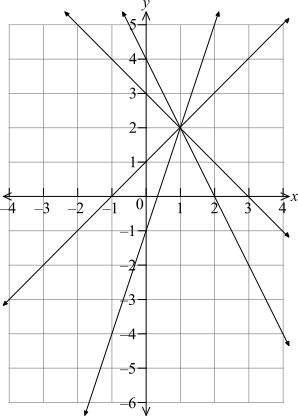
Linear Relationships, SM-Bank 048 MC

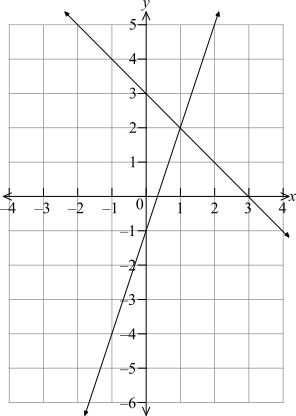
What do all the lines on the following number plane have in common?

  1. \(\text{They all intersect at the point }(2,1)\).
  2. \(\text{They are all parallel to each other}\).
  3. \(\text{They all intersect at the point }(1,2)\).
  4. \(\text{They are all perpendicular to each other}\).
Show Answers Only

\(C\)

Show Worked Solution

\(\text{The lines all pass through the point }(1,2).\)

\(\therefore\ \text{They all intersect at the point }(1,2)\).

\(\Rightarrow C\)

Filed Under: Linear Relationships Tagged With: num-title-ct-core, smc-4216-25-Straight lines

Linear Relationships, SM-Bank 047

  1. Complete the tables of values below for each given rule.  (3 marks)

    \(y=3-x\)
    \begin{array} {|l|c|c|c|c|}
    \hline
    \rule{0pt}{2.5ex}\ \ x\ \ \rule[-1ex]{0pt}{0pt} & -1  &\ \ 0\ \ &\ \ 1\ \ &\ \ 2\ \  \\
    \hline
    \rule{0pt}{2.5ex} \ \ y\ \ \rule[-1ex]{0pt}{0pt} &   &   &  & \\
    \hline
    \end{array}


    \(y=3x-1\)
    \begin{array} {|l|c|c|c|c|}
    \hline
    \rule{0pt}{2.5ex}\ \ x\ \ \rule[-1ex]{0pt}{0pt} & -1  &\ \ 0\ \ &\ \ 1\ \ &\ \ 2\ \  \\
    \hline
    \rule{0pt}{2.5ex} \ \ y\ \ \rule[-1ex]{0pt}{0pt} &   &   &  & \\
    \hline
    \end{array}

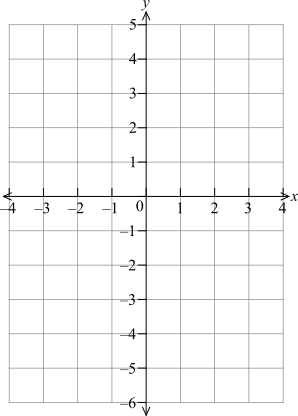
  2. On the number plane below, graph the equations from part (a).  (2 marks)
     
  3. Using the graph, find the point of intersection of the two lines.  (1 mark)

    --- 1 WORK AREA LINES (style=lined) ---

Show Answers Only

a.

\(y=3-x\)
\begin{array} {|l|c|c|c|c|}
\hline
\rule{0pt}{2.5ex}\ \ x\ \ \rule[-1ex]{0pt}{0pt} & -1  &\ \ 0\ \ &\ \ 1\ \ &\ \ 2\ \  \\
\hline
\rule{0pt}{2.5ex} \ \ y\ \ \rule[-1ex]{0pt}{0pt} & 4  & 3  & 2 & 1\\
\hline
\end{array}


\(y=3x-1\)
\begin{array} {|l|c|c|c|c|}
\hline
\rule{0pt}{2.5ex}\ \ x\ \ \rule[-1ex]{0pt}{0pt} & -1  &\ \ 0\ \ &\ \ 1\ \ &\ \ 2\ \  \\
\hline
\rule{0pt}{2.5ex} \ \ y\ \ \rule[-1ex]{0pt}{0pt} & -4  & -1  & 2 & 5\\
\hline
\end{array}

 b.   

c.     \((1 , 2)\)

Show Worked Solution

a.

\(y=3-x\)
\begin{array} {|l|c|c|c|c|}
\hline
\rule{0pt}{2.5ex}\ \ x\ \ \rule[-1ex]{0pt}{0pt} & -1  &\ \ 0\ \ &\ \ 1\ \ &\ \ 2\ \  \\
\hline
\rule{0pt}{2.5ex} \ \ y\ \ \rule[-1ex]{0pt}{0pt} & 4  & 3  & 2 & 1\\
\hline
\end{array}


\(y=3x-1\)
\begin{array} {|l|c|c|c|c|}
\hline
\rule{0pt}{2.5ex}\ \ x\ \ \rule[-1ex]{0pt}{0pt} & -1  &\ \ 0\ \ &\ \ 1\ \ &\ \ 2\ \  \\
\hline
\rule{0pt}{2.5ex} \ \ y\ \ \rule[-1ex]{0pt}{0pt} & -4  & -1  & 2 & 5\\
\hline
\end{array}

 b.   

c.     \(\text{Point of intersection:   }(1 , 2)\)

Filed Under: Linear Relationships Tagged With: num-title-ct-core, smc-4216-25-Straight lines

Linear Relationships, SM-Bank 046 MC

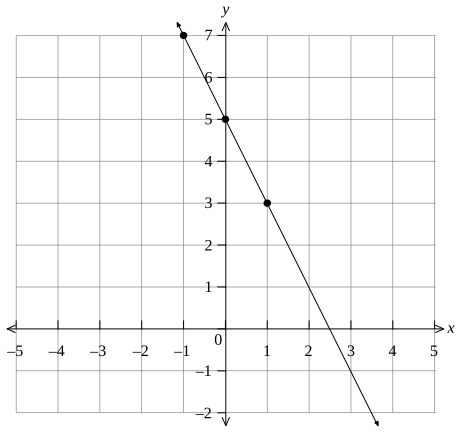
Monique has correctly drawn the graph of \(y=-2x+5\) on the number plane below.

She used the points \((-1,7),\ (0,5)\) and \((1,3)\) to draw the line.

How many more different points could she have used to plot the line \(y=-2x+5\)?

  1. \(0\)
  2. \(2\)
  3. \(8\)
  4. \(\text{An infinite number}\)
Show Answers Only

\(D\)

Show Worked Solution

\(\text{Straight lines are made up of an infinite number of points.}\)

\(\Rightarrow D\)

Filed Under: Linear Relationships Tagged With: num-title-ct-core, smc-4216-25-Straight lines

Linear Relationships, SM Bank 045

  1. Complete the tables of values below for each given rule.  (3 marks)

    \(y=2x+1\)
    \begin{array} {|l|c|c|c|c|}
    \hline
    \rule{0pt}{2.5ex}\ \ x\ \ \rule[-1ex]{0pt}{0pt} & -1  &\ \ 0\ \ &\ \ 1\ \ &\ \ 2\ \  \\
    \hline
    \rule{0pt}{2.5ex} \ \ y\ \ \rule[-1ex]{0pt}{0pt} &   &   &  & \\
    \hline
    \end{array}


    \(y=x-2\)
    \begin{array} {|l|c|c|c|c|}
    \hline
    \rule{0pt}{2.5ex}\ \ x\ \ \rule[-1ex]{0pt}{0pt} & -1  &\ \ 0\ \ &\ \ 1\ \ &\ \ 2\ \  \\
    \hline
    \rule{0pt}{2.5ex} \ \ y\ \ \rule[-1ex]{0pt}{0pt} &   &   &  & \\
    \hline
    \end{array}


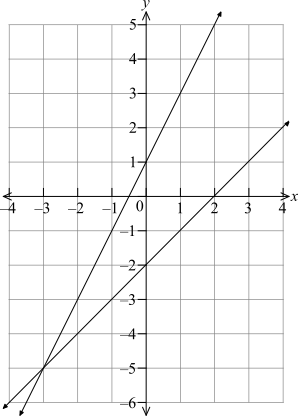
  2. On the number plane below, graph the equations from part (a).  (2 marks)
     
  3. Using the graph, find the point of intersection of the two lines.  (1 mark)

    --- 1 WORK AREA LINES (style=lined) ---

Show Answers Only

a.

\(y=2x+1\)
\begin{array} {|l|c|c|c|c|}
\hline
\rule{0pt}{2.5ex}\ \ x\ \ \rule[-1ex]{0pt}{0pt} & -1  &\ \ 0\ \ &\ \ 1\ \ &\ \ 2\ \  \\
\hline
\rule{0pt}{2.5ex} \ \ y\ \ \rule[-1ex]{0pt}{0pt} & -1  & 1  & 3 & 5\\
\hline
\end{array}


\(y=x-2\)
\begin{array} {|l|c|c|c|c|}
\hline
\rule{0pt}{2.5ex}\ \ x\ \ \rule[-1ex]{0pt}{0pt} & -1  &\ \ 0\ \ &\ \ 1\ \ &\ \ 2\ \  \\
\hline
\rule{0pt}{2.5ex} \ \ y\ \ \rule[-1ex]{0pt}{0pt} & -3  & -2  & -1 & 0\\
\hline
\end{array}

 b.   

c.     \((-3 , -5)\)

Show Worked Solution

a.

\(y=2x+1\)
\begin{array} {|l|c|c|c|c|}
\hline
\rule{0pt}{2.5ex}\ \ x\ \ \rule[-1ex]{0pt}{0pt} & -1  &\ \ 0\ \ &\ \ 1\ \ &\ \ 2\ \  \\
\hline
\rule{0pt}{2.5ex} \ \ y\ \ \rule[-1ex]{0pt}{0pt} & -1  & 1  & 3 & 5\\
\hline
\end{array}


\(y=x-2\)
\begin{array} {|l|c|c|c|c|}
\hline
\rule{0pt}{2.5ex}\ \ x\ \ \rule[-1ex]{0pt}{0pt} & -1  &\ \ 0\ \ &\ \ 1\ \ &\ \ 2\ \  \\
\hline
\rule{0pt}{2.5ex} \ \ y\ \ \rule[-1ex]{0pt}{0pt} & -3  & -2  & -1 & 0\\
\hline
\end{array}

 b.   

c.     \(\text{Point of intersection:   }(-3 , -5)\)

Filed Under: Linear Relationships Tagged With: num-title-ct-core, smc-4216-25-Straight lines

Linear Relationships, SM-Bank 044

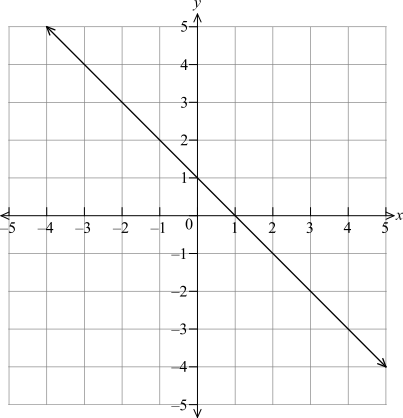
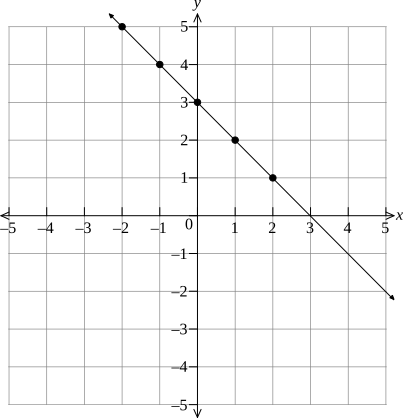
  1. Complete the table of values using the graph of the straight line below.  (2 marks)
    \begin{array} {|l|c|c|c|}
    \hline
    \rule{0pt}{2.5ex}\ \ x\ \ \rule[-1ex]{0pt}{0pt} & -2 & -1  &\ \ 0\ \ &\ \ 1\ \ &\ \ 2\ \  \\
    \hline
    \rule{0pt}{2.5ex} \ \ y\ \ \rule[-1ex]{0pt}{0pt} &  &   &   &  & \\
    \hline
    \end{array}
     
  2. Using either the table or the graph, state the rule connecting \(\large x\) and \(\large y\).  (1 mark)

    --- 2 WORK AREA LINES (style=lined) ---

Show Answers Only

a.

\begin{array} {|l|c|c|c|c|c|c|}
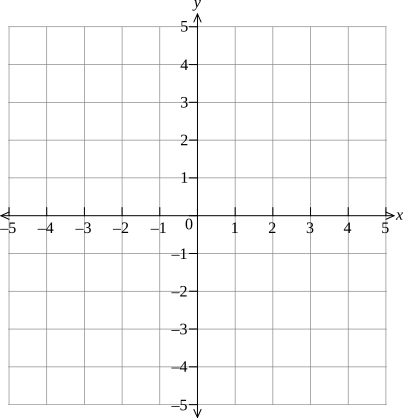
\hline
\rule{0pt}{2.5ex}\ \ x\ \ \rule[-1ex]{0pt}{0pt} & -2 &  -1  &\ \ 0\ \ &\ \ 1\ \ &\ \ 2\ \  \\
\hline
\rule{0pt}{2.5ex} \ \ y\ \ \rule[-1ex]{0pt}{0pt} & 3 & 2  &  1 & 0 & -1 \\
\hline
\end{array}

 b.    \(y=-x+1\)

Show Worked Solution

a.    \(\text{Table of values}\)

\begin{array} {|l|c|c|c|c|c|c|}
\hline
\rule{0pt}{2.5ex}\ \ x\ \ \rule[-1ex]{0pt}{0pt} & -2 &  -1  &\ \ 0\ \ &\ \ 1\ \ &\ \ 2\ \  \\
\hline
\rule{0pt}{2.5ex} \ \ y\ \ \rule[-1ex]{0pt}{0pt} & 3 & 2  &  1 & 0 & -1 \\
\hline
\end{array}

 b.    \(\text{The }y\ \text{values are decreasing by } 1\ \text{and when }x=0,\ \ y=1\)

\(\therefore\ \text{Rule:  }y=-x+1\)

Filed Under: Linear Relationships Tagged With: num-title-ct-core, smc-4216-25-Straight lines

Linear Relationships, SM-Bank 043

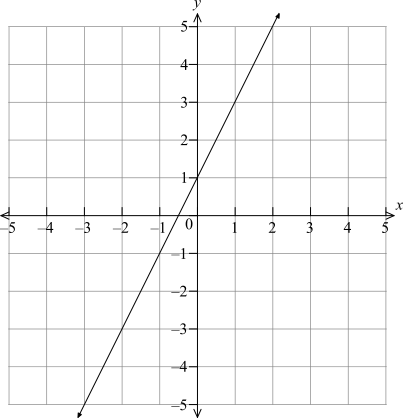
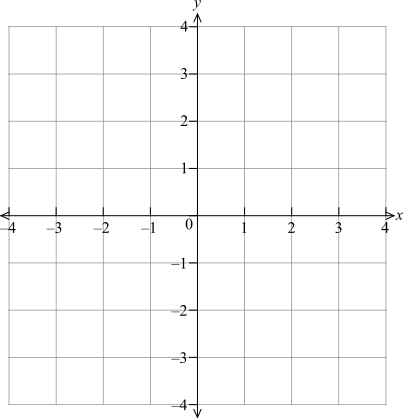
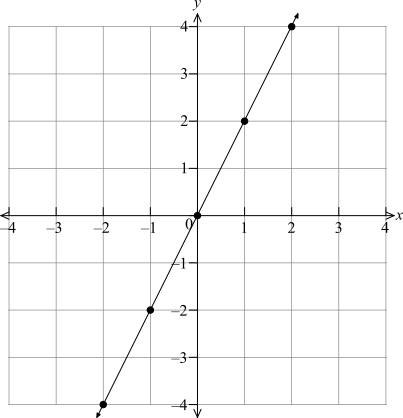
  1. Complete the table of values using the graph of the straight line below.  (2 marks)
    \begin{array} {|l|c|c|c|}
    \hline
    \rule{0pt}{2.5ex}\ \ x\ \ \rule[-1ex]{0pt}{0pt} & -2 & -1  &\ \ 0\ \ &\ \ 1\ \ &\ \ 2\ \  \\
    \hline
    \rule{0pt}{2.5ex} \ \ y\ \ \rule[-1ex]{0pt}{0pt} &  &   &   &  & \\
    \hline
    \end{array}
     
  2. Using either the table or the graph, state the rule connecting \(\large x\) and \(\large y\).  (1 mark)

    --- 2 WORK AREA LINES (style=lined) ---

Show Answers Only

a.

\begin{array} {|l|c|c|c|c|c|c|}
\hline
\rule{0pt}{2.5ex}\ \ x\ \ \rule[-1ex]{0pt}{0pt} & -2 &  -1  &\ \ 0\ \ &\ \ 1\ \ &\ \ 2\ \  \\
\hline
\rule{0pt}{2.5ex} \ \ y\ \ \rule[-1ex]{0pt}{0pt} & -3 & -1  &  1 & 3 & 5 \\
\hline
\end{array}

 b.    \(y=2x+1\)

Show Worked Solution

a.    \(\text{Table of values}\)

\begin{array} {|l|c|c|c|c|c|c|}
\hline
\rule{0pt}{2.5ex}\ \ x\ \ \rule[-1ex]{0pt}{0pt} & -2 &  -1  &\ \ 0\ \ &\ \ 1\ \ &\ \ 2\ \  \\
\hline
\rule{0pt}{2.5ex} \ \ y\ \ \rule[-1ex]{0pt}{0pt} & -3 & -1  &  1 & 3 & 5 \\
\hline
\end{array}

 b.    \(\text{The }y\ \text{values are increasing by } 2\ \text{and when }x=0,\ \ y=1\)

\(\therefore\ \text{Rule:  }y=2x+1\)

Filed Under: Linear Relationships Tagged With: num-title-ct-core, smc-4216-25-Straight lines

Linear Relationships, SM-Bank 042

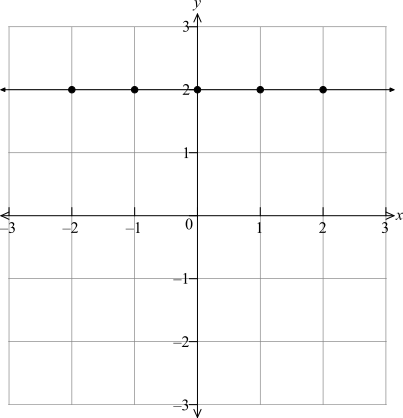
  1. Plot the points from the table on the number plane below and join the points using a ruler. (2 marks)
    \begin{array} {|l|c|c|c|}
    \hline
    \rule{0pt}{2.5ex}\ \ x\ \ \rule[-1ex]{0pt}{0pt} & -2 & -1 &\ \ 0\ \ &\ \ 1\ \ &\ \ 2\ \  \\
    \hline
    \rule{0pt}{2.5ex} \ \ y\ \ \rule[-1ex]{0pt}{0pt} & 2 & 2  & 2  & 2 & 2\\
    \hline
    \end{array}
     
  2. What do you notice about the points?  (1 mark)

    --- 1 WORK AREA LINES (style=lined) ---

  3. Using either the table or the graph, state the rule connecting \(\large x\) and \(\large y\).  (1 mark)

    --- 1 WORK AREA LINES (style=lined) ---

Show Answers Only

a.   

b.    \(\text{They form a horizontal straight line.}\)

c.    \(y=2\)

Show Worked Solution

a.  

b.    \(\text{They form a horizontal straight line.}\)

c.   

\begin{array} {|l|c|c|c|}
\hline
\rule{0pt}{2.5ex}\ \ x\ \ \rule[-1ex]{0pt}{0pt} &\ \ -2\ \  &\ \ -1\ \  &\ \ 0\ \ &\ \ 1\ \ &\ \ 2\ \  \\
\hline
\rule{0pt}{2.5ex} \ \ y\ \ \rule[-1ex]{0pt}{0pt} & 2 & 2  & 2 & 2 & 2\\
\hline
\end{array}

\(y=2\text{ regardless of the value of }x\)

\(\therefore\ \text{Rule:  }y=2\)

Filed Under: Linear Relationships Tagged With: num-title-ct-core, smc-4216-25-Straight lines

Linear Relationships, SM-Bank 041

  1. Plot the points from the table on the number plane below and join the points using a ruler. (2 marks)
    \begin{array} {|l|c|c|c|}
    \hline
    \rule{0pt}{2.5ex}\ \ x\ \ \rule[-1ex]{0pt}{0pt} &\ \ -2\ \  &\ \ -1\ \  &\ \ 0\ \ &\ \ 1\ \ &\ \ 2\ \  \\
    \hline
    \rule{0pt}{2.5ex} \ \ y\ \ \rule[-1ex]{0pt}{0pt} & 5 & 4  & 3  & 2 & 1\\
    \hline
    \end{array}
     
  2. What do you notice about the points?  (1 mark)

    --- 1 WORK AREA LINES (style=lined) ---

  3. Using either the table or the graph, state the rule connecting \(\large x\) and \(\large y\).  (1 mark)

    --- 1 WORK AREA LINES (style=lined) ---

Show Answers Only

a.   

b.    \(\text{They form a straight line.}\)

c.    \(y=3-x\)

Show Worked Solution

a.  

b.    \(\text{They form a straight line.}\)

c.   

\begin{array} {|l|c|c|c|}
\hline
\rule{0pt}{2.5ex}\ \ x\ \ \rule[-1ex]{0pt}{0pt} &\ \ -2\ \  &\ \ -1\ \  &\ \ 0\ \ &\ \ 1\ \ &\ \ 2\ \  \\
\hline
\rule{0pt}{2.5ex} \ \ y\ \ \rule[-1ex]{0pt}{0pt} & 3-(-2)=5 & 3-(-1)=4  & 3-0=3 & 3-1=2 & 3-2=1\\
\hline
\end{array}

\(\therefore\ \text{Rule:  }y=3-x\)

Filed Under: Linear Relationships Tagged With: num-title-ct-core, smc-4216-25-Straight lines

Linear Relationships, SM-Bank 040

  1. Plot the points from the table on the number plane below and join the points using a ruler. (2 marks)
    \begin{array} {|l|c|c|c|}
    \hline
    \rule{0pt}{2.5ex}\ \ x\ \ \rule[-1ex]{0pt}{0pt} &\ \ -2\ \  &\ \ -1\ \  &\ \ 0\ \ &\ \ 1\ \ &\ \ 2\ \  \\
    \hline
    \rule{0pt}{2.5ex} \ \ y\ \ \rule[-1ex]{0pt}{0pt} & -4 & -2  & 0  & 2 & 4\\
    \hline
    \end{array}
     
  2. What do you notice about the points?  (1 mark)

    --- 1 WORK AREA LINES (style=lined) ---

  3. Using either the table or the graph, state the rule connecting \(\large x\) and \(\large y\).  (1 mark)

    --- 1 WORK AREA LINES (style=lined) ---

Show Answers Only

a.   

b.    \(\text{They form a straight line.}\)

c.    \(y=2x\)

Show Worked Solution

a.  

b.    \(\text{They form a straight line.}\)

c.   

\begin{array} {|l|c|c|c|}
\hline
\rule{0pt}{2.5ex}\ \ x\ \ \rule[-1ex]{0pt}{0pt} &\ \ -2\ \  &\ \ -1\ \  &\ \ 0\ \ &\ \ 1\ \ &\ \ 2\ \  \\
\hline
\rule{0pt}{2.5ex} \ \ y\ \ \rule[-1ex]{0pt}{0pt} & 2\times -2=-4 & 2\times -1=-2  & 2\times 0=0  & 2\times 1=2 & 2\times 2=4\\
\hline
\end{array}

\(\therefore\ \text{Rule:  }y=2x\)

Filed Under: Linear Relationships Tagged With: num-title-ct-core, smc-4216-25-Straight lines

Linear Relationships, SM-Bank 039 MC

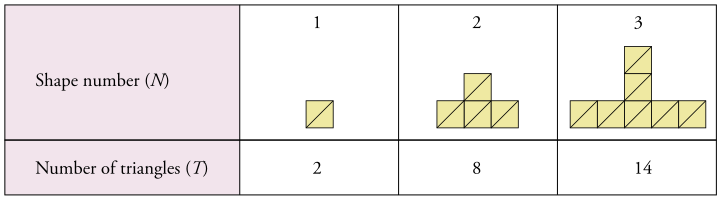
Pepper uses matchsticks to make a pattern of shapes, as shown in the table below.


The equation used to show the relationship between  \(T\)  and  \(N\)  is

  1. \(T = N + 1\)
  2. \(T = 6N\)
  3. \(T = 6N+2\)
  4. \(T = 6N-4\)
Show Answers Only

\(D\)

Show Worked Solution

\(T\ \text{increases by 6 each shape.}\)

\(\text{Consider}\ T = 6N – 4:\)

\(\text{When}\ \ N = 1,\ T = 6\times 1 − 4 = 2\)

\(\text{When}\ \ N = 2, \ T = 6\times − 4 = 8\)

\(\text{When}\ \ N = 3,\ T = 6\times − 4 = 14\)

\(\therefore T = 6N − 4\ \text{is correct}\)

\(\Rightarrow D\)


Filed Under: Linear Relationships Tagged With: num-title-ct-core, smc-4216-15-Patterns, smc-4216-20-Rules

Linear Relationships, SM-Bank 038

  1. Complete the table of values below for the rule  \( y=4x-7\).  (2 marks)
     

    \begin{array} {|l|c|c|c|c|}
    \hline
    \rule{0pt}{2.5ex}\ \ x\ \ \rule[-1ex]{0pt}{0pt} &  -1  &\ \ 0\ \ &\ \ 1\ \ &\ \ 2\ \ \\
    \hline
    \rule{0pt}{2.5ex} \ \ y\ \ \rule[-1ex]{0pt}{0pt} &   &   &  & \\
    \hline
    \end{array} 
  2. Use the table to list the coordinates of the points.  (2 marks)

    --- 2 WORK AREA LINES (style=lined) ---

Show Answers Only

a.    \(\text{Table of values}\)

\begin{array} {|l|c|c|c|c|}
\hline
\rule{0pt}{2.5ex}\ \ x\ \ \rule[-1ex]{0pt}{0pt}&  -1  &\ \ 0\ \ &\ \ 1\ \ &\ \ 2\ \ \\
\hline
\rule{0pt}{2.5ex} \ \ y\ \ \rule[-1ex]{0pt}{0pt} & -11  & -7 & -3 & 1\\
\hline
\end{array}

b.    \((-1 , -11)\ \ (0 , -7)\ \ (1 , -3)\ \ (2 , 1)\)

Show Worked Solution

a.    \(\text{Table of values}\)

\begin{array} {|l|c|c|c|c|c|}
\hline
\rule{0pt}{2.5ex}\ \ x\ \ \rule[-1ex]{0pt}{0pt} &\ \ -1\ \ &\ \ 0\ \ &\ \ 1\ \ &\ \ 2\ \ \\
\hline
\rule{0pt}{2.5ex} \ \ y\ \ \rule[-1ex]{0pt}{0pt} & 4\times (-1)-7=-11  & 4\times (0)-7=-7 & 4\times 1-7=-3 &4\times 2-7=1\\
\hline
\end{array}

b.    \((-1 , -11)\ \ (0 , -7)\ \ (1 , -3)\ \ (2 , 1)\)

Filed Under: Linear Relationships Tagged With: num-title-ct-core, smc-4216-22-Tables

Linear Relationships, SM-Bank 037

  1. Complete the table of values below for the rule  \( y=5-x\).  (2 marks)
     

    \begin{array} {|l|c|c|c|c|}
    \hline
    \rule{0pt}{2.5ex}\ \ x\ \ \rule[-1ex]{0pt}{0pt} &  -1  &\ \ 0\ \ &\ \ 1\ \ &\ \ 2\ \ \\
    \hline
    \rule{0pt}{2.5ex} \ \ y\ \ \rule[-1ex]{0pt}{0pt} &   &   &  & \\
    \hline
    \end{array} 
  2. Use the table to list the coordinates of the points.  (2 marks)

    --- 3 WORK AREA LINES (style=lined) ---

Show Answers Only

a.    \(\text{Table of values}\)

\begin{array} {|l|c|c|c|c|}
\hline
\rule{0pt}{2.5ex}\ \ x\ \ \rule[-1ex]{0pt}{0pt}&  -1  &\ \ 0\ \ &\ \ 1\ \ &\ \ 2\ \ \\
\hline
\rule{0pt}{2.5ex} \ \ y\ \ \rule[-1ex]{0pt}{0pt} & 6  & 5 & 4 & 3\\
\hline
\end{array}

b.    \((-1 , 6)\ \ (0 , 5)\ \ (1 , 4)\ \ (2 , 3)\)

Show Worked Solution

a.    \(\text{Table of values}\)

\begin{array} {|l|c|c|c|c|c|}
\hline
\rule{0pt}{2.5ex}\ \ x\ \ \rule[-1ex]{0pt}{0pt} &\ \ -1\ \ &\ \ 0\ \ &\ \ 1\ \ &\ \ 2\ \ \\
\hline
\rule{0pt}{2.5ex} \ \ y\ \ \rule[-1ex]{0pt}{0pt} & 5-(-1)=6  & 5-0=5 & 5-1=4 & 5-2=3\\
\hline
\end{array}

b.    \((-1 , 6)\ \ (0 , 5)\ \ (1 , 4)\ \ (2 , 3)\)

Filed Under: Linear Relationships Tagged With: num-title-ct-core, smc-4216-22-Tables

Linear Relationships, SM-Bank 036

Complete the table of values below for the given rule.  (2 marks)

\( v=4u-3\)

\begin{array} {|l|c|c|c|c|c|}
\hline
\rule{0pt}{2.5ex}\ \ u\ \ \rule[-1ex]{0pt}{0pt} &  -2  &  -1  &\ \ 0\ \ &\ \ 1\ \ &\ \ 2\ \ \\
\hline
\rule{0pt}{2.5ex} \ \ v\ \ \rule[-1ex]{0pt}{0pt} &   &   &  & \\
\hline
\end{array}

--- 0 WORK AREA LINES (style=lined) ---

Show Answers Only

\begin{array} {|l|c|c|c|c|c|}
\hline
\rule{0pt}{2.5ex}\ \ u\ \ \rule[-1ex]{0pt}{0pt} &  -2  &  -1  &\ \ 0\ \ &\ \ 1\ \ &\ \ 2\ \ \\
\hline
\rule{0pt}{2.5ex} \ \ v\ \ \rule[-1ex]{0pt}{0pt} & -11  & -7  & -3 & 1 & 5\\
\hline
\end{array}

Show Worked Solution

\begin{array} {|l|c|c|c|c|c|}
\hline
\rule{0pt}{2.5ex}\ \ u\ \ \rule[-1ex]{0pt}{0pt} &\ \ -2\ \ &\ \ -1\ \ &\ \ 0\ \ &\ \ 1\ \ &\ \ 2\ \ \\
\hline
\rule{0pt}{2.5ex} \ \ v\ \ \rule[-1ex]{0pt}{0pt} & 4\times -2-3=-11  & 4\times -1-3=-7 & 4\times 0-3=-3 & 4\times 1-3=1 & 4\times 2-3=5\\
\hline
\end{array}

Filed Under: Linear Relationships Tagged With: num-title-ct-core, smc-4216-22-Tables

Linear Relationships, SM-Bank 035

Complete the table of values below for the given rule.  (2 marks)

\( y=-x\)

\begin{array} {|l|c|c|c|c|c|}
\hline
\rule{0pt}{2.5ex}\ \ x\ \ \rule[-1ex]{0pt}{0pt} &  -2  &  -1  &\ \ 0\ \ &\ \ 1\ \ &\ \ 2\ \ \\
\hline
\rule{0pt}{2.5ex} \ \ y\ \ \rule[-1ex]{0pt}{0pt} &   &   &  & \\
\hline
\end{array}

--- 0 WORK AREA LINES (style=lined) ---

Show Answers Only

\begin{array} {|l|c|c|c|c|c|}
\hline
\rule{0pt}{2.5ex}\ \ x\ \ \rule[-1ex]{0pt}{0pt} &  -2  &  -1  &\ \ 0\ \ &\ \ 1\ \ &\ \ 2\ \ \\
\hline
\rule{0pt}{2.5ex} \ \ y\ \ \rule[-1ex]{0pt}{0pt} & 2  & 1  & 0 & -1 & -2\\
\hline
\end{array}

Show Worked Solution

\begin{array} {|l|c|c|c|c|c|}
\hline
\rule{0pt}{2.5ex}\ \ x\ \ \rule[-1ex]{0pt}{0pt} &\ \ -2\ \ &\ \ -1\ \ &\ \ 0\ \ &\ \ 1\ \ &\ \ 2\ \ \\
\hline
\rule{0pt}{2.5ex} \ \ y\ \ \rule[-1ex]{0pt}{0pt} & -(-2)=2  & -(-1)=1 & -(0)=0 & -(1)=-1 & -(2)=-2\\
\hline
\end{array}

Filed Under: Linear Relationships Tagged With: num-title-ct-core, smc-4216-22-Tables

Linear Relationships, SM-Bank 034

Complete the table of values below for the given rule.  (2 marks)

\( y=2x+1\)

\begin{array} {|l|c|c|c|c|}
\hline
\rule{0pt}{2.5ex}\ \ x\ \ \rule[-1ex]{0pt}{0pt} &\ \ -2\ \ &\ \ -1\ \ &\ \ 0\ \ &\ \ 1\ \ \\
\hline
\rule{0pt}{2.5ex} \ \ y\ \ \rule[-1ex]{0pt}{0pt} &   &   &  & \\
\hline
\end{array}

--- 0 WORK AREA LINES (style=lined) ---

Show Answers Only

\begin{array} {|l|c|c|c|c|}
\hline
\rule{0pt}{2.5ex}\ \ x\ \ \rule[-1ex]{0pt}{0pt} &\ \ -2\ \ &\ \ -1\ \ &\ \ 0\ \ &\ \ 1\ \ \\
\hline
\rule{0pt}{2.5ex} \ \ y\ \ \rule[-1ex]{0pt}{0pt} & -3  & 1  & 0 & 1\\
\hline
\end{array}

Show Worked Solution

\begin{array} {|l|c|c|c|c|}
\hline
\rule{0pt}{2.5ex}\ \ x\ \ \rule[-1ex]{0pt}{0pt} &\ \ -2\ \ &\ \ -1\ \ &\ \ 0\ \ &\ \ 1\ \ \\
\hline
\rule{0pt}{2.5ex} \ \ y\ \ \rule[-1ex]{0pt}{0pt} & 2\times -2+1=-3  & 2\times -1+1=-1  & 2\times 0+1=1 & 2\times 1+1=3\\
\hline
\end{array}

Filed Under: Linear Relationships Tagged With: num-title-ct-core, smc-4216-22-Tables

Linear Relationships, SM-Bank 033

Complete the table of values below for the given rule.  (2 marks)

\( y=2+x\)

\begin{array} {|l|c|c|c|c|c|c|}
\hline
\rule{0pt}{2.5ex}\ \ x\ \ \rule[-1ex]{0pt}{0pt} &\ \ 1\ \ &\ \ 2\ \ &\ \ 3\ \ &\ \ 4\ \ \\
\hline
\rule{0pt}{2.5ex} \ \ y\ \ \rule[-1ex]{0pt}{0pt} &   &   &  & \\
\hline
\end{array}

--- 0 WORK AREA LINES (style=lined) ---

Show Answers Only

\begin{array} {|l|c|c|c|c|c|c|}
\hline
\rule{0pt}{2.5ex}\ \ x\ \ \rule[-1ex]{0pt}{0pt} &\ \ 1\ \ &\ \ 2\ \ &\ \ 3\ \ &\ \ 4\ \ \\
\hline
\rule{0pt}{2.5ex} \ \ y\ \ \rule[-1ex]{0pt}{0pt} & 3  & 4  & 5 & 6\\
\hline
\end{array}

Show Worked Solution

\begin{array} {|l|c|c|c|c|c|c|}
\hline
\rule{0pt}{2.5ex}\ \ x\ \ \rule[-1ex]{0pt}{0pt} &\ \ 1\ \ &\ \ 2\ \ &\ \ 3\ \ &\ \ 4\ \ \\
\hline
\rule{0pt}{2.5ex} \ \ y\ \ \rule[-1ex]{0pt}{0pt} & 2+1=3 & 2+2=4  & 2+3=5 & 2+4=6\\
\hline
\end{array}

Filed Under: Linear Relationships Tagged With: num-title-ct-core, smc-4216-22-Tables

Linear Relationships, SM-Bank 032 MC

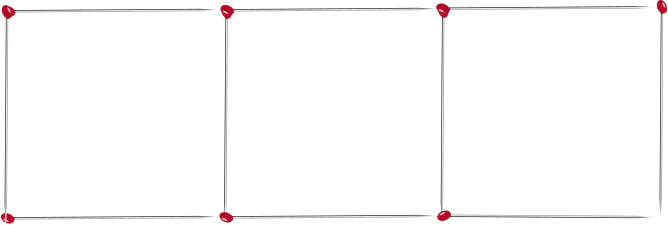
Which rule correctly describes the pattern below?


  1. \(\text{The number of pins}=2\times \text{The number of squares}+3\)
  2. \(\text{The number of pins}=3\times \text{The number of squares}+1\)
  3. \(\text{The number of pins}=1\times \text{The number of squares}+3\)
  4. \(\text{The number of pins}=4\times \text{The number of squares}\)
Show Answers Only

\(B\)

Show Worked Solution

\begin{array} {|l|c|c|c|c|c|c|}
\hline
\rule{0pt}{2.5ex} \text{Number of squares} \rule[-1ex]{0pt}{0pt} & 1 & 2 & 3 \\
\hline
\rule{0pt}{2.5ex} \text{Number of pins} \rule[-1ex]{0pt}{0pt} & 4 & 7 & 10 \\
\hline
\end{array}

\(\therefore\ \text{The number of pins}=3\times \text{Number of squares}+1\)

\(\Rightarrow B\)

Filed Under: Linear Relationships Tagged With: num-title-ct-core, smc-4216-15-Patterns, smc-4216-20-Rules

Linear Relationships, SM-Bank 031 MC

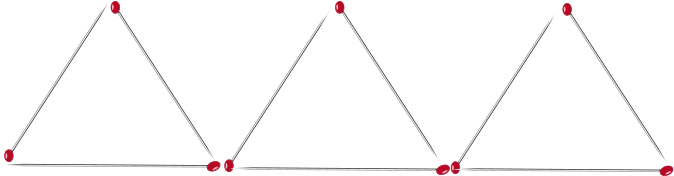
Which rule correctly describes the pattern below?


  1. \(\text{The number of pins}=\text{The number of triangles}+3\)
  2. \(\text{The number of pins}=\text{The number of triangles}+5\)
  3. \(\text{The number of pins}=\text{The number of triangles}\times 2\)
  4. \(\text{The number of pins}=\text{The number of triangles}\times 3\)
Show Answers Only

\(D\)

Show Worked Solution
\(\text{Number of triangles }(t)\) \(\ \ 1\ \ \) \(\ \ 2\ \ \) \(\ \ 3\ \ \) \(\ \ ….\ \ \)
\(\text{Number of pins }(p)\) \(\ \ 3\ \ \) \(\ \ 6\ \ \) \(\ \ 9\ \ \) \(\ \ ….\ \ \)

  
\(\therefore\ \text{The number of pins}=\text{Number of triangles}\times 3\)

\(\Rightarrow D\)

Filed Under: Linear Relationships Tagged With: num-title-ct-core, smc-4216-15-Patterns, smc-4216-20-Rules

Linear Relationships, SM-Bank 030

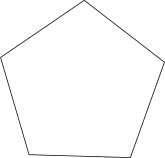
Michael is making a geometric pattern using sticks to make pentagons.

The first 3 shapes in the pattern are shown below.


  1. Draw the next shape in the pattern.  (1 mark)

    --- 6 WORK AREA LINES (style=lined) ---

  2. Complete the table of values using the pattern.  (2 marks)

    Number of pentagons \((\large p)\) \(\ \ 1\ \ \) \(\ \ 2\ \ \) \(\ \ 3\ \ \) \(\ \ 4\ \ \)
    Number of sticks \((\large s)\) \(\ \ 5\ \ \)      
  3. Write the rule connecting the number of sticks \((s)\) to the number of pentagons \((p)\).  (2 marks)

    --- 3 WORK AREA LINES (style=lined) ---

  4. How many sticks will be needed to make \(12\) pentagons?  (2 marks)

    --- 3 WORK AREA LINES (style=lined) ---

Show Answers Only

a.    \(\text{Shape number }4\)

b.    \(\text{Table of values}\)

\(\text{Number of pentagons }(\large p)\) \(\ \ 1\ \ \) \(\ \ 2\ \ \) \(\ \ 3\ \ \) \(\ \ 4\ \ \)
\(\text{Number of sticks }(\large s)\) \(\ \ 5\ \ \) \(\ \ 9\ \ \) \(\ \ 13\ \ \) \(\ \ 17\ \ \)

c.    \(s=4\times p+1\)

d.    \(49\)

Show Worked Solution

a.    \(\text{Shape number }4\)

b.    \(\text{Table of values}\)

\(\text{Number of pentagons }(\large p)\) \(\ \ 1\ \ \) \(\ \ 2\ \ \) \(\ \ 3\ \ \) \(\ \ 4\ \ \)
\(\text{Number of sticks }(\large s)\) \(\ \ 5\ \ \) \(\ \ 9\ \ \) \(\ \ 13\ \ \) \(\ \ 17\ \ \)

c.    \(\text{Rule:  The number of sticks}=4\times \text{(the number of pentagons)}+1\)

\(\therefore\ \text{Rule:  }\ s=4\times p+1\)

d.    \(\text{Find the value of }s\ \text{when }p=12\)

\(s=4\times p+1=4\times 12+1=49\)

Filed Under: Linear Relationships Tagged With: num-title-ct-core, smc-4216-15-Patterns, smc-4216-20-Rules

Linear Relationships, SM-Bank 029

Michael is making a geometric pattern using pins to form triangles.

The first 3 shapes in the pattern are shown below.


  1. Draw the next shape in the pattern.  (1 mark)

    --- 6 WORK AREA LINES (style=lined) ---

  2. Complete the table of values using the pattern.  (2 marks)

    Number of triangles \((t)\) \(\ \ 1\ \ \) \(\ \ 2\ \ \) \(\ \ 3\ \ \) \(\ \ 4\ \ \)
    Number of pins \((p)\) \(\ \ 3\ \ \)      
  3. Write the rule connecting the number of pins \((p)\) to the number of triangles \((t)\).  (2 marks)

    --- 2 WORK AREA LINES (style=lined) ---

  4. How many pins will be needed to make \(25\) triangles?  (2 marks)

    --- 2 WORK AREA LINES (style=lined) ---

Show Answers Only

a.    \(\text{Shape number }4\)

b.    \(\text{Table of values}\)

\(\text{Number of triangles }(t)\) \(\ \ 1\ \ \) \(\ \ 2\ \ \) \(\ \ 3\ \ \) \(\ \ 4\ \ \)
\(\text{Number of pins }(p)\) \(\ \ 3\ \ \) \(\ \ 5\ \ \) \(\ \ 7\ \ \) \(\ \ 9\ \ \)

c.    \(p=2\times t+1\)

d.    \(51\)

Show Worked Solution

a.    \(\text{Shape number }4\)

b.    \(\text{Table of values}\)

\(\text{Number of triangles }(t)\) \(\ \ 1\ \ \) \(\ \ 2\ \ \) \(\ \ 3\ \ \) \(\ \ 4\ \ \)
\(\text{Number of pins }(p)\) \(\ \ 3\ \ \) \(\ \ 5\ \ \) \(\ \ 7\ \ \) \(\ \ 9\ \ \)

c.    \(\text{Rule:  The number of pins}=2\times \text{(the number of triangles)}+1\)

\(\therefore\ \text{Rule:  }\ p=2\times t+1\)

d.    \(\text{Find the value of }p\ \text{when }t=25\)

\(p=2\times t+1=2\times 25+1=51\)

Filed Under: Linear Relationships Tagged With: num-title-ct-core, smc-4216-15-Patterns, smc-4216-20-Rules

Linear Relationships, SM-Bank 028

A weekly gym membership can be purchased for different numbers of classes, as shown in the table below. 

Number of classes 1 2 3 4
Cost in dollars  42  72  102  132

What is the rule connecting the number of classes purchased and the cost in dollars?  (2 marks)

Show Answers Only

\(\text{Cost in dollars}=30\times \text{Number of classes}+12\)

Show Worked Solution

\(\text{Firstly, look at the increase in the cost with each additional class }\)

\(\longrightarrow\ 42 , 72 , 102 , 132\ \ \longrightarrow\text{The cost increases by }$30\text{ every class}\)

\(\text{Secondly, if we look at the difference between }42\ \text{and }30\ \text{in the first class}\)

\(\text{we get }12\text{ which needs to be added to each membership}\)

\(\therefore\ \text{Rule:  Cost in dollars}=30\times \text{Number of classes}+12\)

Filed Under: Linear Relationships Tagged With: num-title-ct-core, smc-4216-20-Rules

Linear Relationships, SM-Bank 027

A surfboard can be hired for different numbers of hours, as shown in the table below. 

Number of hours 1 2 3 4
Cost in dollars  35  50  65  80

What is the rule connecting the number of hours of surfboard hire and the cost in dollars?  (2 marks)

Show Answers Only

\( Cost in dollars}=15\times \text{Number of hours}+20\)

Show Worked Solution

\(\text{Firstly, look at the increase in the cost with each hour of hire }\)

\(\longrightarrow\ 35 , 50 , 65 , 80\ \ \longrightarrow\text{The price increases by }$15\text{ every hour}\)

\(\text{Secondly, if we look at the difference between }35\ \text{and }15\ \text{in the first hour}\)

\(\text{we get }20\text{ which needs to be added to each hiring fee}\)

\(\therefore\ \text{Rule:  Cost in dollars}=15\times \text{Number of hours}+20\)

Filed Under: Linear Relationships Tagged With: num-title-ct-core, smc-4216-20-Rules

  • « Previous Page
  • 1
  • …
  • 13
  • 14
  • 15
  • 16
  • 17
  • …
  • 31
  • Next Page »

Copyright © 2014–2026 SmarterEd.com.au · Log in