Which two of the following fractions are not in simplest form? (2 marks)
`1/3, 2/9, 5/15, 6/28, 8/21`
Aussie Maths & Science Teachers: Save your time with SmarterEd
Which two of the following fractions are not in simplest form? (2 marks)
`1/3, 2/9, 5/15, 6/28, 8/21`
Which two of the following fractions are not in simplest form? (2 marks)
`1/8, 3/7, 4/12, 9/11, 7/14`
Convert `\ 7 9/11` to an improper fraction. (1 mark)
Convert `8 5/9` to an improper fraction. (1 mark)
Convert `4 1/5` to an improper fraction. (1 mark)
Convert `99/12` to a mixed number, in simplest form. (2 marks)
Convert `35/14` to a mixed number, in simplest form. (2 marks)
Convert `84/40` to a mixed number, in simplest form. (2 marks)
Convert `47/7` to a mixed number. (1 mark)
Convert `27/5` to a mixed number. (1 mark)
Convert `11/7` to a mixed number. (1 mark)
Simplify `896/1248`, giving your answer in simplest form. (2 marks)
--- 5 WORK AREA LINES (style=lined) ---
Simplify `2550/5000`, giving your answer in simplest form. (2 marks)
--- 4 WORK AREA LINES (style=lined) ---
Simplify `27/45`, giving your answer in simplest form. (1 mark)
--- 2 WORK AREA LINES (style=lined) ---
Simplify `25/75`, giving your answer in simplest form. (1 mark)
--- 2 WORK AREA LINES (style=lined) ---
--- 2 WORK AREA LINES (style=lined) ---
--- 1 WORK AREA LINES (style=lined) ---
--- 1 WORK AREA LINES (style=lined) ---
State whether the following pairs of fractions are equivalent by using the `=` or `≠` symbol in the box between the fractions. (3 marks)
| a. |
|
| b. |
|
| c. |
|
--- 0 WORK AREA LINES (style=lined) ---
A bowl has 16 pieces of fruit in it.
12 of the pieces of fruit are oranges.
What fraction of the pieces of fruit are oranges? Give your answer in simplest form. (1 mark)
--- 3 WORK AREA LINES (style=lined) ---

--- 2 WORK AREA LINES (style=lined) ---
a. `5\ text(additional triangles need to be shaded (8 in total))`
`text(One possible solution.`

b. `8/24 = 4/12 = 2/6 = 1/3`
`text(Note: Many other fractions equivalent to)\ 1/3\ text(are possible.)`
a. `text(There are 24 triangles altogether.)`
`text(Number of triangles)\ = 1/3 xx 24 = 8`
`:.\ 5\ text(additional triangles need to be shaded (8 in total))`
`text(One possible solution.`
b. `text(Using diagram)`
`8/24 = 4/12 = 2/6 = 1/3`
`text(Note: Many other fractions equivalent to)\ 1/3\ text(are possible.)`
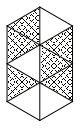
Which shape has `2/5` shaded?
| A. | B. | C. | D. | |
 |
 |
 |
 |
`text(Checking Option A:`
`\frac{\text(Shaded triangles)}{\text(Total triangles)}=4/10=2/5`
`=> A`
Which shape has `3/5` shaded?
| A. | B. | C. | D. | |
|
|
|
|
`text(Checking Option C:`
`\frac{\text(Shaded triangles)}{\text(Total triangles)}=6/10=3/5`
`=> C`
Shade `4/7` of the image below. (1 mark)

--- 0 WORK AREA LINES (style=lined) ---
`text(8 triangles must be shaded.)`
`text(Note: Many options are possible.)`
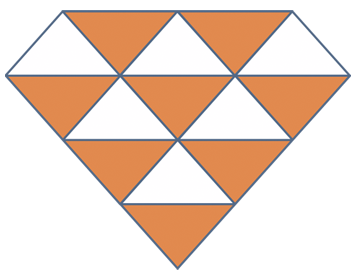
`text(There are 14 triangles)`
`4/7 xx 14 = 8`
`:.\ text(Any 8 triangles shaded is acceptable.)`
Write the following fractions in order from largest to smallest. (2 marks)
`5/8, 1/4, 5/24, 1/2, 1/6`
--- 5 WORK AREA LINES (style=lined) ---
Which set of fractions is ordered smallest to largest?
Which letter is pointing closest to `3/5` on this number line?


`1/2<3/5<1\ :.\ X\ text(is the closest to)\ 3/5`
`=> B`
--- 2 WORK AREA LINES (style=lined) ---

--- 0 WORK AREA LINES (style=lined) ---
i. `-1 1/5 , -2/6 , 1/3 `
ii.

i. `text(Ascending order)\ =>\ -1 1/5 , -2/6 , 1/3 `
ii.
The fraction `8/10` and `1/5` have been shaded on this fraction wall.

What is `8/10 - 1/5?`
Which position is closest to `1/3` on this number line?

The table shows the fractions of the Australian workforce in some industries.
\begin{array} {|l|c|}
\hline \ & \textbf{Fraction of the} \\ \textbf{Industry} \ & \textbf{Australian workforce} \\
\hline \text{Automotive} & \dfrac{1}{12} \\
\hline \text{Finance} & \dfrac{1}{13} \\
\hline \text{Health Care} & \dfrac{1}{7} \\
\hline \text{Telecommunications} & \dfrac{1}{10} \\
\hline \end{array}
Which of these industries has the least number of employees in the workforce? (1 mark)
Which number is exactly halfway between `1 1/3` and `4 2/3`? (2 marks)
Freddie watches television for 5 hours each day.
What fraction of the day is Freddie not watching television?
Alison has 15 lollipops and decides to give `1/3` of them to her sister.
How many lollipops does her sister get?
Riley threw a shotput in the school athletics carnival and landed it where the arrow marker is shown below.

Which of these is closest to the length of his throw?
Evaluate `(-2)^3-(-2)^2`. (2 marks)
What is the value of the expression `[(4-12)xx(-3- -7)]/4`? (2 marks)
What is the value of `-20÷[-2xx4-3xx-6]` ? (1 mark)
What is the value of `(-10)^4` ? (1 mark)
What is the value of `(-4)^3` ? (1 mark)
What is the value of the expression `7xx-8 ÷ -2`? (2 marks)
What is the value of the expression `-4-3xx(-2)`? (1 mark)
What is the value of the expression `-3xx5-2xx(-3)`?
What is the value of the expression `-2+4xx3`?
Aurora had $500 in her bank account at the beginning of September.
During the month she withdrew $415 and deposited $82?
Write and solve a directed number sentence to show the balance of Aurora's account at the end of the month? (2 marks)
Jamison measured the temperature at sunrise to be `-7\^circ`C.
He measured the temperature again 3 hours later and found it had risen to `5\^circ`C.
--- 1 WORK AREA LINES (style=lined) ---
--- 1 WORK AREA LINES (style=lined) ---
Evaluate the following. (3 marks)
--- 1 WORK AREA LINES (style=lined) ---
--- 1 WORK AREA LINES (style=lined) ---
--- 1 WORK AREA LINES (style=lined) ---
Evaluate the following. (3 marks)
--- 1 WORK AREA LINES (style=lined) ---
--- 1 WORK AREA LINES (style=lined) ---
--- 1 WORK AREA LINES (style=lined) ---
Evaluate the following. (3 marks)
--- 1 WORK AREA LINES (style=lined) ---
--- 1 WORK AREA LINES (style=lined) ---
--- 1 WORK AREA LINES (style=lined) ---
When discussing multiplication of directed numbers with his friend, Jeremy remarked
'If the number of minus signs in the question is odd I know
the answer is going to be negative and if the number of minus
signs is even I know the answer is going to be positive'.
Is Jeremy correct? Justify your answer with examples. (3 marks)
--- 7 WORK AREA LINES (style=lined) ---
Find the values of the following. (3 marks)
--- 1 WORK AREA LINES (style=lined) ---
--- 1 WORK AREA LINES (style=lined) ---
--- 1 WORK AREA LINES (style=lined) ---
Evaluate the following. (3 marks)
--- 1 WORK AREA LINES (style=lined) ---
--- 1 WORK AREA LINES (style=lined) ---
--- 1 WORK AREA LINES (style=lined) ---
Evaluate the following products. (3 marks)
--- 1 WORK AREA LINES (style=lined) ---
--- 1 WORK AREA LINES (style=lined) ---
--- 1 WORK AREA LINES (style=lined) ---
Find the following products. (3 marks)
--- 1 WORK AREA LINES (style=lined) ---
--- 1 WORK AREA LINES (style=lined) ---
--- 1 WORK AREA LINES (style=lined) ---
Find the following products. (3 marks)
--- 1 WORK AREA LINES (style=lined) ---
--- 1 WORK AREA LINES (style=lined) ---
--- 1 WORK AREA LINES (style=lined) ---
Explain why `(-5)^2` is not the same as `-5^2\`. (2 marks)
Which of the following best represents `3 xx -5`?
Which of the following best represents `4 xx -3`?
Find the following products. (3 marks)
--- 1 WORK AREA LINES (style=lined) ---
--- 1 WORK AREA LINES (style=lined) ---
--- 1 WORK AREA LINES (style=lined) ---
Find the following products. (3 marks)
--- 1 WORK AREA LINES (style=lined) ---
--- 1 WORK AREA LINES (style=lined) ---
--- 1 WORK AREA LINES (style=lined) ---
Two numbers added together equal `-1`.
The two numbers multiplied together equal `-56`.
What are the two numbers? (2 marks)
Two numbers added together equal `-`7.
The two numbers multiplied together equal 12.
What are the two numbers? (2 marks)


