SmarterEd

Aussie Maths & Science Teachers: Save your time with SmarterEd

  • Login
  • Get Help
  • About

Advanced Trigonometry, SMB-016

Express each of the following in terms of its reference angle \(\theta\), where  \(0 \leq \theta \leq 90\).

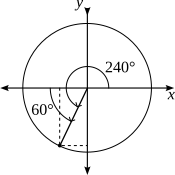
  1. \(\tan 235^{\circ}\).   (1 mark)

    --- 2 WORK AREA LINES (style=lined) ---
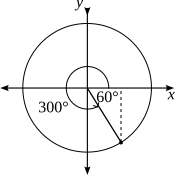
  2. \(\sin 310^{\circ}\).   (1 mark)

    --- 2 WORK AREA LINES (style=lined) ---
Show Answers Only

a.   \(\tan 55^{\circ}\)

b. \(-\sin 50^{\circ}\)

Show Worked Solution

a.   \(235^{\circ}\ \ \Rightarrow\ \ \text{3rd quadrant (sin/cos –ve)} \)

\(\text{Reference angle:}\ 180+\theta=235^{\circ}\ \ \Rightarrow \ \theta=55^{\circ}\)

\(\tan 235^{\circ} = \dfrac{-\sin 55^{\circ}}{-\cos 55^{\circ}} = \tan 55^{\circ}\)


b.   \(310^{\circ}\ \ \Rightarrow\ \ \text{4th quadrant (sin –ve)} \)

\(\text{Reference angle:}\ \ 360-310=50^{\circ}\)

\(\sin 310^{\circ} = -\sin 50^{\circ}\)

Filed Under: Unit Circle Tagged With: num-title-ct-pathd, smc-5601-40-Reference angle

Advanced Trigonometry, SMB-015

Express each of the following in terms of its reference angle \(\theta\), where  \(0 \leq \theta \leq 90\).

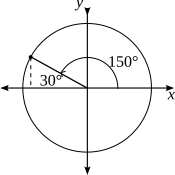
  1. \(\sin 165^{\circ}\).   (1 mark)

    --- 2 WORK AREA LINES (style=lined) ---
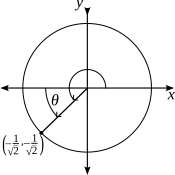
  2. \(\cos 250^{\circ}\).   (1 mark)

    --- 2 WORK AREA LINES (style=lined) ---
Show Answers Only

a.   \(\sin 15^{\circ}\)

b. \(-\cos 70^{\circ}\)

Show Worked Solution

a.   \(165^{\circ}\ \ \Rightarrow\ \ \text{2nd quadrant (sin +ve)} \)

\(\text{Reference angle:}\ \ 180-165=15^{\circ}\)

\(\sin 165^{\circ} = \sin 15^{\circ}\)


b.   \(250^{\circ}\ \ \Rightarrow\ \ \text{3rd quadrant (cos –ve)} \)

\(\text{Reference angle:}\ \ 180+\theta=250^{\circ}\ \ \Rightarrow \ \theta=70^{\circ}\)

\(\cos 250^{\circ} = -\cos 70^{\circ}\)

Filed Under: Unit Circle Tagged With: num-title-ct-pathd, smc-5601-40-Reference angle

Advanced Trigonometry, SMB-014

Determine the quadrant in which the following statement about \(\theta\) is true:

  1. \(\cos \theta\) is negative and \(\sin \theta\) is negative.   (1 mark)

    --- 2 WORK AREA LINES (style=lined) ---
  2. \(\tan \theta\) is negative and \(\cos \theta\) is positive.   (1 mark)

    --- 2 WORK AREA LINES (style=lined) ---
Show Answers Only

a.   \(\text{3rd quadrant}\)

b.   \(\text{4th quadrant}\)

Show Worked Solution

a.   \(\cos \theta \ \Rightarrow\ \text{–ve in 2nd/3rd quadrant}\)

\(\sin \theta \ \Rightarrow\ \text{–ve in 3rd/4th quadrant}\)

\(\Rightarrow\ \text{3rd quadrant}\)
  

b.   \(\tan \theta \ \Rightarrow\ \text{–ve in 2nd/4th quadrant}\)

\(\cos \theta \ \Rightarrow\ \text{+ve in 1st/4th quadrant}\)

\(\Rightarrow\ \text{4th quadrant}\)

Filed Under: Unit Circle Tagged With: num-title-ct-pathd, smc-5601-10-Find quadrant

Advanced Trigonometry, SMB-013

Determine the quadrant in which the following statement about \(\theta\) is true:

  1. \(\sin \theta\) is positive and \(\cos \theta\) is positive.   (1 mark)

    --- 2 WORK AREA LINES (style=lined) ---
  2. \(\tan \theta\) is negative and \(\cos \theta\) is negative.   (1 mark)

    --- 2 WORK AREA LINES (style=lined) ---
Show Answers Only

a.   \(\text{1st quadrant}\)

b.   \(\text{2nd quadrant}\)

Show Worked Solution

a.   \(\sin \theta \ \Rightarrow\ \text{+ve in 1st/2nd quadrant}\)

\(\cos \theta \ \Rightarrow\ \text{+ve in 1st/4th quadrant}\)

\(\Rightarrow\ \text{1st quadrant}\)
  

b.   \(\tan \theta \ \Rightarrow\ \text{–ve in 2nd/4th quadrant}\)

\(\cos \theta \ \Rightarrow\ \text{–ve in 2nd/3rd quadrant}\)

\(\Rightarrow\ \text{2nd quadrant}\)

Filed Under: Unit Circle Tagged With: num-title-ct-pathd, smc-5601-10-Find quadrant

Advanced Trigonometry, SMB-012

Determine the quadrant in which the following statement about \(\theta\) is true:

  1. \(\tan \theta\) is positive and \(\sin \theta\) is negative.   (1 mark)

    --- 2 WORK AREA LINES (style=lined) ---
  2. \(\sin \theta\) is negative and \(\cos \theta\) is positive.   (1 mark)

    --- 2 WORK AREA LINES (style=lined) ---
Show Answers Only

a.   \(\text{3rd quadrant}\)

b.   \(\text{4th quadrant}\)

Show Worked Solution

a.  \(\tan \theta \ \Rightarrow\ \text{+ve in 1st/3rd quadrant}\)

\(\sin \theta \ \Rightarrow\ \text{–ve in 3rd/4th quadrant}\)

\(\Rightarrow\ \theta\ \text{is in the 3rd quadrant}\)
  

b.   \(\sin \theta \ \Rightarrow\ \text{–ve in 3rd/4th quadrant}\)

\(\cos \theta \ \Rightarrow\ \text{+ve in 1st/4th quadrant}\)

\(\Rightarrow\ \theta\ \text{is in the 4th quadrant}\)

Filed Under: Unit Circle Tagged With: num-title-ct-pathd, smc-5601-10-Find quadrant

Advanced Trigonometry, SMB-011

  1. Determine the reference angle for \(240^{\circ}\).   (1 mark)

    --- 2 WORK AREA LINES (style=lined) ---
  2. Using part (a) or otherwise, give the exact value for \(\cos 240^{\circ}\)   (2 marks)

    --- 4 WORK AREA LINES (style=lined) ---

Show Answers Only

a.   \(60^{\circ}\)

b.   \(-\dfrac{1}{2}\)

Show Worked Solution

a.   \(240^{\circ}\ \text{is in the 3rd quadrant.}\)

\(\text{Reference angle:}\ \ 180+\theta=240^{\circ}\ \ \Rightarrow \ \ \theta = 60^{\circ}\)
  

b.   \(\cos 60^{\circ} = \dfrac{1}{2}\)

\(\Rightarrow \ \cos \theta<0\ \ \text{in 3rd quadrant}\)

\(\therefore \cos 240^{\circ} = -\dfrac{1}{2}\)

Filed Under: Exact Values, Equations and Trig Graphs Tagged With: num-title-ct-pathd, smc-5610-20-cos

Advanced Trigonometry, SMB-010

  1. Determine the reference angle for \(210^{\circ}\).   (1 mark)

    --- 2 WORK AREA LINES (style=lined) ---

  2. Using part (a) or otherwise, give the exact value for \(\tan 210^{\circ}\)   (2 marks)

    --- 4 WORK AREA LINES (style=lined) ---

Show Answers Only

a.   \(30^{\circ}\)

b.   \(\dfrac{1}{\sqrt{3}}\)

Show Worked Solution

a.   \(210^{\circ}\ \text{is in the 3rd quadrant.}\)

\(\text{Reference angle:}\ \ 180+\theta=210^{\circ}\ \ \Rightarrow \ \ \theta = 30^{\circ}\)
  

b.   \(\tan 30^{\circ} = \dfrac{1}{\sqrt{3}}\)

\(\Rightarrow \ \tan \theta>0\ \ \text{in 3rd quadrant}\)

\(\therefore \tan 210^{\circ} = \dfrac{1}{\sqrt{3}}\)

Filed Under: Exact Values, Equations and Trig Graphs Tagged With: num-title-ct-pathd, smc-5610-30-tan

Advanced Trigonometry, SMB-009

  1. Determine the reference angle for \(120^{\circ}\).   (1 mark)

    --- 2 WORK AREA LINES (style=lined) ---

  2. Using part (a) or otherwise, give the exact value for \(\tan 120^{\circ}\)   (2 marks)

    --- 4 WORK AREA LINES (style=lined) ---

Show Answers Only

a.   \(60^{\circ}\)

b.   \(-\sqrt{3}\)

Show Worked Solution

a.   \(120^{\circ}\ \text{is in the 2nd quadrant.}\)

\(\text{Reference angle:}\ \ 180-120=60^{\circ}\)
  

b.   \(\tan 60^{\circ} = \sqrt{3}\)

\(\Rightarrow \ \tan \theta<0\ \ \text{in 2nd quadrant}\)

\(\therefore \tan 120^{\circ} = -\sqrt{3}\)

Filed Under: Exact Values, Equations and Trig Graphs Tagged With: num-title-ct-pathd, smc-5610-30-tan

Advanced Trigonometry, SMB-008

  1. Determine the reference angle for \(315^{\circ}\).   (1 mark)

    --- 2 WORK AREA LINES (style=lined) ---

  2. Using part (a) or otherwise, give the exact value for  \(\sin 315^{\circ}\).   (2 marks)

    --- 4 WORK AREA LINES (style=lined) ---

Show Answers Only

a.   \(45^{\circ}\)

b.   \(-\dfrac{1}{\sqrt{2}}\)

Show Worked Solution

a.   \(315^{\circ}\ \text{is in the 4th quadrant.}\)

\(\text{Reference angle:}\ \ 360-315=45^{\circ}\)
  

b.   \(\sin 45^{\circ} = \dfrac{1}{\sqrt{2}}\)

\(\Rightarrow \ \sin \theta<0\ \ \text{in 4th quadrant}\)

\(\therefore \sin 315^{\circ} = -\dfrac{1}{\sqrt{2}}\)

Filed Under: Exact Values, Equations and Trig Graphs Tagged With: num-title-ct-pathd, smc-5610-10-sin

Advanced Trigonometry, SMB-008 MC

Consider the angle  \(\theta = 290^{\circ}\).

Which of the following correctly describes the quadrant containing this angle?

  1. The quadrant where \(\cos \theta\) is negative and \(\sin \theta\) is positive.
  2. The quadrant where \(\cos \theta\) is negative and \(\sin \theta\) is negative.
  3. The quadrant where \(\tan \theta\) is negative and \(\cos \theta\) is positive.
  4. The quadrant where \(\cos \theta\) is positive and \(\sin \theta\) is negative.
Show Answers Only

\(D\)

Show Worked Solution

\(\text{The angle 290° is in the 4th quadrant}\ (270^{\circ} \lt 290^{\circ} \lt 360^{\circ})\)

\(\text{Quadrant IV:}\ \sin(-), \cos (+), \tan(-) \)

\(\Rightarrow D\)

Filed Under: Unit Circle Tagged With: num-title-ct-pathd, smc-5601-10-Find quadrant

Advanced Trigonometry, SMB-007 MC

Consider the angle \(\theta = 135^{\circ}\).

Which of the following correctly describes the quadrant in which this angle lies?

  1. The quadrant where \(\cos \theta\) is negative and \(\sin \theta\) is positive.
  2. The quadrant where \(\cos \theta\) is positive and \(\sin \theta\) is negative.
  3. The quadrant where \(\tan \theta\) is positive and \(\sin \theta\) is negative.
  4. The quadrant where \(\cos \theta\) is negative and \(\sin \theta\) is negative.
Show Answers Only

\(A\)

Show Worked Solution

\(\text{The angle 135° is in the 2nd quadrant.}\)

\(\text{Quadrant II:}\  \sin (+), \cos(-), \tan(-) \)

\(\Rightarrow A\)

Filed Under: Unit Circle Tagged With: num-title-ct-pathd, smc-5601-10-Find quadrant

Advanced Trigonometry, SMB-006 MC

Consider the angle  \(\theta = 260^{\circ}\)

Determine which of the following descriptions correctly identify the quadrant containing this angle.

  1. The quadrant where \(\cos \theta\) is negative and \(\sin \theta\) is positive.
  2. The quadrant where \(\cos \theta\) is positive and \(\tan \theta\) is positive.
  3. The quadrant where \(\tan \theta\) is negative and \(\sin \theta\) is positive.
  4. The quadrant where \(\cos \theta\) is negative and \(\sin \theta\) is negative.
Show Answers Only

\(D\)

Show Worked Solution

\(260^{\circ}\ \text{lies in Quadrant III}\ \ (180^{\circ} \lt 260^{\circ} \lt 270^{\circ}) \)

\(\text{In quadrant III:}\ \ \tan (+), \sin (-), \cos (-)\)

\(\Rightarrow D\)

Filed Under: Unit Circle Tagged With: num-title-ct-pathd, smc-5601-10-Find quadrant

Advanced Trigonometry, SMB-007

A point \(X\) is located on the unit circle at angle 300\(^{\circ}\) from the positive \(x\)-axis.

  1. Determine the quadrant in which \(X\) lies.   (1 mark)

    --- 2 WORK AREA LINES (style=lined) ---

  2. Find the coordinates of point \(X\).   (2 marks)

    --- 6 WORK AREA LINES (style=lined) ---

Show Answers Only

a.   \(\text{Quadrant IV}\)

b.   \(X\left( \dfrac{1}{2}, -\dfrac{\sqrt{3}}{2}\right) \)

Show Worked Solution

a.   
         

\(300^{\circ}\ \text{lies in Quadrant IV}\ \ (270^{\circ} \lt 300^{\circ} \lt 360^{\circ}) \)
 

b.   \(\text{Reference angle}\ (\theta):\  360^{\circ}-\theta=300^{\circ}\ \ \Rightarrow \ \ \theta=60^{\circ}\)

\(x\text{-coordinate of}\ X = \cos\,60^{\circ} = \dfrac{1}{2}\)

\(y\text{-coordinate of}\ X = -\sin\,60^{\circ} = -\dfrac{\sqrt{3}}{2}\)

\(X\left( \dfrac{1}{2}, -\dfrac{\sqrt{3}}{2}\right) \)

Filed Under: Unit Circle Tagged With: num-title-ct-pathd, smc-5601-10-Find quadrant, smc-5601-20-Find coordinates

Advanced Trigonometry, SMB-006

A point \(V\) is located on the unit circle at angle 240\(^{\circ}\) from the positive \(x\)-axis.

  1. Determine the quadrant in which \(V\) lies.   (1 mark)

    --- 2 WORK AREA LINES (style=lined) ---

  2. Find the coordinates of point \(V\).   (2 marks)

    --- 6 WORK AREA LINES (style=lined) ---

Show Answers Only

a.   \(\text{Quadrant III}\)

b.   \(V\left(-\dfrac{1}{2}, -\dfrac{\sqrt{3}}{2}\right) \)

Show Worked Solution

a.   
         

\(240^{\circ}\ \text{lies in Quadrant III}\ \ (180^{\circ} \lt 240^{\circ} \lt 270^{\circ}) \)
 

b.   \(\text{Reference angle}\ (\theta):\  180^{\circ}+\theta=240^{\circ}\ \ \Rightarrow \ \ \theta=60^{\circ}\)

\(x\text{-coordinate of}\ V = -\cos\,60^{\circ} = -\dfrac{1}{2}\)

\(y\text{-coordinate of}\ V = -\sin\,60^{\circ} = -\dfrac{\sqrt{3}}{2}\)

\(V\left(-\dfrac{1}{2}, -\dfrac{\sqrt{3}}{2}\right) \)

Filed Under: Unit Circle Tagged With: num-title-ct-pathd, smc-5601-10-Find quadrant, smc-5601-20-Find coordinates

Advanced Trigonometry, SMB-005

Point \(T\) has the coordinates \(\left( \dfrac{1}{2}, -\dfrac{1}{2} \right) \).

Portabella claims that point \(T\) is on the unit circle.

Verify whether this statement is true, providing justification for your answer.   (2 marks)

--- 5 WORK AREA LINES (style=lined) ---

Show Answers Only

\(\text{By Pythagoras:}\)

\(\left( \dfrac{1}{2} \right)^2 + \left( -\dfrac{1}{2} \right)^2 =\dfrac{1}{4} + \dfrac{1}{4} = \dfrac{1}{2} \)

\(\text{Since the hypotenuse length = }\dfrac{1}{2} \neq 1\)

\(\Rightarrow T\left( \dfrac{1}{2}, -\dfrac{1}{2} \right)\ \text{does not lie on the unit circle.}\)

Show Worked Solution

\(\text{By Pythagoras:}\)

\(\left( \dfrac{1}{2} \right)^2 + \left( -\dfrac{1}{2} \right)^2 =\dfrac{1}{4} + \dfrac{1}{4} = \dfrac{1}{2} \)

\(\text{Since the hypotenuse length = }\dfrac{1}{2} \neq 1\)

\(\Rightarrow T\left( \dfrac{1}{2}, -\dfrac{1}{2} \right)\ \text{does not lie on the unit circle.}\)

Filed Under: Unit Circle Tagged With: num-title-ct-pathd, smc-5601-50-Coordinates on circle?

Advanced Trigonometry, SMB-004

Point \(R\) has the coordinates \(\left( \dfrac{\sqrt{2}}{\sqrt{3}}, \dfrac{1}{\sqrt{3}} \right) \).

Ralph believes that point \(R\) lies on the unit circle. Determine if Ralph is correct, giving reasons for your answer.   (2 marks)

--- 5 WORK AREA LINES (style=lined) ---

Show Answers Only

\(\text{By Pythagoras:}\)

\(\left( \dfrac{\sqrt{2}}{\sqrt{3}} \right)^2 + \left( \dfrac{1}{\sqrt{3}} \right)^2 =\dfrac{2}{3} + \dfrac{1}{3} = 1 \)

\(\text{Since the hypotenuse length = 1}\)

\(\Rightarrow R\left( \dfrac{\sqrt{2}}{\sqrt{3}}, \dfrac{1}{\sqrt{3}} \right)\ \text{lies on the unit circle.}\)

Show Worked Solution

\(\text{By Pythagoras:}\)

\(\left( \dfrac{\sqrt{2}}{\sqrt{3}} \right)^2 + \left( \dfrac{1}{\sqrt{3}} \right)^2 =\dfrac{2}{3} + \dfrac{1}{3} = 1 \)

\(\text{Since the hypotenuse length = 1}\)

\(\Rightarrow R\left( \dfrac{\sqrt{2}}{\sqrt{3}}, \dfrac{1}{\sqrt{3}} \right)\ \text{lies on the unit circle.}\)

Filed Under: Unit Circle Tagged With: num-title-ct-pathd, smc-5601-50-Coordinates on circle?

Advanced Trigonometry, SMB-001

A point \(Q\) is located on the unit circle at angle 150\(^{\circ}\) from the positive \(x\)-axis.

  1. Determine the quadrant in which \(Q\) lies.   (1 mark)

    --- 2 WORK AREA LINES (style=lined) ---

  2. Find the coordinates of point \(Q\).   (2 marks)

    --- 6 WORK AREA LINES (style=lined) ---

Show Answers Only

a.   \(\text{Quadrant II}\)

b.   \(Q\left( -\dfrac{\sqrt{3}}{2}, \dfrac{1}{2}\right) \)

Show Worked Solution

a.   \(150^{\circ}\ \text{lies in Quadrant II}\ \ \ (90^{\circ} \lt 150^{\circ} \lt 180^{\circ})\)
 

b.  
         

\(x\text{-coordinate}\ = -\cos\,30^{\circ} = -\dfrac{\sqrt{3}}{2}\)

\(y\text{-coordinate}\ = \sin\,30^{\circ} = \dfrac{1}{2}\)

\(Q\left( -\dfrac{\sqrt{3}}{2}, \dfrac{1}{2}\right) \)

Filed Under: Unit Circle Tagged With: num-title-ct-pathd, smc-5601-10-Find quadrant, smc-5601-20-Find coordinates

Advanced Trigonometry, SMB-005 MC

Determine which of the following angles on the unit circle has coordinates \(\left(-\dfrac{1}{\sqrt{2}}, -\dfrac{1}{\sqrt{2}}\right)\).

  1. \(135^{\circ}\)
  2. \(225^{\circ}\)
  3. \(315^{\circ}\)
  4. \(335^{\circ}\)
Show Answers Only

\(B\)

Show Worked Solution

\(\text{Coordinates are in the 3rd quadrant.}\)
 

\(\tan \theta= \dfrac{\frac{1}{\sqrt{2}}}{\frac{1}{\sqrt{2}}} = 1 \)

\(\text{Find reference angle:}\)

\(\theta =\tan^{-1}\left( 1 \right) = 45^{\circ}\)

\(\text{Angle on unit circle}\ = 180+45=225^{\circ}\)

\(\Rightarrow B\)

Filed Under: Unit Circle Tagged With: num-title-ct-pathd, smc-5601-30-Find angle

Advanced Trigonometry, SMB-002 MC

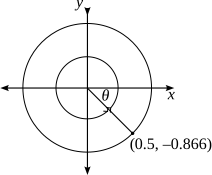
If point \(P\) lies on the unit circle at coordinates \((0.5, -0.866)\), which quadrant does \(P\) lie in and what is the approximate angle in standard position?

  1. Quadrant \(\text{III}\), 210\(^{\circ}\)
  2. Quadrant \(\text{IV}\), 300\(^{\circ}\)
  3. Quadrant \(\text{III}\), 240\(^{\circ}\)
  4. Quadrant \(\text{IV}\), 330\(^{\circ}\)
Show Answers Only

\(B\)

Show Worked Solution

\(P\ \text{is found in Quadrant IV}\)
 

\(\theta = 60^{\circ}\)

\(\text{Angle in standard position}\ =360-60 = 300^{\circ}\)

\(\Rightarrow B\)

Filed Under: Unit Circle Tagged With: num-title-ct-pathd, smc-5601-10-Find quadrant, smc-5601-30-Find angle

Advanced Trigonometry, SMB-001 MC

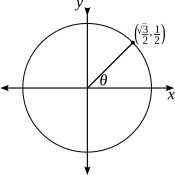
Which of the following angles on the unit circle has coordinates \(\left(\dfrac{\sqrt{3}}{2}, \dfrac{1}{2}\right)\)?

  1. \(30^{\circ}\)
  2. \(60^{\circ}\)
  3. \(120^{\circ}\)
  4. \(150^{\circ}\)
Show Answers Only

\(A\)

Show Worked Solution

\(\text{Coordinates are in the 1st quadrant.}\)
  

\(\tan \theta\) \(= \dfrac{\frac{1}{2}}{\frac{\sqrt{3}}{2}} = \dfrac{1}{2} \times \dfrac{2}{\sqrt{3}} = \dfrac{1}{\sqrt{3}} \)  
\(\theta\) \(=\tan^{-1}\left( \dfrac{1}{\sqrt{3}} \right) = 30^{\circ}\)  

 
\(\Rightarrow A\)

Filed Under: Unit Circle Tagged With: num-title-ct-pathd, smc-5601-30-Find angle

Advanced Trigonometry, SMB-003

Determine the angle on the unit circle that has coordinates

  1. \(\left(1, 0\right)\)   (1 mark)

    --- 3 WORK AREA LINES (style=lined) ---

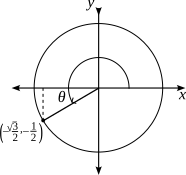
  2. \(\left(-\dfrac{\sqrt{3}}{2}, -\dfrac{1}{2}\right)\)   (2 marks)

    --- 6 WORK AREA LINES (style=lined) ---

Show Answers Only

a.  \(\theta = 90^{\circ}\)

b.  \(\theta=210^{\circ}\)

Show Worked Solution

a.   \((1, 0)\ \Rightarrow\ \text{Coordinates are on the positive \(y\)-axis.}\)

\(\theta = 90^{\circ}\)
 

b.   \(\text{Coordinates are in the 3rd quadrant.}\)
 

\(\tan \theta= \dfrac{\frac{1}{2}}{\frac{\sqrt{3}}{2}} = \dfrac{1}{2} \times \dfrac{2}{\sqrt{3}} =  \dfrac{1}{\sqrt{3}}\)

\(\text{Find reference angle:}\)

\(\theta =\tan^{-1}\left( \dfrac{1}{\sqrt{3}} \right) = 30^{\circ}\)

\(\text{Angle on unit circle}\ = 180+30=210^{\circ}\)

Filed Under: Unit Circle Tagged With: num-title-ct-pathd, smc-5601-30-Find angle

Advanced Trigonometry, SMB-002

Determine the angle on the unit circle that has coordinates

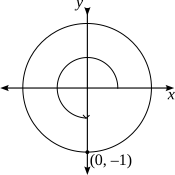
  1. \(\left(0, -1\right)\)   (1 mark)

    --- 3 WORK AREA LINES (style=lined) ---

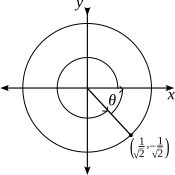
  2. \(\left(\dfrac{1}{\sqrt{2}}, -\dfrac{1}{\sqrt{2}}\right)\)   (2 marks)

    --- 6 WORK AREA LINES (style=lined) ---

Show Answers Only

a.  \(\theta = 270^{\circ}\)

b.  \(\theta=315^{\circ}\)

Show Worked Solution

a.   \(\text{Coordinates are on the negative \(y\)-axis.}\)
 

\(\theta = 270^{\circ}\)
 

b.   \(\text{Coordinates are in the 4th quadrant.}\)
 

\(\tan \theta= \dfrac{\frac{1}{\sqrt{2}}}{\frac{1}{\sqrt{2}}} = 1\)

\(\text{Find reference angle:}\)

\(\theta =\tan^{-1}\left( 1 \right) = 45^{\circ}\)

\(\text{Angle on unit circle}\ = 360-45=315^{\circ}\)

Filed Under: Unit Circle Tagged With: num-title-ct-pathd, smc-5601-30-Find angle

Advanced Trigonometry, SMB-004 MC

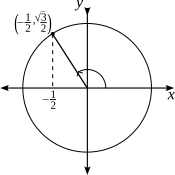
Determine which of the following angles on the unit circle has coordinates \(\left(-\dfrac{1}{2}, \dfrac{\sqrt{3}}{2}\right)\).

  1. \(120^{\circ}\)
  2. \(150^{\circ}\)
  3. \(210^{\circ}\)
  4. \(300^{\circ}\)
Show Answers Only

\(A\)

Show Worked Solution

\(\text{Coordinates are in the 2nd quadrant.}\)
 

\(\tan \theta= \dfrac{\frac{\sqrt{3}}{2}}{\frac{1}{2}} = \dfrac{\sqrt{3}}{2} \times \dfrac{2}{1} = \sqrt{3} \)

\(\text{Find reference angle:}\)

\(\theta =\tan^{-1}\left( \sqrt{3} \right) = 60^{\circ}\)

\(\text{Angle on unit circle}\ = 180-60=120^{\circ}\)

\(\Rightarrow A\)

Filed Under: Unit Circle Tagged With: num-title-ct-pathd, smc-5601-30-Find angle

Advanced Trigonometry, SMB-003 MC

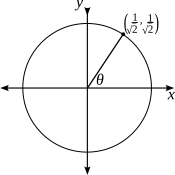
Determine which of the following angles on the unit circle has coordinates \(\left(\dfrac{1}{\sqrt{2}}, \dfrac{1}{\sqrt{2}}\right)\).

  1. \(30^{\circ}\)
  2. \(45^{\circ}\)
  3. \(120^{\circ}\)
  4. \(135^{\circ}\)
Show Answers Only

\(B\)

Show Worked Solution

\(\text{Coordinates are in the 1st quadrant.}\)
 

\(\tan \theta\) \(= \dfrac{\frac{1}{\sqrt{2}}}{\frac{1}{\sqrt{2}}} = 1 \)  
\(\theta\) \(=\tan^{-1}\left( 1 \right) = 45^{\circ}\)  

 
\(\Rightarrow B\)

Filed Under: Unit Circle Tagged With: num-title-ct-pathd, smc-5601-30-Find angle

  • « Previous Page
  • 1
  • 2

Copyright © 2014–2026 SmarterEd.com.au · Log in