SmarterEd

Aussie Maths & Science Teachers: Save your time with SmarterEd

  • Login
  • Get Help
  • About

Financial Maths, 2ADV M1 SM-Bank 15

Phil is a builder who has purchased a large set of tools.

The value of Phil’s tools is depreciated using the reducing balance method.

The value of the tools, in dollars, after `n` years, `V_n` , can be modelled by the recurrence relation shown below.
 

`V_0 = 60\ 000, qquad qquad  V_(n + 1) = 0.9 V_n`
 

  1. Use recursion to show that the value of the tools after two years.   (1 mark)

    --- 1 WORK AREA LINES (style=lined) ---

  2. Phil plans to replace these tools when their value first falls below $20 000.


    After how many years will Phil replace these tools?  (1 mark)

    --- 1 WORK AREA LINES (style=lined) ---

  3. Phil has another option for depreciation. He depreciates the value of the tools by a flat rate of 8% of the purchase price per annum.


    Let `V_n` be the value of the tools after `n` years, in dollars.


    Write down a recurrence relation, in terms of `V_0, V_(n + 1)` and `V_n`, that could be used to model the value of the tools using this flat rate depreciation.  (1 mark)

    --- 2 WORK AREA LINES (style=lined) ---
Show Answers Only
  1. `$48\ 600`
  2. `11\ text(years)`
  3. `V_(n + 1) = V_n – 0.08 V_0`
Show Worked Solution
a.   `V_0` `= 60\ 000`
  `V_1` `= 0.9 xx 60\ 000 = 54\ 000`
  `V_2` `= 0.9 xx 54\ 000 = $48\ 600`


b.  `text(Find)\ \ n\ \ text(such that:)`

COMMENT: Dividing by  `log_e 0.9`  is dividing by a negative number!

`60\ 000 xx 0.9^n` `< 20\ 000`  
`log_e 0.9^n` `<log_e (1/3)`  
`n` `> log_e (1/3) / log_e 0.9`  
  `> 10.427`  

 
`:.\ text(Phil will replace in the 11th year.)`


c.  `text(Annual depreciation) = 0.08 xx V_0`

`:. V_(n + 1) = V_n – 0.08V_0`

Filed Under: Geometric Series (Y12) Tagged With: Band 3, Band 4, smc-1006-60-Recursion

Financial Maths, 2ADV M1 SM-Bank 8

When placed in a pond, the length of a fish was 14.2 centimetres.

During its first month in the pond, the fish increased in length by 3.6 centimetres.

During its `n`th month in the pond, the fish increased in length by `G_n` centimetres, where  `G_(n+1) = 0.75G_n`

Calculate the maximum length this fish can grow to.  (3 marks)

--- 6 WORK AREA LINES (style=lined) ---

Show Answers Only

`28.6\ text(cm)`

Show Worked Solution

`text(Initial length) = 14.2\ text(cm)`

`G_1 = 3.6`

`G_2 = (0.75) G_1 = (0.75) 3.6`

`G_3 = (0.75) G_2 = (0.75^2) 3.6`

`text(Growth is a geometric sequence)`

`underbrace(3.6, \ 3.6(0.75), \ 3.6(0.75)^2, …)_{text(GP where)\ \ a=3.6,\ \ r=0.75}`

 
`text(S)text(ince)\ \ |\ r\ |< 1,`

`S_oo` `= a/(1-r)`
  `= (3.6)/(1-0.75)`
  `= 14.4`

 
`:.\ text(Maximum length of fish)`

`= 14.2 +14.4`

`=28.6\ text(cm)`

Filed Under: Geometric Series (Y12) Tagged With: Band 4, smc-1006-60-Recursion

Financial Maths, 2ADV M1 SM-Bank 6

Julie deposits some money into a savings account that will pay compound interest every month.

The balance of Julie’s account, in dollars, after `n` months, `V_n` , can be modelled by the recurrence relation shown below.
 

`V_0 = 12\ 000, qquad V_(n + 1) = 1.0062\ V_n`
 

  1.  Recursion can be used to calculate the balance of the account after one month.


    1. Write down a calculation to show that the balance in the account after one month, `V_1`, is  $12 074.40. (1 mark)

      --- 2 WORK AREA LINES (style=lined) ---

    2. After how many months will the balance of Julie’s account first exceed $12 300  (1 mark)

      --- 2 WORK AREA LINES (style=lined) ---

  2.  A rule of the form  `V_n = a xx b^n`  can be used to determine the balance of Julie's account after `n` months.

    1. Complete this rule for Julie’s investment after `n` months by writing the appropriate numbers in the boxes provided below. (1 mark)
       
balance = 
 
 × 
 
 n


    1. What would be the value of `n` if Julie wanted to determine the value of her investment after three years?  (1 mark)

      --- 1 WORK AREA LINES (style=lined) ---

Show Answers Only

a.i.   `text(Proof)\ \ text{(See Worked Solutions)}`

a.ii.  `4\ text(months)`

b.i  `text(balance) = 12\ 000 xx 1.0062^n`

b.ii.  `36`

Show Worked Solution
a.i.   `V_1` `= 1.0062 xx V_0`
    `= 1.0062 xx 12000`
    `= $12\ 074.40\ text(… as required.)`


a.ii.   `V_2` `= 1.0062 xx 12\ 074.40 = 12\ 149.26`
  `V_3` `= 1.0062 xx 12\ 149.26 = 12\ 224.59`
  `V_4` `= 1.0062 xx 12\ 224.59 = 12\ 300.38`

 
`:.\ text(After 4 months)`

 
b.i.
  `text(balance) = 12\ 000 xx 1.0062^n`

 
b.ii.
  `n = 12 xx 3 = 36`

Filed Under: Geometric Series (Y12) Tagged With: Band 3, Band 4, smc-1006-60-Recursion

Financial Maths, 2ADV M1 SM-Bank 5 MC

Shirley would like to purchase a new home. She will establish a loan for $225 000 with interest charged at the rate of 3.6% per annum, compounding monthly.

Each month, Shirley will pay only the interest charged for that month.

Let `V_n` be the value of Shirley’s loan, in dollars, after `n` months.

A recurrence relation that models the value of `V_n` is

  1. `V_0 = 225\ 000,qquadV_(n + 1) = 1.003 V_n`
  2. `V_0 = 225\ 000,qquadV_(n + 1) = 1.036 V_n`
  3. `V_0 = 225\ 000,qquadV_(n + 1) = 1.003 V_n - 8100`
  4. `V_0 = 225\ 000,qquadV_(n + 1) = 1.003 V_n - 675`
Show Answers Only

`D`

Show Worked Solution

`text(Monthly interest rate)`

`= text(3.6%)/12 = 0.3text(%) = 0.003`
 

`text(Monthly payment)`

`= 225\ 000 xx 0.3text(%)`

`= $675`
 

`:.\ text(Recurrence Relation is)`

`V_(n + 1) = 1.003V_n – 675`
 

`=> D`

Filed Under: Geometric Series (Y12) Tagged With: Band 4, smc-1006-60-Recursion

Financial Maths, 2ADV M1 SM-Bank 4 MC

Each trading day, a share trader buys and sells shares according to the rule
 

 `T_(n+1)=0.6 T_n + 50\ 000`
 

where `T_n` is the number of shares the trader owns at the start of the `n`th trading day.

From this rule, it can be concluded that each day

A.    the trader sells 60% of the shares that she owned at the start of the day and then buys another 50 000 shares.

B.    the trader sells 40% of the shares that she owned at the start of the day and then buys another 50 000 shares.

C.    the trader sells 50 000 of the shares that she owned at the start of the day.

D.    the trader sells 60% of the 50 000 shares that she owned at the start of the day.

Show Answers Only

`B`

Show Worked Solution

`T_(n+1)=0.6\ \T_n + 50 000`

`text(The difference equation describes a rule)`

`text(where a trader sells 40% of shares owned on)`

`text{the day before (left with 60% or 0.6}\ T_n text{)} `

`text(and then buys another 50 000 each day.)`

`=> B`

Filed Under: Geometric Series (Y12) Tagged With: Band 4, smc-1006-60-Recursion

Financial Maths, 2ADV M1 SM-Bank 3 MC

The first four terms of a sequence are

`12, 18, 30, 54`

A recursive equation that generates this sequence is

A. `t_(n+1)` `= t_n + 6` `t_1` `=12`
B. `t_(n+1)` `= 1.5t_n` `t_1` `= 12`
C. `t_(n+1)` `= 0.5t_n + 12` `t_1` `= 12`
D. `t_(n+1)` `= 2t_n - 6` `t_1` `= 12`
Show Answers Only

`D`

Show Worked Solution

`text(Calculating)` `t_3` `text(in each given option)`

`text(eliminates)\ A, B\ text(and)\ C.`

`rArr D`

Filed Under: Geometric Series (Y12) Tagged With: Band 4, smc-1006-60-Recursion

Financial Maths, 2ADV M1 SM-Bank 2 MC

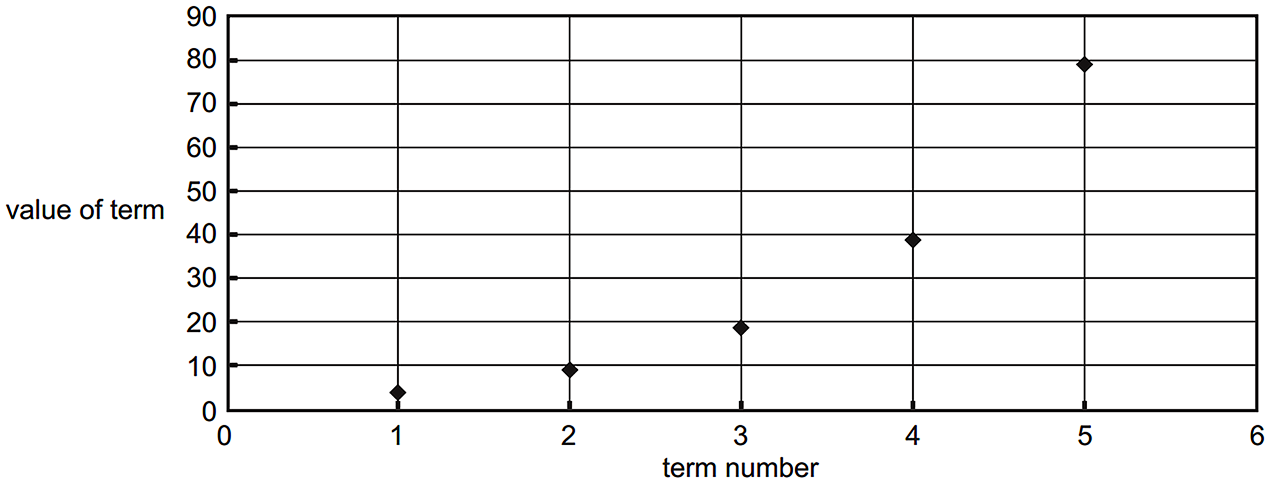
The values of the first five terms of a sequence are plotted on the graph shown below.


The recursion equation that could describe the sequence is

A.   `t_(n+1) = t_n + 5,` `\ \ \ \ \ t_1 = 4`
B.   `t_(n+1) = 2t_n + 1,` `\ \ \ \ \ t_1 = 4`
C.   `t_(n+1) = t_n - 3,` `\ \ \ \ \ t_1 = 4`
D.   `t_(n+1) = 3t_n,` `\ \ \ \ \ t_1 = 4`
Show Answers Only

`B`

Show Worked Solution

`text(By elimination,)`

`text(There is no common difference between terms,)`

`:.\ text(Cannot be A, or C)`

`text(The equation in B has)\ \ t_2=9,\ \ text(while the equation)`

`text(in C has)\ \ t_2=12.`

`rArr B`

Filed Under: Geometric Series (Y12) Tagged With: Band 4, smc-1006-60-Recursion

Copyright © 2014–2025 SmarterEd.com.au · Log in