SmarterEd

Aussie Maths & Science Teachers: Save your time with SmarterEd

  • Login
  • Get Help
  • About

Trigonometry, EXT1 T3 EQ-Bank 2

The tides in Ulladulla Harbour can be modelled to the equation

\(h=2 \sqrt{3} \cos (2 t)+2 \sin (2 t)\)

where \(h\) is the height of the tide in metres and \(t\) is the time in hours after midnight.

Large fishing vessels can only enter or leave the harbour when the tide is at least 2 meters high.

Determine the first time after midnight that large shipping vessels can no longer enter or exit the harbour and when access is again possible, giving your answers to the nearest minute?   (4 marks)

--- 12 WORK AREA LINES (style=lined) ---
Show Answers Only

\(\text{Vessels can not enter/exit the harbour between 00:47 and 02:53.}\)

Show Worked Solution

\(A \sin (x+2 t)=2 \sqrt{3} \cos (2 t)+2 \sin (2 t) \)

\(A \sin x \cos (2 t)+A \cos x \sin (2 t)=2 \sqrt{3} \cos (2 t)+2 \sin (2 t)\)

\(\text{Equating coefficients:}\)

\(A \sin x=2 \sqrt{3}\)

\(A \cos x=2 \)

\(A^2=(2 \sqrt{3})^2+2^2=16 \ \Rightarrow \ \ A=4 \)
 

\(\dfrac{A \sin x}{A \cos x}=\dfrac{2 \sqrt{3}}{2} \ \Rightarrow \ \tan x=\sqrt{3} \ \Rightarrow \ x=\dfrac{\pi}{3} \)

\(\Rightarrow \ h=4 \sin \left(\dfrac{\pi}{3}+2 t\right)\)
 

\(\text{Find \(t\) when  \(h=2\):}\)

\(2=4 \sin \left(\dfrac{\pi}{3}+2 t\right)\)

\(\dfrac{\pi}{3}+2 t=\sin ^{-1}\left(\dfrac{1}{2}\right)=\dfrac{\pi}{6}, \dfrac{5 \pi}{6}, \dfrac{13 \pi}{6}, \cdots\)

\begin{array}{l|l}
2 t_1=\dfrac{5 \pi}{6}-\dfrac{\pi}{3}=\dfrac{\pi}{2} \quad & \quad2 t_2=\dfrac{13 \pi}{6}-\dfrac{\pi}{3}=\dfrac{11 \pi}{6}\\
t_1=\dfrac{\pi}{4} & \quad t_2=\dfrac{11 \pi}{12}\\
\ =0.7853 \ldots \text{hours} & \quad\ \ \ =2.879 \ldots \text {hours}\\
\ \ = \ \text{47 mins (after 12)} & \quad \quad=\ \text{2 hr 53 mins}\\
\end{array}

\(\therefore\ \text{Vessels can not enter/exit the harbour between 00:47 and 02:53.}\)

Filed Under: Auxiliary Angles (Ext1) Tagged With: Band 5, smc-1075-10-Rsin, smc-1075-40-Real world context

Trigonometry, EXT1 T3 EQ-Bank 5

A particular energy wave can be modelled by the function

`f(t) = sqrt5 sin 0.2t + 2 cos 0.2t, \ \ t ∈ [0, 50]`

  1. Express this function in the form  `f(t) = Rsin(nt-alpha), \ \ alpha ∈ [0, 2pi]`.  (2 marks)

    --- 6 WORK AREA LINES (style=lined) ---

  2. Find the time the wave first attains its maximum value. Give your answer to one decimal place.  (2 marks)

    --- 6 WORK AREA LINES (style=lined) ---

Show Answers Only
  1. `f(t) = 3sin(0.2t-5.553)`
  2. `t = 4.2`
Show Worked Solution

i.   `f(t) = sqrt5 sin 0.2t + 2cos 0.2t`

`Rsin(nt-alpha)` `= Rsin(0.2t-alpha)`
  `= Rsin 0.2t cosalpha-Rcos 0.2t sinalpha`


`=> Rcosalpha = sqrt5,\ \ R sinalpha = −2`

`R^2` `= (sqrt5)^2 + (-2)^2 = 9`
`R` `= 3`

 
`cosalpha = sqrt5/3, sinalpha = −2/3`

`=> alpha\ text(is in 4th quadrant)`
 

`text(Base angle) = cos^(−1)(sqrt5/3) = 0.7297`

`:.alpha` `= 2pi-0.7297`
  `= 5.553…`

 
`:. f(t) = 3sin(0.2t-5.553)`


ii.   `text(Max value occurs when)\ sin(0.2t-5.553) = 1`

`0.2t-5.553` `= pi/2`
`0.2t` `= 7.124…`
`t` `= 35.62…`

 
`text(Test if)\ \ t > 0\ \ text(for:)`

`0.2t-5.553` `= -(3pi)/2`
`0.2t` `= 0.8406`
`t` `= 4.20…`

 
`:. text(Time of 1st maximum:)\ \ t = 4.2`

Filed Under: Auxiliary Angles (Ext1) Tagged With: Band 4, Band 5, smc-1075-10-Rsin, smc-1075-40-Real world context

Trigonometry, EXT1 T3 EQ-Bank 4

The current flowing through an electrical circuit can be modelled by the function

`qquad f(t) = 6sin 0.05t + 8cos 0.05t, \ \ t >= 0`

  1.  Express the function in the form  `f(t) = Asin(at + b),\ \ text(for)\ \ 0<=b<=pi/2`.  (2 marks)

    --- 6 WORK AREA LINES (style=lined) ---

  2.  Find the time at which the current first obtains it maximum value.   (1 mark)

    --- 4 WORK AREA LINES (style=lined) ---

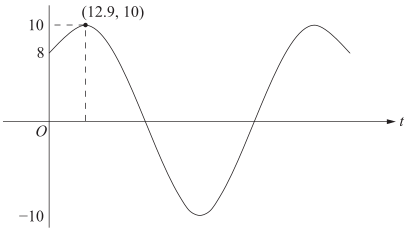
  3.  Sketch the graph of  `f(t)`. Clearly show its range and label the coordinates of its first maximum value. Do not label `x`-intercepts.   (1 mark)

    --- 10 WORK AREA LINES (style=lined) ---

Show Answers Only
  1. `f(t) = 10sin(0.05t + 0.927)`
  2.   `12.9\ \ (text(to 1 d.p.))`
  3.  
Show Worked Solution

i.   `f(t) = 6sin 0.05t + 8cos 0.05t`

`Asin(at + b)` `=Asin(0.05t + b)`  
  `= Asin(0.05t)\ cos(b) + Acos(0.05t)\ sin(b)`  

 
`=> Acos(b) = 6, \ Asin(b) = 8`

`A^2` `= 6^2 + 8^2`
`A` `= 10`


`=> 10cos(b)` `= 6`
`cos(b)` `= 6/10`
`b` `= cos^(−1) 0.06 ~~ 0.927\ text(radians)`

 
`:. f(t) = 10sin(0.05t + 0.927)`


ii.   `text(Max occurs at)\ \ sin(0.05t + 0.927)= sin\ pi/2`

`0.05t + 0.927` `= pi/2`
`0.05t` `= 0.643…`
`:.t` `= 12.87`
  `= 12.9\ \ (text(to 1 d.p.))`


iii.   

Filed Under: Auxiliary Angles (Ext1) Tagged With: Band 4, smc-1075-10-Rsin, smc-1075-40-Real world context

Copyright © 2014–2025 SmarterEd.com.au · Log in