A particle is projected from the origin, with initial speed \(V\) at an angle of \(\theta\) to the horizontal. The position vector of the particle, \(\underset{\sim}{r}(t)\), where \(t\) is the time after projection and \(g\) is the acceleration due to gravity, is given by \(\underset{\sim}{r}(t)=\left(\begin{array}{c}Vt\cos\theta \\Vt\sin \theta -\dfrac{gt^2}{2}\end{array}\right)\). (Do NOT prove this.) Let \(D(t)\) be the distance of the particle from the origin at time \(t\), so \(D(t)=|\underset{\sim}{r}(t)|\). Show that for \(\theta<\sin ^{-1}\left(\sqrt{\dfrac{8}{9}}\right)\) the distance, \(D(t)\), is increasing for all \(t>0\). (4 marks) --- 14 WORK AREA LINES (style=lined) ---
Vectors, EXT1 V1 SM-Bank 30
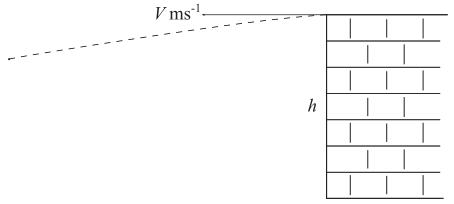
A canon ball is fired from a castle wall across a horizontal plane at `V` ms−1.
Its position vector `t` seconds after it is fired from its origin is given by `underset~s(t) = V tunderset~i - 1/2g t^2 underset~j`.
- If the projectile hits the ground at a distance 8 times the height at which it was fired, show that it initial velocity is given by
`V = 4sqrt(2hg)` (2 marks)
--- 5 WORK AREA LINES (style=lined) ---
- Show that the total distance the canon ball travels can be expressed as
`int_0^sqrt((2h)/g) sqrt(g(32h + g t^2))\ dt` (2 marks)
--- 5 WORK AREA LINES (style=lined) ---