SmarterEd

Aussie Maths & Science Teachers: Save your time with SmarterEd

  • Login
  • Get Help
  • About

Networks, STD1 N1 2025 HSC 14

The time, in minutes, it takes to travel by road between six towns is recorded and shown in the network diagram below.
 

  1. In this network the shortest path corresponds to the minimum travel time.
  2. What is the minimum travel time between towns \(A\) and \(F\), and what is the corresponding path?   (2 marks)

    --- 3 WORK AREA LINES (style=lined) ---

New roads are built to connect a town \(G\) to towns \(A\) and \(D\). The table gives the times it takes to travel by the new roads.

\begin{array} {|c|c|c|}
\hline
\rule{0pt}{2.5ex} \textit{Town} \rule[-1ex]{0pt}{0pt} & \textit{Time} \text{(minutes)}  \rule[-1ex]{0pt}{0pt} & \textit{Town} \\
\hline
\rule{0pt}{2.5ex} A \rule[-1ex]{0pt}{0pt} & 8 \rule[-1ex]{0pt}{0pt} & G \\
\hline
\rule{0pt}{2.5ex} G \rule[-1ex]{0pt}{0pt} & 22 \rule[-1ex]{0pt}{0pt} & D \\
\hline
\end{array}

  1. Add the new roads and times to the network diagram below.   (2 marks)
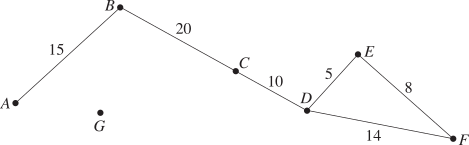


    --- 0 WORK AREA LINES (style=lined) ---

  2. Explain whether the path in part (a) is still the shortest path from \(A\) to \(F\) after the new roads are added.   (1 mark)

    --- 3 WORK AREA LINES (style=lined) ---

Show Answers Only

a.    \(\text{Minimum travel time}\ = 15+20+10+5+8=58\ \text{minutes}\)

\(\text{Path: }A → B → C → D → E → F\)
 

b.    \(\text{New roads}\ A  → G\ \text{and }G → D \)
 

c.    \(\text{Using the new roads }A → G\ \text{and }G → D:\)

\(\text{Minimum travel time}\ =8+22+5+8=43\ \text{minutes.}\)

\(\text{Therefore the original path is no longer the shortest path.}\)
Show Worked Solution

a.    \(\text{Minimum travel time}\ = 15+20+10+5+8=58\ \text{minutes}\)

\(\text{Path: }A → B → C → D → E → F\)
 

b.    \(\text{New roads}\ A  → G\ \text{and }G → D \)
 

c.    \(\text{Using the new roads }A → G\ \text{and }G → D:\)

\(\text{Minimum travel time}\ =8+22+5+8=43\ \text{minutes.}\)

\(\text{Therefore the original path is no longer the shortest path.}\)
Filed Under: Shortest Paths Tagged With: Band 3, Band 4, smc-1137-10-Network Diagram, smc-1137-20-Table

Networks, STD2 N2 SM-Bank 28

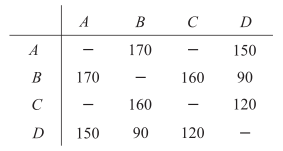
In central Queensland, there are four petrol stations `A`, `B`, `C` and `D`. The table shows the length, in kilometres, of roads connecting these petrol stations.


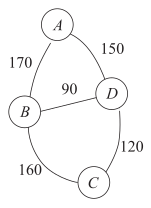
  1. Construct a network diagram to represent the information in the table.  (2 marks)

    --- 5 WORK AREA LINES (style=lined) ---

  2. A petrol tanker needs to refill each station. It starts at Station `A` and visits each station.


    Calculate the shortest distance that can be travelled by the petrol tanker. In your answer, include the order the petrol stations are refilled.  (2 marks)

    --- 4 WORK AREA LINES (style=lined) ---

Show Answers Only
  1.  
  2. `380\ text(km)`
Show Worked Solution
a.   


b.   `text(Shortest Path from)\ A\ (text(visiting all stations))`

`A – B – D – C`

`text(Distance)` `= 170 + 90 + 120`
  `= 380\ text(km)`

Filed Under: Basic Concepts, Basic Concepts, Shortest Paths, Shortest Paths, Shortest Paths (Std2-2027) Tagged With: Band 3, Band 4, smc-1136-10-Table to Network, smc-1137-20-Table, smc-6307-10-Table to Network, smc-6308-20-Tables, smc-912-10-Table to Network, smc-913-20-Table

Networks, STD2 N2 SM-Bank 25 MC

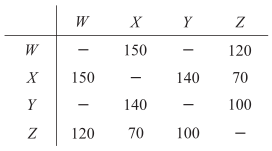
In a town, there are four cafes `W`, `X`, `Y` and `Z`. The table shows the distances, in metres, of paved footpath connecting the cafes.

A coffee supplier needs to visit each cafe.

What is the shortest distance she needs to walk along the paved footpath if she starts at cafe `W`?

  1. 260 m
  2. 320 m
  3. 330 m
  4. 360 m
Show Answers Only

`text(B)`

Show Worked Solution

`text(Possible paths:)`

`W – Z – X – Y = 120 + 70 + 140 = 330\ text(m)`

`W – Z – Y – X = 120 + 100 + 140 = 360\ text(m)`

`W – X – Z – Y = 150 + 70 + 100 = 320\ text(m)`

`W – X – Y – Z = 150 + 140 + 100 = 390\ text(m)`

`=>\ text(B)`

Filed Under: Shortest Paths, Shortest Paths, Shortest Paths (Std2-2027) Tagged With: Band 4, smc-1137-20-Table, smc-6308-20-Tables, smc-913-20-Table

Networks, STD2 N2 SM-Bank 12

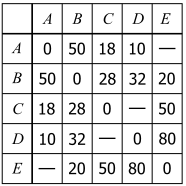
The following table shows the travelling time, in minutes, between towns which are directly connected by roads.

A dash indicates that towns are not directly connected.


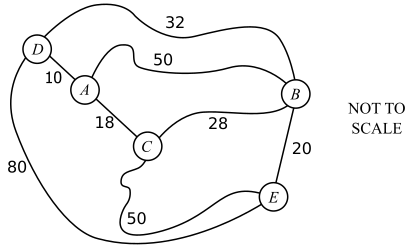
  1. Draw a network diagram showing the information in this table.  (2 marks) 

    --- 6 WORK AREA LINES (style=lined) ---

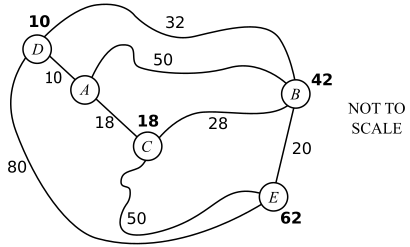
  2. What is the shortest travelling time between A and E?  (1 mark)

    --- 1 WORK AREA LINES (style=lined) ---

Show Answers Only
  1.  
         
     
  2. `62\ text(minutes)`
Show Worked Solution
i.  

`text(Important to note that network diagrams)`

`text(do not need to be drawn to scale.)`


ii.   `text(One strategy – using Dijkstra’s algorithm:)`


`:.\ text(Shortest travelling time is the path)\ \ A – D – B – E`

`= 10 + 32 + 20`

`= 62\ text(minutes)`

Filed Under: Shortest Paths, Shortest Paths, Shortest Paths (Std2-2027) Tagged With: Band 4, smc-1137-20-Table, smc-6308-20-Tables, smc-913-20-Table

Copyright © 2014–2025 SmarterEd.com.au · Log in