SmarterEd

Aussie Maths & Science Teachers: Save your time with SmarterEd

  • Login
  • Get Help
  • About

Calculus, SPEC2 2017 VCAA 3

A brooch is designed using inverse circular functions to make the shape shown in the diagram below.


The edges of the brooch in the first quadrant are described by the piecewise function

`f(x){(3text(arcsin)(x/2)text(,), 0 <= x <= sqrt2),(3text(arccos)(x/2)text(,), sqrt2 < x <= 2):}`

  1. Write down the coordinates of the corner point of the brooch in the first quadrant.  (1 mark)

    --- 2 WORK AREA LINES (style=lined) ---

  2. Specify the piecewise function that describes the edges in the third quadrant.  (1 mark)

    --- 2 WORK AREA LINES (style=lined) ---

  3. Given that each unit in the diagram represents one centimetre, find the area of the brooch.
  4. Give your answer in square centimetres, correct to one decimal place.  (3 marks)

    --- 2 WORK AREA LINES (style=lined) ---

  5. Find the acute angle between the edges of the brooch at the origin. Give your answer in degrees, correct to one decimal place.  (3 marks)

    --- 6 WORK AREA LINES (style=lined) ---

  6. The perimeter of the brooch has a border of gold.
    Show that the length of the gold border needed is given by a definite integral of the form  `int_0^2 (sqrt(a + b/(4-x^2)))dx`, where  `a, b ∈ R`. Find the values of `a` and `b`.  (2 marks)

    --- 5 WORK AREA LINES (style=lined) ---

Show Answers Only

  1. `(sqrt2,(3pi)/4)`
  2. `text(See Worked Solutions)`
  3. `9.9\ text(cm²)`
  4. `67.4°`
  5. `a = 16, b = 144`

Show Worked Solution

a.   `text(Corner point occurs when)\ \ x=sqrt2.`

`y=3 sin^(-1) (sqrt2/2) = (3pi)/4`

`:.\ text(Coordinates are:)\ \ (sqrt2, (3pi)/4)`
 

b.    `text(Reflect in the)\ xtext(-axis and then the)\ ytext(-axis:)`

♦ Mean mark 49%.

`g(x){(-3text(arccos)(- x/2)text(,), -2 <= x < -sqrt2),(-3text(arcsin)(- x/2)text(,), -sqrt2 <= x <= 0):}`


c.    `A` `= 4 xx (int_0^sqrt2 3sin^(−1)(x/2)dx + int_sqrt2^2 3cos^(−1)(x/2)dx)`
    `~~ 9.9\ text(cm²)`
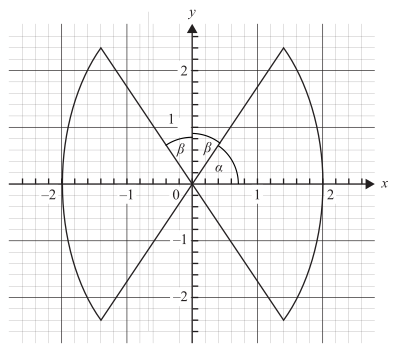
 

d.   `text(Find the gradient of graph at)\ \ x=0:`

`f′(0) = 3/2`

`alpha = tan^(−1)(3/2) = 56.31…°`

`beta = pi/2-tan^(−1)(1.5) = 33.69°`


`:.\ text(Acute angle between the edges)`

`=2 xx 33.69`

`=67.4°`
  

e.  `f′(x)\ {(3/sqrt(4-x^2)text(,), 0<= x <= sqrt2),((-3)/sqrt(4-x^2)text(,), sqrt2 < x <= 2):}`
 

`:.\ text(Length of border)`

♦♦ Mean mark 27%.

`= 4 int_0^sqrt2 sqrt(1 + (3/sqrt(4-x^2))^2)\ dx + 4 int_sqrt2^2 sqrt(1 + ((-3)/sqrt(4-x^2))^2)\ dx`

`= 4 int_0^2 sqrt(1 + (3/sqrt(4-x^2))^2)\ dx`

`= int_0^2 sqrt(16 + 144/(4-x^2)\ dx`

  
`:. a=16, \ b=144`

Filed Under: Arc Lengths, Areas and Other, Inverse Trig Functions (SM) Tagged With: Band 4, Band 5, smc-1153-40-Combinations, smc-1181-10-Arc length, smc-1181-20-Area Under Curves

Algebra, SPEC1-NHT 2018 VCAA 3

Find  `sin(t)`  given that  `t = arccos (12/13) + arctan (3/4)`.  (3 marks)

Show Answers Only

`56/65`

Show Worked Solution
`sin (t)` `= sin (cos^(-1) (12/13) + tan^(-1)(3/4))`
  `= sin (cos^(-1) (12/13)) cos (tan^(-1) (3/4)) + sin (tan^(-1)(3/4)) cos (cos^(-1)(12/13))`


`cos^(-1) (12/13) in (0, pi/2), quad tan^(-1)(3/4) in (0, pi/2)`

`:. sin (t)` `= 5/13 xx 4/5 + 3/5 xx 12/13`
  `= 20/65 + 36/65`
  `= 56/65`

Filed Under: Inverse Trig Functions (SM) Tagged With: Band 4, smc-1153-40-Combinations

Copyright © 2014–2025 SmarterEd.com.au · Log in