SmarterEd

Aussie Maths & Science Teachers: Save your time with SmarterEd

  • Login
  • Get Help
  • About

Calculus, SPEC2 2024 VCAA 11 MC

The velocity-time graph of a particle moving along an east-west line with velocity \(v\) m s\(^{-1}\) at time \(t\) seconds, starting from a fixed origin \(O\), is shown below. The graph comprises two straight line segments.
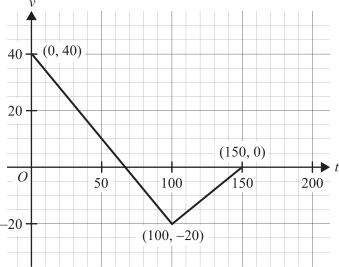
 

The initial velocity of the particle is 40 m s\(^{-1}\) to the east.

How far, in metres, is the particle to the east of \(O\), 150 seconds later?

  1. \(450\)
  2. \(500\)
  3. \(1000\)
  4. \(\dfrac{6500}{3}\)
Show Answers Only

\(B\)

Show Worked Solution

\(\text{Distance travelled East = area under graph and above the}\ x\text{-axis.}\)

\(\text{Gradient of line = }-0.6 \ \ \Rightarrow\ \ \text{Cuts axis at}\ \ x=66 \dfrac{2}{3}\)

\(\text{Distance (east)}\ = \dfrac{1}{2} \times 66 \dfrac{2}{3} \times 40 = \dfrac{4000}{3}\ \text{m} \)

\(\text{Distance travelled West = area above graph and below the}\ x\text{-axis.}\)

\(\text{Distance (west)}\ = \dfrac{1}{2} \times 83 \dfrac{1}{3} \times 20 = \dfrac{2500}{3}\ \text{m} \)

\(\text{Net distance east (at 150 sec)}\ = \dfrac{4000}{3}-\dfrac{2500}{3}=500\ \text{m}\)

\(\Rightarrow B\)

Mean mark 58%.

Filed Under: Motion (SM) Tagged With: Band 4, smc-1159-40-Graphs

Calculus, SPEC2 2011 VCAA 19 MC

The motion of a lift (elevator) in a shopping centre is given by the velocity-time graph below, where time  `t`  is in seconds, and the velocity of the lift is `v` metres per second. For  `v > 0`  the lift is moving upwards.
 

SPEC2 2011 VCAA 19 MC
 

The graph shows that at the end of 30 seconds, the position of the lift is

A.   17.5 metres above its starting level.

B.   5 metres above its starting level.

C.   at the same position as its starting level.

D.   5 metres below its starting level.

E.   17.5 metres below its starting level.

Show Answers Only

`A`

Show Worked Solution
`text(Distance)` `= text(Area of trap) – text(Area of triangle)`
  `= 1/2(5 + 15)3 – 1/2 xx 10 xx 2.5`
  `= 17.5\ text(m)`

 
`text{Net area is above the}\ xtext{-axis (lift is higher).}`

`=> A`

Filed Under: Motion (SM) Tagged With: Band 4, smc-1159-40-Graphs

Calculus, SPEC2 2012 VCAA 18 MC

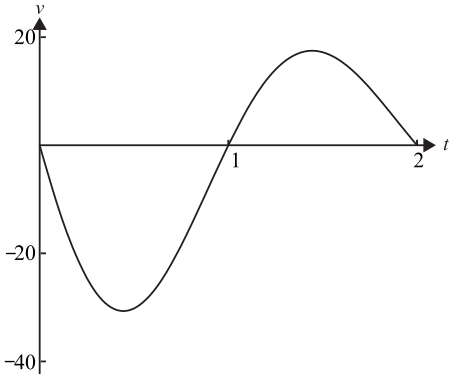
The velocity–time graph for the first 2 seconds of the motion of a particle that is moving in a straight line with respect to a fixed point is shown below.


The particle’s velocity `v` is measured in cm/s. Initially the particle is  `x_0` cm from the fixed point.

The distance travelled by the particle in the first 2 seconds of its motion is given by

A.   `int_0^2 v\ dt`

B.   `int_0^2 v\ dt + x_0`

C.   `int_1^2 v\ dt - int_0^1 v\ dt`

D.   `|\ int_0^2 v\ dt\ |`

E.   `int_1^2 v\ dt - int_0^1 v\ dt + x_0`

Show Answers Only

`C`

Show Worked Solution

`text(Distance = Total area between curve and the axis)`

COMMENT: Starting point `x_0` has no effect on total distance travelled.

`d= int_1^2 v\ dt – int_0^1 v\ dt`

 
`=> C`

Filed Under: Motion (SM) Tagged With: Band 4, smc-1159-40-Graphs

Calculus, SPEC2 2014 VCAA 22 MC

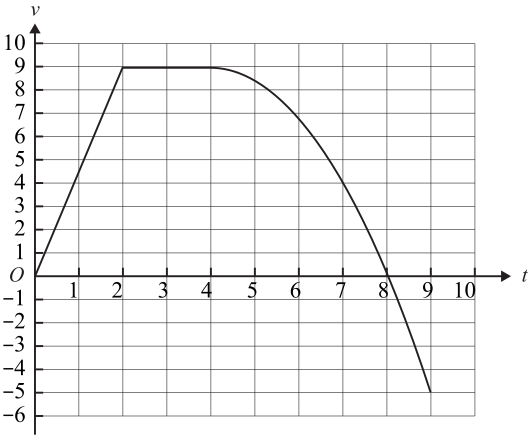
The velocity–time graph below shows the motion of a body travelling in a straight line, where `v\ text(ms)^(−1)` is its velocity after `t` seconds.

The velocity of the body over the time interval  `t in [4,9]`  is given by  `v(t) = −9/16(t - 4)^2 + 9`.

The distance, in metres, travelled by the body over nine seconds is closest to

A.   45.6

B.   47.5

C.   48.6

D.   51.0

E.   53.4

Show Answers Only

`E`

Show Worked Solution

`text(Distance travelled = area between curve and)\ xtext(-axis.)`

`text(Between)\ \ t=0 and t=4:`

♦ Mean mark 49%.

`d` `= 1/2 xx 9 (4 + 2)`
  `= 27`

 
`text(Between)\ \ t=4 and t=8:`

`d` `= int_4^8 9 – 9/16(t – 4)^2\ dt`
  `= 24`

 
`text(Between)\ \ t=8 and t=9:`

`d` `= |\ int_8^9 9 – 9/16 (t – 4)^2\ dt\ |`
  `= 39/16`


`:.\ text(Total distance)` `= 27 + 24 + 39/16`
  `~~ 53.4`

 
`=> E`

Filed Under: Motion (SM) Tagged With: Band 5, smc-1159-40-Graphs

Calculus, SPEC2 2015 VCAA 11 MC

The velocity–time graph for a body moving along a straight line is shown below.
 

SPEC2 2015 VCAA 11 MC
 

The body first returns to its initial position within the time interval

A.   (0, 0.5)

B.   (0.5, 1.5)

C.   (1.5, 2.5)

D.   (2.5, 3.5)

E.   (3.5, 5)

Show Answers Only

`D`

Show Worked Solution

`text(Body moves forward between)\ \ t = 0 and t=2.`

`text(Body moves in reverse direction between)\ \ t = 2 and t=4.`

`text(By approximation, between)\ \ t=0 and t=4,\ text(the area below)`

`text(the)\ xtext(-axis equals the area above the)\ x text(-axis occurs when)\ \ t~~3.25`

`text(seconds.)`

 
`=> D`

Filed Under: Motion (SM) Tagged With: Band 4, smc-1159-40-Graphs

Calculus, SPEC2-NHT 2018 VCAA 17 MC

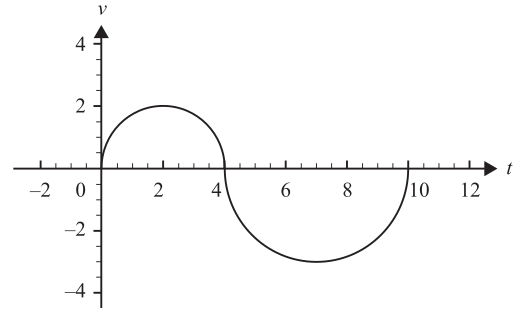
An object travels in a straight line relative to an origin `O`.

At time `t` seconds its velocity, `v` metres per second, is given by
 

`v(t) = {(sqrt(4 - (t - 2)^2), text(,) quad 0 <= t <= 4), (-sqrt(9 - (t - 7)^2), text(,) quad 4 < t <= 10):}`
 

The graph of  `v(t)`  is shown below.

The object will be back at its initial position when `t` is closest to

A.   4.0

B.   6.5

C.   6.7

D.   6.9

E.   7.0

Show Answers Only

`C`

Show Worked Solution

`text(Solve for)\ k:`

`int_0^4 sqrt(4 – (t – 2)^2)\ dt= int_4^k sqrt(9 -(t – 7)^2)\ dt`

 
`k~~ 6.7`

`=>  C`

Filed Under: Motion (SM) Tagged With: Band 4, smc-1159-10-Motion as f(t), smc-1159-40-Graphs

Copyright © 2014–2025 SmarterEd.com.au · Log in