SmarterEd

Aussie Maths & Science Teachers: Save your time with SmarterEd

  • Login
  • Get Help
  • About

Vectors, SPEC1 2023 VCAA 9

A plane contains the points \( A(1,3,-2), B(-1,-2,4)\) and \( C(a,-1,5)\), where \(a\) is a real constant. The plane has a \(y\)-axis intercept of 2 at the point \(D\).

  1. Write down the coordinates of point \(D\).   (1 mark)

--- 1 WORK AREA LINES (style=lined) ---

  1. Show that \(\overrightarrow{A B}\) and \(\overrightarrow{A D}\) are \(-2 \underset{\sim}{\text{i}}-5 \underset{\sim}{\text{j}}+6 \underset{\sim}{\text{k}}\)  and  \(-\underset{\sim}{\text{i}}-\underset{\sim}{\text{j}}+2 \underset{\sim}{\text{k}}\), respectively.   (1 mark)

--- 4 WORK AREA LINES (style=lined) ---

  1. Hence find the equation of the plane in Cartesian form.  (2 marks)

--- 7 WORK AREA LINES (style=lined) ---

  1.  Find \(a\).   (1 mark)

--- 3 WORK AREA LINES (style=lined) ---

  1.  \(\overline{A B}\) and \(\overline{A D}\) are adjacent sides of a parallelogram. Find the area of this parallelogram.   (1 mark)

--- 2 WORK AREA LINES (style=lined) ---
Show Answers Only

a.    \(D(0,2,0)\)

b.    \(\overrightarrow{A B}=\overrightarrow{O B}-\overrightarrow{O A}=\left(\begin{array}{c}
-1 \\
-2 \\
4
\end{array}\right)-\left(\begin{array}{c}
1 \\
3 \\
-2
\end{array}\right)=\left(\begin{array}{c}
-2 \\
-5 \\
6
\end{array}\right)=-2 \underset{\sim}{\text{i}}-5\underset{\sim}{\text{j}}+6 \underset{\sim}{\text{k}}\)

\(\overrightarrow{A D}=\overrightarrow{O D}-\overrightarrow{O A}=\left(\begin{array}{c}0 \\ 2 \\ 0\end{array}\right)-\left(\begin{array}{c}1 \\ 3 \\ -2\end{array}\right)=\left(\begin{array}{c}-1 \\ -1 \\ 2\end{array}\right)=-\underset{\sim}{\text{i}}-\underset{\sim}{\text{j}}+2\underset{\sim}{\text{k}}\)

c.    \(4 x+2 y+3 z =4\)

d.    \(a=-\dfrac{9}{4}\)

e.    \(A=\sqrt{29}\)

Show Worked Solution

a.    \(D(0,2,0)\)

 
b.   
\(\overrightarrow{A B}=\overrightarrow{O B}-\overrightarrow{O A}=\left(\begin{array}{c}
-1 \\
-2 \\
4
\end{array}\right)-\left(\begin{array}{c}
1 \\
3 \\
-2
\end{array}\right)=\left(\begin{array}{c}
-2 \\
-5 \\
6
\end{array}\right)=-2 \underset{\sim}{\text{i}}-5\underset{\sim}{\text{j}}+6 \underset{\sim}{\text{k}}\)

\(\overrightarrow{A D}=\overrightarrow{O D}-\overrightarrow{O A}=\left(\begin{array}{c}0 \\ 2 \\ 0\end{array}\right)-\left(\begin{array}{c}1 \\ 3 \\ -2\end{array}\right)=\left(\begin{array}{c}-1 \\ -1 \\ 2\end{array}\right)=-\underset{\sim}{\text{i}}-\underset{\sim}{\text{j}}+2\underset{\sim}{\text{k}}\)

 
c.
    \(\overrightarrow{A B} \times \overrightarrow{A D}=\left|\begin{array}{ccc}
\underset{\sim}{\text{i}} & \underset{\sim}{\text{j}} & \underset{\sim}{\text{k}} \\ -2 & -5 & 6 \\ -1 & -1 & 2\end{array}\right|\)

\(\ \quad \quad \quad \quad \   \begin{aligned} & =(-10+6)\underset{\sim}{\text{i}}-(-4+6)\underset{\sim}{\text{j}}+(2-5) \underset{\sim}{\text{k}} \\ & =-4 \underset{\sim}{i}-2 \underset{\sim}{j}-3 \underset{\sim}{k}\end{aligned}\)

\(\text{Plane:}\ \ -4 x-2 y-3 z=k\)

\(\text{Substitute}\  D(0,2,0)\  \text{into equation}\ \ \Rightarrow \ \text{k}=-4\)

\begin{aligned}
\therefore-4 x-2 y-3 z & =-4 \\
4 x+2 y+3 z & =4
\end{aligned}

 
d.
    \(\text{Find}\ a\ \Rightarrow \ \text{substitute}\ (a, 1,-5)\ \text{into plane equation:}\)

\begin{aligned}
-4 & =-4a+2-15 \\
4 a & =-9 \\
a & =-\dfrac{9}{4}
\end{aligned}

e.     \(\text{Area}\) \(=|\overrightarrow{A B} \times \overrightarrow{A D}|\)
    \(=|-4\underset{\sim}{i}-2\underset{\sim}{j}-3\underset{\sim}{k}|\)
    \(=\sqrt{16+4+9} \)
    \(=\sqrt{29}\)

Filed Under: Basic Concepts and Calculations, Vector Lines, Planes and Geometry Tagged With: Band 4, Band 5, smc-1176-45-Vector planes, smc-1176-55-Cross product, smc-1177-30-Quadrilaterals, smc-1177-50-2D problems

Vectors, SPEC2 2011 VCAA 10 MC

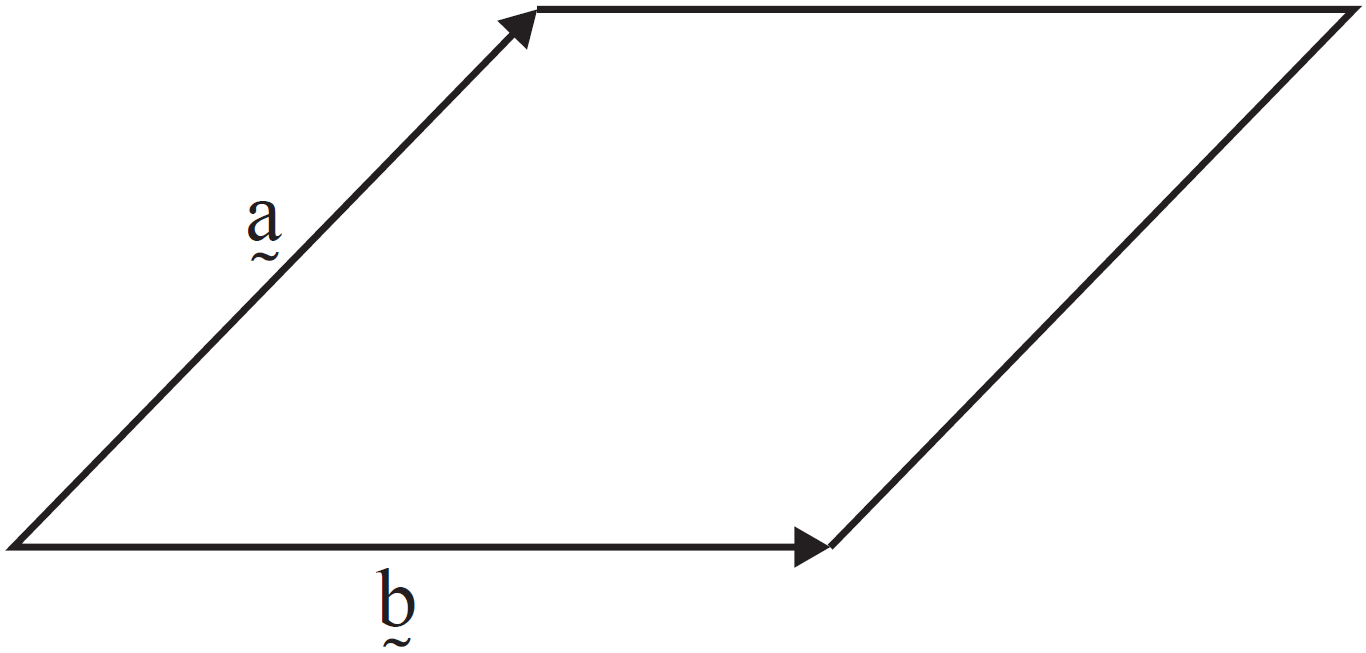
The diagram below shows a rhombus, spanned by the two vectors  `underset~a`  and  `underset~b`.
 

SPEC2 2011 VCAA 10 MC
 

It follows that

A.   `underset~a.underset~b = 0`

B.   `underset~a = underset~b`

C.   `(underset~a + underset~b).(underset~a - underset~b) = 0`

D.   `|\ underset~a + underset~b\ | = |\ underset~a - underset~b|`

E.   `2underset~a + 2underset~b = underset~0`

Show Answers Only

`C`

Show Worked Solution

`text(Consider A:)`

`text(If)\ \ underset~a · underset~b = 0\ \ =>\ \ underset~a ⊥ underset~b\ \ text{(incorrect)}`

`text(Consider B:)`

`underset~a != underset~b\ \ text{(incorrect)}`

`text(Consider C:)`

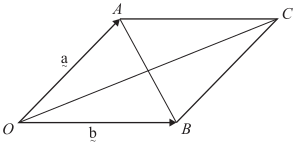
`underset~a + underset~b` `= overset(->)(OC)`
`underset~a – underset~b` `= overset(->)(BA)`

 
`overset(->)(OC) · overset(->)(BA)=0`

`text{The diagonals of a rhombus are perpendicular  (correct)}`

`=> C`

Filed Under: Vector Lines, Planes and Geometry Tagged With: Band 4, smc-1177-30-Quadrilaterals, smc-1177-50-2D problems

Vectors, SPEC1 2015 VCAA 1

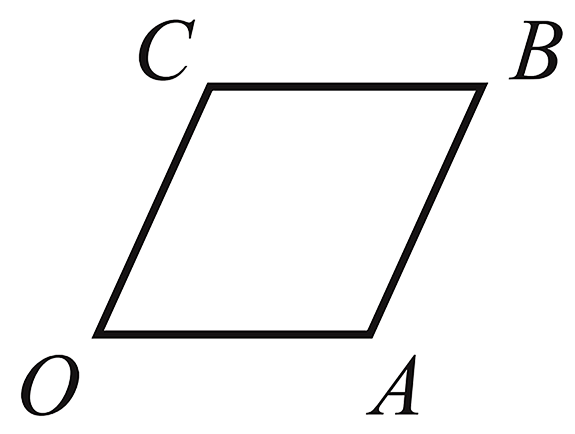
Consider the rhombus  `OABC`  shown below, where  `vec (OA) = a underset ~i`  and  `vec (OC) = underset ~i + underset ~j + underset ~k`, and `a` is a positive real constant.
 

VCAA 2015 spec 1a
 

  1. Find  `a.`  (1 mark)

    --- 2 WORK AREA LINES (style=lined) ---
  2. Show that the diagonals of the rhombus  `OABC`  are perpendicular.  (2 marks)

    --- 6 WORK AREA LINES (style=lined) ---

Show Answers Only

  1. `sqrt 3`
  2. `text(Proof)\ \ text{(See Worked Solutions)}`

Show Worked Solution

a.   `|\ vec(OA)\ | = |\ vec(OC)\ |,`

`:. a` `= sqrt (1^2 + 1^2 + 1^2)`
  `= sqrt 3`


b.   `overset(->)(CB) = overset(->)(OA), \ \ overset(->)(AB) = overset(->)(OC)`

MARKER’S COMMENT: Vector notation was poor in many answers.

`overset(->)(OB) = overset(->)(OC) + overset(->)(CB)`

`= underset~i + underset~j + underset~k + sqrt3 underset~i`

`= (sqrt3 + 1)underset~i + underset~j + underset~k`
 

`overset(->)(AC) = overset(->)(AO) + overset(->)(OC)`

`= −sqrt3underset~i + underset~i + underset~j + underset~k`

`= (1 – sqrt3)underset~i + underset~j + underset~k`
 

`overset(->)(AC) · overset(->)(OB)` `= (1 + sqrt3)(1 – sqrt3) + 1 + 1`
  `= 1 – 3 + 1 + 1`
  `= 0`

 
`:. overset(->)(AC) ⊥ overset(->)(OB)`

Filed Under: Vector Lines, Planes and Geometry Tagged With: Band 4, smc-1177-30-Quadrilaterals, smc-1177-50-2D problems

Copyright © 2014–2025 SmarterEd.com.au · Log in