Consider the following algorithm used to estimate a volume of revolution.
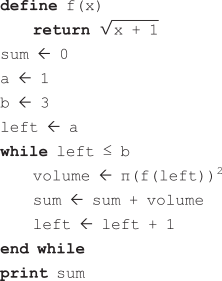
The algorithm above will print the value
- \(5 \pi\)
- \(9 \pi\)
- \(14 \pi\)
- \(29 \pi\)
Aussie Maths & Science Teachers: Save your time with SmarterEd
Consider the following algorithm used to estimate a volume of revolution.
The algorithm above will print the value
Consider the following pseudocode.
define \(f(x, y)=e^{x y}\)
\(\begin{aligned} & x \leftarrow 0 \\ & y \leftarrow 0 \\ & h \leftarrow 0.5 \\ & n \leftarrow 0\end{aligned}\)
while \(n \geq 0\)
\(\begin{aligned} & y \leftarrow y+h \times f(x, y) \\ & x \leftarrow x+h \\ & n \leftarrow n+1\end{aligned}\)
print \(y\)
end while
After how many iterations will the pseudocode print 2.709 ?