SmarterEd

Aussie Maths & Science Teachers: Save your time with SmarterEd

  • Login
  • Get Help
  • About

Calculus, EXT2 C1 2024 HSC 11d

Evaluate  \(\displaystyle\int_0^{\frac{\pi}{2}} \dfrac{1}{\sin \theta+1}\, d \theta\).   (3 marks)

--- 9 WORK AREA LINES (style=lined) ---

Show Answers Only

\(1\)

Show Worked Solution

\(t=\tan (\frac{\theta}{2}), \ \sin \theta=\dfrac{2 t}{1+t^2}\)

\(d t=\dfrac{1}{2} \sec ^2 (\frac{\theta}{2})\, d \theta \ \Rightarrow \ d \theta=\dfrac{2}{1+\tan ^2 (\frac{\theta}{2})}\, d t=\dfrac{2}{1+t^2}\, d t\)

\(\text {When}\ \ \theta=\dfrac{\pi}{2}\ \ \Rightarrow\ \ \tan (\frac{\theta}{2})=1\)

\(\text {When}\ \ \theta=0\ \ \Rightarrow\ \ \tan(\frac{\theta}{2})=0\)

\(\displaystyle{\int}_0^{\frac{\pi}{2}} \dfrac{1}{\sin \theta+1}\, d \theta\) \(=\displaystyle{\int}_0^1 \frac{1}{\dfrac{2 t}{1+t^2}+1} \cdot \frac{2}{1+t^2}\, d t\)
  \(=\displaystyle{\int}_0^1 \dfrac{2}{2 t+1+t^2}\, d t\)
  \(=\displaystyle{\int}_0^1 \dfrac{2}{(t+1)^2}\, d t\)
  \(=-\left[\dfrac{2}{t+1}\right]_0^1\)
  \(=-\left(\dfrac{2}{2}-2\right)\)
  \(=1\)

Filed Under: Trig Integration Tagged With: Band 3, smc-1193-20-t = tan theta/2

Calculus, EXT2 C1 2022 HSC 11f

Using the substitution  `t=tan\ x/2`, find

`int(dx)/(1+cos x-sin x)`  (3 marks)

--- 8 WORK AREA LINES (style=lined) ---


Show Answers Only

`-lnabs(1-tan(x/2))+C`

Show Worked Solution

`text(Let)\ \ t = tan\ x/2, \ cos\ x = (1-t^2)/(1 + t^2), \ sin\ x=(2t)/(1+t^2)`

`dt = 1/2 sec^2\ x/2\ dx \ => \ d x = (2\ dt)/(sec^2\ x/2) = 2/(1 + t^2)\ dt`

`text{I}` `= int(dx)/(1+cos x-sin x)`  
  `=int 1/(1+(1-t^2)/(1 + t^2)-(2t)/(1 + t^2)) *2/(1 + t^2)\ dt`  
  `=int 2/(1+t^2+1-t^2-2t)\ dt`  
  `=int 1/(1-t)\ dt`  
  `=-ln abs(1-t)+C`  
  `=-lnabs(1-tan(x/2))+C`  

Filed Under: Substitution and Harder Integration, Trig Integration Tagged With: Band 3, smc-1057-10-Trig, smc-1057-50-Substitution given, smc-1193-20-t = tan theta/2

Calculus, EXT2 C1 2021 HSC 14a

Evaluate  `int_0^(pi/2) 1/(3 + 5cosx)\ dx`.  (4 marks)

--- 8 WORK AREA LINES (style=lined) ---

Show Answers Only

`1/4 ln 3`

Show Worked Solution

`text(Let)\ \ t = tan\ theta/2, \ cos theta = (1-t^2)/(1 + t^2)`

`dt = 1/2 sec^2\ theta/2\ d theta \ => \ d theta = (2\ dt)/(sec^2\ theta/2) = 2/(1 + t^2)\ dt`

`text(Convert limits:)`

`theta` `= pi/2  → \ t=1`
`theta` `= 0  → \ t=0`
`int_0^(pi/2) 1/(3 + 5cosx)\ dx` `= int_0^1 1/(3 + 5((1-t^2)/(1 + t^2))) · 2/(1 + t^2)\ dt`
  `= int_0^1 2/(3(1 + t^2) + 5(1-t^2))\ dt`
  `= int_0^1 1/(4-t^2)\ dt`
  `= int_0^1 1/((2 + t)(2-t))\ dt`
  `= 1/4 int_0^1 1/(2+t) + 1/(2-t)\ dt`
  `= 1/4 [ln |2 + t|-ln|2-t|]_0^1`
  `= 1/4 [ln 3-ln1-(ln 2-ln 2)]`
  `= 1/4 ln 3`

Filed Under: Trig Integration Tagged With: Band 4, smc-1193-20-t = tan theta/2

Calculus, EXT2 C1 2005 HSC 1e

Let  `t=tan(theta/2).`

  1. Show that  `(dt)/(d theta) = 1/2(1+t^2)`   (1 mark)

    --- 3 WORK AREA LINES (style=lined) ---

  2. Show that  `sin theta = (2t)/(1+t^2).`   (2 marks)

    --- 6 WORK AREA LINES (style=lined) ---

  3. Use the substitution  `t=tan(theta/2)`  to find  `int text(cosec)\ theta\ d theta.`   (2 marks)

    --- 5 WORK AREA LINES (style=lined) ---

Show Answers Only
  1. `text(See Worked Solutions)`
  2. `text(See Worked Solutions)`
  3. `log_e | tan frac{theta}{2} | + c`
Show Worked Solution
i.     `t` `= tan frac{theta}{2}`
  `frac{dt}{d theta}` `= frac{1}{2} text{sec}^2 frac{theta}{2}`
    `= frac{1}{2} (1 + tan^2 frac{theta}{2})`
    `= frac{1}{2} (1 + t^2)`


ii.   `text{Show} \ \ sin theta = frac{2t}{1 + t^2} :`
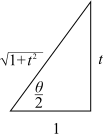
 

`sin theta` `= 2 \ sin frac{theta}{2} cos frac{theta}{2}`
  `= 2 * frac{t}{sqrt(1 + t^2)} * frac{1}{sqrt(1 + t^2)}`
  `= frac{2t}{1 + t^2}`


iii.   `int \ text{cosec} \ theta \ d theta`

`t = tan frac {theta}{2}`

`frac{dt}{d theta} = frac{1}{2} text{sec}^2 frac{theta}{2} \ , \ d theta = frac{2dt}{sec^2 frac{theta}{2}} = frac{2}{1 + t^2}  dt`

`int \ text{cosec} \ theta\ d theta` `= int frac{1 + t^2}{2t} xx frac{2}{1 + t^2} dt`
  `= int frac{1}{t}\ dt`
  `= log_e | t | + c`
  `= log_e | tan frac{theta}{2} | + c`

Filed Under: Trig Integration Tagged With: Band 3, Band 4, smc-1193-20-t = tan theta/2

Calculus, EXT2 C1 2018 HSC 14a

Using the substitution  `t = tan\ theta/2`  evaluate  `int_0^(pi/2) (d theta)/(2 - costheta)`.  (3 marks)

--- 8 WORK AREA LINES (style=lined) ---

Show Answers Only

`(2sqrt3 pi)/9`

Show Worked Solution

`t = tan\ theta/2, \ costheta = (1 – t^2)/(1 + t^2), \ d theta = 2/(1 + t^2) dt`

`text(When)\ \ theta = pi/2, \ t = 1`

`text(When)\ \ theta = 0, \ t = 0`
 

`int_0^(pi/2) (d theta)/(2 – costheta)` `= int_0^1 1/(2 – (1 – t^2)/(1 + t^2)) · 2/(1 + t^2)\ dt`
  `= int_0^1 2/(2(1 + t^2) – (1 – t^2))\ dt`
  `= int_0^1 2/(1 + 3t^2)\ dt`
  `= [2/sqrt3 tan^(−1)(sqrt3 t)]_0^1`
  `= 2/sqrt3 tan^(−1) sqrt3 – 0`
  `= (2pi)/(3sqrt3)`
  `= (2sqrt3 pi)/9`

Filed Under: Trig Integrals, Trig Integration Tagged With: Band 3, smc-1193-20-t = tan theta/2

Calculus, EXT2 C1 2017 HSC 11d

Using the substitution  `t = tan {:theta/2:}`, or otherwise, evaluate

`int_0^((2 pi)/3) 1/(1 + cos theta)\ d theta`.  (3 marks)

--- 6 WORK AREA LINES (style=lined) ---

Show Answers Only

`sqrt 3`

Show Worked Solution

`text(Let)\ \ t = tan {:theta/2:}, \ cos theta = (1 – t^2)/(1 + t^2), \ d theta = (2 dt)/(1 + t^2)`


`text(When)\ theta = 0, t = tan 0 = 0`

`text(When)\ theta = (2 pi)/3, t = tan {:pi/3:} = sqrt 3`

`int_0^((2pi)/3) 1/(1 + cos theta)\ d theta` `= int_0^(sqrt 3) ((2dt)/(1 + t^2))/((1 + t^2)/(1 + t^2) + (1 – t^2)/(1 + t^2))`
  `= int_0^(sqrt 3) (2/(1 + t^2))/(2/(1 + t^2))\ dt`
  `= int_0^(sqrt 3) 1\ dt`
  `= [t]_0^ (sqrt 3)`
  `= sqrt 3 – 0`
  `= sqrt 3`

Filed Under: Trig Integrals, Trig Integration Tagged With: Band 3, smc-1193-20-t = tan theta/2

Calculus, EXT2 C1 2006 HSC 1e

Use the substitution  `t = tan\ theta/2`  to show that

`int_(pi/2)^((2 pi)/3) (d theta)/(sin theta) = 1/2 log 3.`  (3 marks)

--- 8 WORK AREA LINES (style=lined) ---

Show Answers Only

`text(Proof)\ \ text{(See Worked Solutions)}`

Show Worked Solution

`text(Let)\ \ t = tan\ \ theta/2,\ \ sin theta = (2t)/(1 + t^2),\ \ d theta = 2/(1 + t^2)\ dt`

`text(When)\ \ theta = pi/2,\ \ t = 1`

`text(When)\ \ theta = (2 pi)/3,\ \ t = sqrt 3`

`:.int_(pi/2)^((2 pi)/3) (d theta)/(sin theta)` `= int_1^sqrt 3 (1 + t^2)/(2t) xx2/(1 + t^2)\ dt`
  `= int_1^ sqrt 3 (dt)/t`
  `= [ln t]_1^sqrt 3`
  `= ln sqrt 3 – ln 1`
  `=ln3^(1/2)-0`
  `= 1/2 ln 3`

Filed Under: Trig Integrals, Trig Integration Tagged With: Band 3, smc-1193-20-t = tan theta/2

Calculus, EXT2 C1 2010 HSC 1d

Using the substitution  `t = tan\ x/2`, or otherwise, evaluate  `int_0^(pi/2) (dx)/(1 + sin\ x)`.   (4 marks)

--- 6 WORK AREA LINES (style=lined) ---

Show Answers Only

`1`

Show Worked Solution

`t = tan\ x/2, \ dx = (2\ dt)/(1 + t^2), \ sin\ x = (2t)/(1 + t^2)`

`text(When)\ \ x=pi/2,\ \ t=tan\ pi/4=1`

`text(When)\ \ x=0,\ \ t=tan0=0`

`:.int_0^(pi/2) (dx)/(1 + sin\ x)` `=int_0^1 ((2\ dt)/(1 + t^2))/(1 + (2t)/(1 + t^2))`
  `=int_0^1 2/(1 + t^2 + 2t)\ dt`
  `=int_0^1 (2)/((1 + t)^2)\ dt`
  `=[(-2)/(1 + t)]_0^1`
  `=(-2)/2 − (-2)/1`
  `=1`

Filed Under: Trig Integrals, Trig Integration Tagged With: Band 3, smc-1193-20-t = tan theta/2

Calculus, EXT2 C1 2012 HSC 12a

Using the substitution  `t = tan\ theta/2`, or otherwise, find  `int(d theta)/(1 − cos\ theta)`.   (3 marks)

--- 6 WORK AREA LINES (style=lined) ---

Show Answers Only

`-cot\ theta/2 + c`

Show Worked Solution

`t = tan\ theta/2`

`dt=1/2 sec^2 (theta/2)\ d theta,\ \ \ d theta=(2\ dt)/sec^2 (theta/2)=2/(1+t^2)\ dt`

`cos\ theta = (1 − t^2)/(1 + t^2)`

`int(d theta)/(1 − cos\ theta)` `= int1/(1 − ((1 − t^2)/(1 + t^2))) xx 2/(1 + t^2)\ dt`
  `= int 2/(1 + t^2 − (1 − t^2))`
  `= int(dt)/(t^2)`
  `= -1/t + c`
  `= -1/(tan\ theta/2) + c`
  `= -cot\ theta/2 + c`

Filed Under: Trig Integrals, Trig Integration Tagged With: Band 3, smc-1193-20-t = tan theta/2

Calculus, EXT2 C1 2013 HSC 12a

Using the substitution  ` t = tan\ x/2`, or otherwise, evaluate

`int_0^(pi/2) 1/(4 + 5 cos x)\ dx.`  (4 marks)

--- 8 WORK AREA LINES (style=lined) ---

Show Answers Only

`1/3 ln 2`

Show Worked Solution

`t = tan\ x/2`

`=>cos x = (1 – t^2)/(1 + t^2)\ ,\ \ \ dx = (2\ dt)/(1 + t^2)`

`text(When)\ \ x = 0\ ,\ t = 0\ ;\ \ x = pi/2\ ,\ t = 1`

`int_0^(pi/2) (dx)/(4 + 5 cos x)` `= int_0^1 1/{4 + (5(1 – t^2))/(1 + t^2)} xx (2\ dt)/(1 + t^2)`
  `= int_0^1 (2\ dt)/(4 + 4t^2 + 5 – 5t^2)`
  `= int_0^1 (2\ dt)/(9 – t^2)`
  `=2 int_0^1 1/((3-t)(3+t))`
  `= 1/3 int_0^1 (1/(3 – t) + 1/(3 + t))\ dt`
  `= 1/3 [-ln (3 – t) + ln (3 + t)]_0^1`
  `= 1/3 [(-ln 2 + ln 4) – (-ln 3 + ln 3)]`
  `= 1/3 ln2`

Filed Under: Trig Integrals, Trig Integration Tagged With: Band 3, smc-1193-20-t = tan theta/2

Calculus, EXT2 C1 2014 HSC 13a

Using the substitution  `t = tan\ x/2`, or otherwise, evaluate

`int_(pi/3)^(pi/2) 1/(3sinx - 4cosx + 5)\ dx`.  (3 marks)

--- 8 WORK AREA LINES (style=lined) ---

Show Answers Only

`(2sqrt3 − 3)/6`

Show Worked Solution

`t = tan\ x/2,\ \ \ sinx=(2t)/(1+t^2)`

`cos x = (1-t^2)/(1+t^2),\ \ \ dx=(2 dt)/(1+t^2`

`text(When)\ \ \ x = pi/3,\ \ t = tan\ pi/6 =1/sqrt3`

`text(When)\ \ \ x = pi/2, \ \ t = tan\ pi/4=1`.

`int_(pi/3)^(pi/2) 1/(3\ sin\ x − 4\ cos\ x + 5)`
`= int_(1/sqrt3)^1 1/((6t)/(1 + t^2) − (4(1 − t^2))/(1 + t^2) + 5) xx (2dt)/(1 + t^2)`
`= int_(1/sqrt3)^1 2/(6t − 4 + 4t^2 + 5 + 5t^2)dt`
`= int_(1/sqrt3)^1 2/(9t^2 + 6t + 1)dt`
`= 2 int_(1/sqrt3)^1 (dt)/((3t + 1)^2)`
`= -2/3[1/(3t + 1)]_(1/sqrt3)^1`
`= -2/3(1/4 − 1/(sqrt3 + 1))` 
`= -2/3(1/4 − (sqrt3 − 1)/2)`
`= -1/6+sqrt3/3-1/3`
`= (2sqrt3 − 3)/6`

Filed Under: Trig Integrals, Trig Integration Tagged With: Band 4, smc-1193-20-t = tan theta/2

Copyright © 2014–2025 SmarterEd.com.au · Log in