SmarterEd

Aussie Maths & Science Teachers: Save your time with SmarterEd

  • Login
  • Get Help
  • About

Calculus, EXT1 C3 EQ-Bank 16

A tank contains 5000 litres of fruit juice concentrate solution with an initial concentrate percentage of 5.0%. Another fruit juice solution with a concentrate percentage of 3.0% is pumped into the tank at a rate of 40 litres per minute. The mixture is pumped out at the same rate, keeping the volume constant, and the liquid is kept thoroughly mixed.
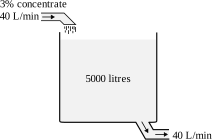
 

Let \(y\) be the volume of fruit concentrate, in litres, present in the tank at time \(t\).

  1. Show that  \(\dfrac{dy}{dt}=\dfrac{150-y}{125} \)   (1 mark)

    --- 4 WORK AREA LINES (style=lined) ---

  2. Show that the amount fruit juice concentrate in the tank at time \(t\) is given by
  3.       \(y=150 + 100e^{-0.008t} \)   (3 marks)

    --- 9 WORK AREA LINES (style=lined) ---

  4. Determine how long will it take for the mixture to reach a fruit juice concentration of 3.5%, giving your answer to the nearest minute?   (2 marks)

    --- 6 WORK AREA LINES (style=lined) ---

Show Answers Only

a.   \(\text{See Worked Solutions}\)

b.  \(\text{See Worked Solutions}\)

c.   \(\text{174 minutes}\)

Show Worked Solution

a.    \(\text{Inflow}=40 \ \text{L/min} \times 0.03=1.2 \ \text{L/min}\)

\(\text{Outflow }=40 \ \text{L/min} \times \dfrac{y}{5000}=\dfrac{y}{125} \ \text{L/min}\)

\(\dfrac{dy}{dt}\) \(=\text{Inflow}-\text{Outflow}\)
  \(=1.2-\dfrac{y}{125}\)
  \(=\dfrac{150-y}{125}\)


b.     \(\dfrac{dy}{dt}\) \(=\dfrac{150-y}{125}\)
  \(\dfrac{dt}{dy}\) \(=\dfrac{125}{150-y}\)
  \(\displaystyle\int dt\) \(=\displaystyle \int \dfrac{125}{150-y} \, dy\)
  \(t\) \(=-125\, \ln \abs{150-y}+c\)
  \(\ln \abs{150-y}\) \(=-\dfrac{t}{125}+c\)
  \(150-y\) \(=e^{-0.008 t+c}\)
  \(150-y\) \(=e^{-0.008 t} \cdot e^c\)
  \(150-y\) \(=A e^{-0.008 t}\)

 
\(\text{At} \ \ t=0, y=5000 \times 0.05=250\ \text{L}\)

\(150-250=Ae^{\circ} \ \  \Rightarrow \ \  A=-100\)

\(150-y\) \(=-100 e^{-0.008 t}\)
\(y\) \(=150+100 e^{0.008 t}\)


c.   \(\text{When fruit concentrate}=3.5 \%\)

\(y=5000 \times 0.035=175 \ \text{L}\)

\(\text{Find} \ t \ \text{when} \ \ y=175:\)

\(175\) \(=150+100 e^{-0.008 t}\)
\(25\) \(=100 e^{-0.008 t}\)
\(e^{-0.008t}\) \(=0.25\)
\(-0.008 t\) \(=\ln (0.25)\)
\(t\) \(=\dfrac{\ln (0.25)}{-0.008}\)
  \(=173.28 \ldots\)


\(\therefore \ \text{After 174 minutes, the fruit concentrate first falls below} \  3.5\%\)

Filed Under: Applications of Differential Equations Tagged With: Band 4, Band 5, smc-1198-10-Mixing

Calculus, EXT1 C3 EQ-Bank 10

A tank initially contains 300 grams of salt that is dissolved in 50 L of water. A solution containing 15 grams of salt per litre of water is poured into the tank at a rate of 2 litres per minute and the mixture in the tank is kept well stirred.

At the same time, 2 litres of the mixture flows out of the tank per minute.

  1. Find the differential equation, `(dm)/(dt)`, where `m` represents the mass, in grams, of salt in the tank at time `t` minutes.   (2 marks)

    --- 4 WORK AREA LINES (style=lined) ---

  2. Express `m` in terms of `t`.   (3 marks)

    --- 8 WORK AREA LINES (style=lined) ---

  3. Find the concentration of salt in the liquid in the longer term.   (1 mark)

    --- 4 WORK AREA LINES (style=lined) ---

Show Answers Only
  1. `(dm)/(dt) = 30-m/25`
  2. `m=750-450e^(-t/25)`
  3. `15\ text{g/L}`
Show Worked Solution

i.    `V = 50\ text{L}`

`(dm)/(dt) text{(in)} = 15 xx 2 = 30\ text(g/min)`

`(dm)/(dt) text{(out)} = 2 xx m/50 = m/25\ text(g/min)`

`:. (dm)/(dt) = 30-m/25`
 

ii.  `(dm)/(dt)=(750-m)/25`

`(dt)/(dm)` `=25/(750-m)`  
`t` `=int 25/(750-m)\ dm`  
  `=-25ln(750-m)+c`  

 
`text{When}\ \ t=0, m=300:`

`0` `=-25ln(750-300)+c`  
`c` `=25ln450`  


`t` `=25ln450-25ln(750-m)`  
  `=25ln(450/(750-m))`  
`t/25` `=ln(450/(750-m))`  
`e^(t/25)` `=450/(750-m)`  
`750-m` `=450e^(-t/25)`  
`m` `=750-450e^(-t/25)`  


iii.  `text{Method 1}`

`text{As}\ t->oo:`

`m->750-450e^(-oo)=750`

`text{Concentration} (m/V)->750/50=15\ text{g/L}`
 

`text{Method 2}`

`text{Concentration}\ -> (dm)/(dt) text{(in)} = 15\ text{g/L}`

Filed Under: Applications of Differential Equations Tagged With: Band 4, Band 5, smc-1198-10-Mixing

Calculus, EXT1 C3 2020 SPEC2 10

A tank initially contains 300 grams of salt that is dissolved in 50 L of water. A solution containing 15 grams of salt per litre of water is poured into the tank at a rate of 2 L per minute and the mixture in the tank is kept well stirred. At the same time, 5 L of the mixture flows out of the tank per minute.

Find the differential equation,  `(dm)/(dt)`, where  `m` represents the mass, in grams, of salt in the tank at time `t` minutes, for a non-zero volume of mixture.   (2 marks)

Show Answers Only

`(dm)/(dt) = 30 – (5m)/(50 – 3t)`

Show Worked Solution

`V(t) = 50 + 2t – 5t = 50 – 3t`

`(dm)/(dt)\ text(in) = 15 xx 2 = 30\ text(g/min)`

`(dm)/(dt)\ text(out) = 5 xx m/(50 – 3t) = (5m)/(50 – 3t)`

`:. (dm)/(dt) = 30 – (5m)/(50 – 3t)`

Filed Under: Uncategorized Tagged With: Band 4, smc-1198-10-Mixing

Calculus, EXT1 C3 2018 VCE 8

A tank initially holds 16 L of water in which 0.5 kg of salt has been dissolved. Pure water then flows into the tank at a rate of 5 L per minute. The mixture is stirred continuously and flows out of the tank at a rate of 3 L per minute.

  1.  Show that the differential equation for `Q`, the number of kilograms of salt in the tank after `t` minutes, is given by

    `qquad (dQ)/(dt) = -(3Q)/(16 + 2t)`  (1 mark)
      
  2.  Solve the differential equation given in part a. to find `Q` as a function of `t`.
      
    Express your answer in the form  `Q = a/(16 + 2t)^(b/c)`, where `a, b` and `c` are positive integers.  (3 marks)
Show Answers Only
  1.  `text(Proof)\ \ text{(See Worked Solutions)}`
  2.  `Q = 32/(16 + 2t)^(3/2)`
Show Worked Solution

a. `Q_0 = 0.5, \ V_0 = 16`

♦ Net mean mark of both parts 44%.

`V(t)` `= 16 + (5 – 3) t`
  `= 16 + 2t`

 
`text(Concentration)\ (C)= Q/V= Q/(16 + 2t)\ text(kg/L)`

`(dQ)/(dt)` `= 0 xx 5 – 3C`
  `= -(3Q)/(16 + 2t)`

MARKER’S COMMENT: Many students took the common factor of 2 from  `16+2t`. This wasn’t necessary and complicated the arithmetic in part b.


b.   `-1/(3Q) * (dQ)/(dt) = 1/(16 + 2t)`

`int -1/(3Q)\ dQ` `= int 1/(16 + 2t) dt`
`-1/3 int 1/Q\ dQ` `= 1/2 int 2/(16 + 2t)\ dt`
`-1/3 ln Q` ` = [1/2 ln(16 + 2t)] + c`

 
`text(When)\ \ t=0,\ \ Q=0.5,`

COMMENT: A very challenging test of using exponential and log laws!

`-1/3 ln (1/2)` `= 1/2 ln (16) +c`
`c` `= -1/2 ln (16) -1/3 ln (1/2)`


`-1/3 ln Q` `= 1/2 ln(16 + 2t) -1/2 ln(16) – 1/3 ln (1/2)`
`-1/3 ln Q` `= 1/2 ln ((16 + 2t)/16) – 1/3 ln (1/2)`
`-1/3 ln Q` `= ln (((16 + 2t)^(1/2))/4) – ln (2^(-1/3))`
`ln (Q^(-1/3))` `= ln (((16 + 2t)^(1/2))/(2^2 ⋅ 2^(-1/3)))`
`Q^(-1/3)` `= ((16 + 2t)^(1/2))/(2^(5/3))`
`Q` `= (((16 + 2t)^(1/2))/(2^(5/3)))^-3`
  `= (16 + 2t)^(- 3/2)/(2^(-5))`
`:. Q` `= 32/((16 + 2t)^(3/2))`

Filed Under: Uncategorized Tagged With: Band 4, Band 5, smc-1198-10-Mixing

Calculus, EXT1 C3 2014 VCE 10 MC

A large tank initially holds 1500 L of water in which 100 kg of salt is dissolved. A solution containing 2 kg of salt per litre flows into the tank at a rate of 8 L per minute. The mixture is stirred continuously and flows out of the tank through a hole at a rate of 10 L per minute.

The differential equation for `Q`, the number of kilograms of salt in the tank after `t` minutes, is given by

A.   `(dQ)/(dt) = 16 - (5Q)/(750 - t)`

B.   `(dQ)/(dt) = 16 - (5Q)/(750 + t)`

C.   `(dQ)/(dt) = 16 + (5Q)/(750 - t)`

D.   `(dQ)/(dt) = (100Q)/(750 - t)`

Show Answers Only

`A`

Show Worked Solution

`(dQ_text(in))/(dV)= 2\ text(kg/L),\ (dV_text(in))/(dt) = 8\ text(L/min)`

`V_0 = 1500,\ Q_0 = 100`

`(dV_text(out))/(dt) = 10\ text(L/min)`
  

`V(t)` `= 1500 + (8 – 10)t`
  `= 1500 – 2t`
  `= 2(750 – t)`


`(dQ_text(in))/(dt)` `= 2 xx 8 = 16 text(kg/min)`
`(dQ_text(out))/(dt)` `= Q/(v(t)) xx 10`
  `= (10Q)/(2(750 – t))`
  `= (5Q)/(750 – t)`

 
`:.(dQ)/(dt)= 16 – (5Q)/(150 – t)`

`=> A`

Filed Under: Uncategorized Tagged With: Band 4, smc-1198-10-Mixing

Calculus, EXT1 C3 2013 VCE 13 MC

Water containing 2 grams of salt per litre flows at the rate of 10 litres per minute into a tank that initially contained 50 litres of pure water. The concentration of salt in the tank is kept uniform by stirring and the mixture flows out of the tank at the rate of 6 litres per minute.

If `Q` grams is the amount of salt in the tank `t` minutes after the water begins to flow, the differential equation relating `Q` to `t` is

A.   `(dQ)/(dt) = 20 - (3Q)/(25 + 2t)`

B.   `(dQ)/(dt) = 10 - (3Q)/(25 + 2t)`

C.   `(dQ)/(dt) = 20 - (3Q)/(25 - 2t)`

D.   `(dQ)/(dt) = 10 - (3Q)/(25 - 2t)`

Show Answers Only

`A`

Show Worked Solution
`text(Volume)` `= 50 + (10 – 6)t`
  `= 50 + 4t`

 
`text(Salt in tank at time)\ \ t=Q\ text(grams)`

`:.\ text(Concentration)\ = Q/(50 + 4t)\ text(grams per litre)`
 

`(dQ)/(dt)text(in) = 2 xx 10 = 20\ \ text(g/min)`

`(dQ)/(dt)text(out)` `= 6 xx Q/(50 + 4t)`
  `= (3Q)/(25 + 2t)`

 
`:. (dQ)/(dt) = 20 – (3Q)/(25 + 2t)`

`=> A`

Filed Under: Uncategorized Tagged With: Band 4, smc-1198-10-Mixing

Copyright © 2014–2025 SmarterEd.com.au · Log in