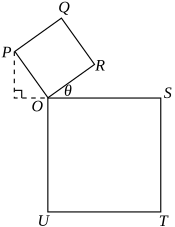
Two squares \(OPQR\) and \(OSTU\), are drawn in the diagram below, with \(O R=1, OS=2\) and \(\angle S O R=\theta\) where \(0^{\circ} \leqslant \theta \leqslant 90^{\circ}\). Let \(\overrightarrow{O S}=2 \underset{\sim}{i}\) and \(\overrightarrow{O U}=-2 \underset{\sim}{j}.\) --- 6 WORK AREA LINES (style=lined) --- --- 9 WORK AREA LINES (style=lined) ---
a. \(\text{Show} \ \ \overrightarrow{OP}=-\sin \theta \underset{\sim}{i}+\cos \theta \underset{\sim}{j}\) b. \(\text{If \(Q, R, T\) are collinear:}\) \(m_{\overrightarrow{QR}}=m_{\overrightarrow{R T}} \quad \text{(same gradient through \(R)\)}\) \(m_{\overrightarrow{Q R}}=m_{\overrightarrow{O P}}=\dfrac{\cos \theta}{-\sin \theta}\ \ \text{(opposite sides of a square)}\) \(\displaystyle T\binom{2}{-2}, R\binom{\cos \theta}{\sin \theta}\) \(m_{\overrightarrow{R T}}=\dfrac{\sin \theta+2}{\cos \theta-2}\) \(\text{Equating gradients:}\)
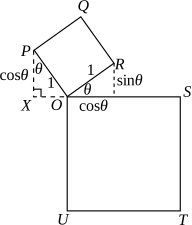
\(\angle P O R\)
\(=90^{\circ} \ \text{(internal angle of square)}\)
\(\angle XOP\)
\(=(90-\theta)^{\circ}\ \ (\text{\(180^{\circ}\) in straight line)}\)
\(\angle XPO\)
\(=\theta\ \ \left(180^{\circ} \ \text{in} \ \Delta XPO \right)\)
\(XP\)
\(=\cos \theta\)
\(XO\)
\(=\sin \theta\)
\(\therefore \overrightarrow{OP}=-\sin \theta\underset{\sim}{i}+\cos \theta\underset{\sim}{j}\)
\(\dfrac{\cos \theta}{-\sin \theta}\)
\(=\dfrac{\sin \theta+2}{\cos \theta-2}\)
\(\cos ^2 \theta-2 \cos \theta\)
\(=-\sin ^2 \theta-2 \sin \theta\)
\(\cos ^2 \theta+\sin ^2 \theta\)
\(=2 \cos \theta-2 \sin \theta\)
\(1\)
\(=2(\cos \theta-\sin \theta)\)
\(\dfrac{1}{2}\)
\(=\cos \theta-\sin \theta\)
\(\therefore Q, R \ \text{and \(T\) are collinear when \(\cos \theta-\sin \theta=\dfrac{1}{2}\)}\).