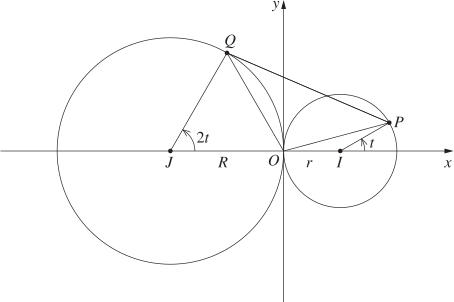
--- 8 WORK AREA LINES (style=lined) --- The point \(P\) lies on the circle centred at \(I(r, 0)\) with radius \(r>0\), such that \(\overrightarrow{I P}\) makes an angle of \(t\) to the horizontal. The point \(Q\) lies on the circle centred at \(J(-R, 0)\) with radius \(R>0\), such that \(\overrightarrow{J Q}\) makes an angle of \(2 t\) to the horizontal. --- 10 WORK AREA LINES (style=lined) ---
i. \(=\dfrac{1}{2} \big{|} r(1+\cos\ t) \cdot R \sin\ 2t-r\ \sin\ t\ \cdot R(\cos\ 2t-1)\ \big{|} \) \(f(\pi) = f(- \pi) = 0\) \(\therefore A_{\triangle AOB}\ \text{is maximum when}\ \ t=\dfrac{\pi}{3}, \ – \dfrac{\pi}{3} \)
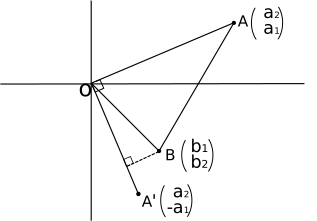
\(\Big{|}\text{proj}_{\overrightarrow{OA^{′}}} \overrightarrow{OB} \Big{|}\)
\(=\ \text{⊥ height of}\ \triangle OAB\ \text{from side}\ \overrightarrow{OA} \)
\(= \Bigg{|} \dfrac{\overrightarrow{OB} \cdot \overrightarrow{OA^{′}}}{|\overrightarrow{OA^{′}}|} \Bigg{|} \)
\(= \Bigg{|} \dfrac{b_1a_2-b_2a_1}{|\overrightarrow{OA^{′}}|} \Bigg{|} \)
\(\text{Area}\ \triangle AOB\)
\(=\dfrac{1}{2} \Bigg{|} \dfrac{b_1a_2-b_2a_1}{|\overrightarrow{OA^{′}}|} \Bigg{|} \cdot |\overrightarrow{OA} | \)
\(=\dfrac{1}{2}\left|a_1 b_2-a_2 b_1\right|\ \ \ (\text{noting}\ \ |\overrightarrow{OA} |=|\overrightarrow{OA^{′}} |) \)
ii.
\(\overrightarrow{OP}\)
\(=\overrightarrow{OI}+\overrightarrow{IP}\)
\(= \left(\begin{array}{l}r \\ 0\end{array}\right) + \left(\begin{array}{c} r\ \cos \ t \\ r\ \sin \ t\end{array}\right) \)
\(= \left(\begin{array}{c} r(1+ \cos \ t) \\ r\ \sin \ t\end{array}\right) \)
\(\overrightarrow{OQ}\)
\(=\overrightarrow{OJ}+\overrightarrow{JQ}\)
\(= \left(\begin{array}{c} -R \\ 0 \end{array}\right) + \left(\begin{array}{l} R\ \cos\ 2t \\ R\ \sin\ 2t\end{array}\right) \)
\(= \left(\begin{array}{c} R(\cos\ 2t-1) \\ R\ \sin\ 2t\end{array}\right) \)
\(\text{Using part (i):}\)
\(A_{\triangle OPQ}\)
\(=\dfrac{rR}{2} \big{|} \sin\ 2t+\cos\ t\ \sin\ 2t-\sin\ t\ \cos\ 2t+\sin\ t\ \big{|} \)
\(=\dfrac{rR}{2} \big{|} \sin\ 2t+\sin\ t\ + \sin(2t-t) \big{|} \)
\(=\dfrac{rR}{2} \big{|} 2\sin\ t\ \cos\ t +2\sin\ t \big{|} \)
\(= rR \big{|} \sin\ t(\cos\ t+1) \big{|} \)
\(\text{Let}\ \ f(t)=\sin\ t(\cos\ t+1) \)
\(f^{′}(t) \)
\(=\cos\ t(\cos\ t+1)+\sin\ t(-\sin\ t) \)
\(=\cos^{2}t+\cos\ t-\sin^{2}t\)
\(=\cos^{2}t+\cos\ t-(1-\cos^{2}t) \)
\(=2\cos^{2}t+\cos\ t-1 \)
\(=(2\cos^{2}t-1)(\cos\ t+1) \)
\(\text{SP’s when}\ \ f^{′}(t)=0:\)
\(\cos\ t\)
\(=\dfrac{1}{2} \)
\(\cos\ t\)
\(=-1\)
\(t\)
\(=\dfrac{\pi}{3}, \ – \dfrac{\pi}{3} \)
\(t\)
\(=\pi, \ -\pi \)
\(\text{Testing SP’s:}\)
Vectors, EXT1 V1 2020 HSC 9 MC
The projection of the vector `((6),(7))` onto the line `y = 2x` is `((4),(8))`.
The point `(6, 7)` is reflected in the line `y = 2x` to a point `A`.
What is the position vector of the point `A`?
- `((6),(12))`
- `((2),(9))`
- `((−6),(7))`
- `((−2),(1))`
Show Worked Solution
`text(Graph the projection and reflection:)`
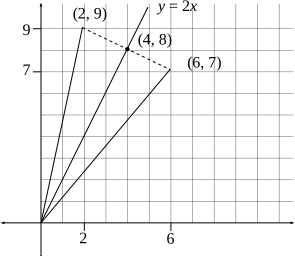
`=>B`