SmarterEd

Aussie Maths & Science Teachers: Save your time with SmarterEd

  • Login
  • Get Help
  • About

Vectors, EXT1 V1 2025 HSC 8 MC

Points \(A\) and \(B\) have non-zero, non-parallel position vectors \(\underset{\sim}{a}\) and \(\underset{\sim}{b}\) respectively.

Point \(C\) has position vector  \(\underset{\sim}{c}=3 \underset{\sim}{a}-2 \underset{\sim}{b}\).

The points \(A, B\) and \(C\) lie on the same line.

Which of the following must be true?

  1. Point \(A\) always lies between Points \(B\) and \(C\).
  2. Point \(B\) always lies between Points \(A\) and \(C\).
  3. Point \(C\) always lies between Points \(A\) and \(B\).
  4. The order of the points cannot be determined.
Show Answers Only

\(A\)

Show Worked Solution

\(\underset{\sim}{c}=3 \underset{\sim}{a}-2 \underset{\sim}{b}\ \ldots\  (1)\)

\(\text{Since \(A, B\) and \(C\) are collinear:}\)

\(\overrightarrow{A C}\) \(=\lambda \overrightarrow{A B}\)
\(\underset{\sim}{c}-\underset{\sim}{a}\) \(=\lambda(\underset{\sim}{b}-\underset{\sim}{a})\)
\(\underset{\sim}{c}\) \(=\underset{\sim}{a}+\lambda(\underset{\sim}{b}-\underset{\sim}{a})\)
\(\lambda\) \(=-2\ \text{(see (1) above)}\)


\(\Rightarrow A\)

Filed Under: Vectors and Geometry (Ext1) Tagged With: Band 5, smc-1211-80-Collinear

Vectors, EXT1 V1 EQ-Bank 3

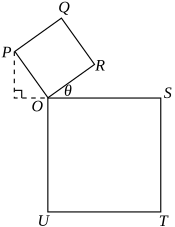
Two squares \(OPQR\) and \(OSTU\), are drawn in the diagram below, with  \(O R=1, OS=2\)  and  \(\angle S O R=\theta\)  where  \(0^{\circ} \leqslant \theta \leqslant 90^{\circ}\).

Let  \(\overrightarrow{O S}=2 \underset{\sim}{i}\)  and  \(\overrightarrow{O U}=-2 \underset{\sim}{j}.\)
 

  1. Using vector methods, show  \(\overrightarrow{OP}=-\sin \theta \underset{\sim}{i}+\cos \theta \underset{\sim}{j}\).    (2 marks)

    --- 6 WORK AREA LINES (style=lined) ---

  2. Using vector methods, show that if \(Q, R\) and \(T\) are collinear,  \(\cos \theta-\sin \theta=\dfrac{1}{2}\).    (3 marks)

    --- 9 WORK AREA LINES (style=lined) ---

Show Answers Only

a.   \(\text{Proof (Show worked solutions)}\)

b.   \(\text{Proof (Show worked solutions)}\)

Show Worked Solution

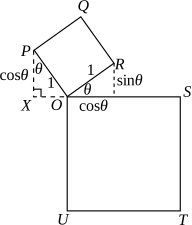
a.    \(\text{Show} \ \ \overrightarrow{OP}=-\sin \theta \underset{\sim}{i}+\cos \theta \underset{\sim}{j}\)

\(\angle P O R\) \(=90^{\circ} \ \text{(internal angle of square)}\)
\(\angle XOP\) \(=(90-\theta)^{\circ}\ \ (\text{\(180^{\circ}\) in straight line)}\)
\(\angle XPO\) \(=\theta\ \ \left(180^{\circ} \ \text{in} \ \Delta XPO \right)\)
\(XP\) \(=\cos \theta\)
\(XO\) \(=\sin \theta\)

  
\(\therefore \overrightarrow{OP}=-\sin \theta\underset{\sim}{i}+\cos \theta\underset{\sim}{j}\)
 

b.    \(\text{If   \(Q, R, T\)  are collinear:}\)

\(m_{\overrightarrow{QR}}=m_{\overrightarrow{R T}} \quad \text{(same gradient through \(R)\)}\)

\(m_{\overrightarrow{Q R}}=m_{\overrightarrow{O P}}=\dfrac{\cos \theta}{-\sin \theta}\ \ \text{(opposite sides of a square)}\)
 

\(\displaystyle T\binom{2}{-2}, R\binom{\cos \theta}{\sin \theta}\)

\(m_{\overrightarrow{R T}}=\dfrac{\sin \theta+2}{\cos \theta-2}\)
 

\(\text{Equating gradients:}\)

\(\dfrac{\cos \theta}{-\sin \theta}\) \(=\dfrac{\sin \theta+2}{\cos \theta-2}\)
\(\cos ^2 \theta-2 \cos \theta\) \(=-\sin ^2 \theta-2 \sin \theta\)
\(\cos ^2 \theta+\sin ^2 \theta\) \(=2 \cos \theta-2 \sin \theta\)
\(1\) \(=2(\cos \theta-\sin \theta)\)
\(\dfrac{1}{2}\) \(=\cos \theta-\sin \theta\)

 
\(\therefore Q, R \ \text{and \(T\) are collinear when  \(\cos \theta-\sin \theta=\dfrac{1}{2}\)}\).

Filed Under: Vectors and Geometry (Ext1) Tagged With: Band 4, Band 5, smc-1211-15-Square, smc-1211-80-Collinear

Copyright © 2014–2025 SmarterEd.com.au · Log in