SmarterEd

Aussie Maths & Science Teachers: Save your time with SmarterEd

  • Login
  • Get Help
  • About

Calculus, 2ADV C4 2024 HSC 10 MC

The diagram shows the graph  \(y = f(x)\).
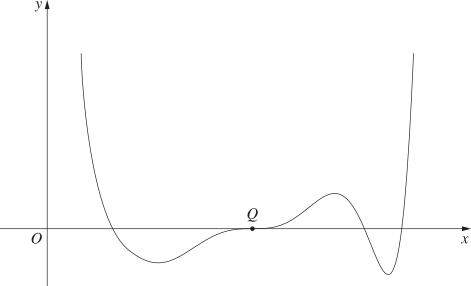
 

The point \(Q\) is a horizontal point of inflection.

Let  \(A(x)= \displaystyle \int_0^x f(t)\,dt\).

How many points of inflection does the graph  \(y=A(x)\)  have?

  1. \(2\)
  2. \(3\)
  3. \(4\)
  4. \(5\)
Show Answers Only

\(B\)

Show Worked Solution

\(A(x) = \displaystyle \int_0^x f(t)\,dt \ \text{(note this definite integral produces a}\ F(x)\text{)}\)

\(A^{′}(x) = f(x) \)

\(A^{″}(x) = f^{′}(x) \)

♦♦ Mean mark 41%.

\(\text{POI requirements:}\ A^{″}(x) = 0\ \text{and sign (concavity) changes either side.}\)

\(\text{Inspect graph of}\ f(x)\ \text{to find where}\ \ f^{′}(x)=0\ \ \text{and gradient changes}\)

\(\text{either side of possible points.}\)

\(\text{→ the three turning points all qualify}\)

\(\text{→ point}\ Q\ \text{does not qualify (gradient is positive both sides)}\)

\(\Rightarrow B\)

Filed Under: Other Integration Applications (Y12) Tagged With: Band 5, smc-1213-30-Other applications

Calculus, 2ADV C4 2021 HSC 27

Kenzo has a solar powered phone charger. Its power, `P`, can be modelled by the function

`P(t) = 400 sin(pi/12 t),\ \ 0 <= t <= 12`,

where  `t`  is the number of hours after sunrise.

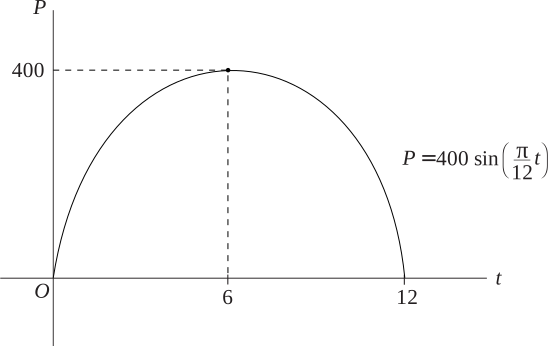
  1. Sketch the graph of  `P` for  `0 ≤ t ≤ 12`.  (2 marks)

    --- 8 WORK AREA LINES (style=lined) ---

Power is the rate of change of energy. Hence the amount of energy, `E` units, generated by the solar powered phone charger from  `t = a`  to  `t = b`,  where  `0 ≤ a ≤ b ≤ 12` is given by

`E = int_a^b P(t)\ dt`.

  1. Show that  `E = 4800/pi (cos\ (api)/12 - cos\ (bpi)/12)`.  (2 marks)

    --- 4 WORK AREA LINES (style=lined) ---

  2. To make a phone call, a phone battery needs at least 300 units of energy. Kenzo woke up 3 hours after sunrise and found that his phone battery had no units of energy. He immediately began to use his solar powered charger to charge his phone battery.
  3. Find the least amount of time he needed to wait before he could make a phone call. Give your answer correct to the nearest minute.  (3 marks)

    --- 6 WORK AREA LINES (style=lined) ---

  4. The next day, Kenzo woke up 6 hours after sunrise and again found that his phone battery had no units of energy. He immediately began to use his solar powered charger to charge his phone battery.
  5. Would it take more time or less time or the same amount of time, compared to the answer in part (c), to charge his phone battery in order to make a phone call? Explain your answer by referring to the graph drawn in part (a).  (1 mark)

    --- 2 WORK AREA LINES (style=lined) ---
Show Answers Only
  1.  
  2. `text(See Worked Solution)`
  3. `text(57 minutes)`
  4. `text(The power produced is at its peak when)\ t = 6`
  5. `:.\ text(It will charge in less time.)`
Show Worked Solution

a.

b.    `E` `= int_a^b 400 sin(pi/12 t)\ dt`
    `= [-400 · 12/pi cos(pi/12 t)]_a^b`
    `= -4800/pi cos(pi/12 b) – (-4800/pi cos(pi/12 a))`
    `= 4800/pi(cos\ (api)/12 – cos\ (bpi)/12)`


♦♦ Mean mark part (c) 29%
COMMENT: It is arguable that the nearest minute may also be 3h 58 m as the phone is not adequately charged at 3h 57 m.

c.   `text(Find)\ \ b\ \ text(given)\ \ E = 300\ \ text(and)\ \ a = 3:`

`300` `= 4800/pi (cos\ pi/4 – cos\ (bpi)/12)`
`(300pi)/4800` `= 1/sqrt2 – cos\ (bpi)/12`
`cos\ (bpi)/12` `= 1/sqrt2 – pi/16`
`(bpi)/12` `= cos^(-1) (1/sqrt2 – pi/16)`
`b` `= 12/pi cos^(-1)(1/sqrt2 – pi/16)`
  `= 3.952…`
  `= 3\ text{h 57 m  (nearest minute)}`

 
`:.\ text(Least time before phone is charged = 57 minutes)`


♦♦ Mean mark part (d) 22%

d.   `text(The power produced is at its peak when)\ \ t = 6.`

`:.\ text(It will charge in less time.)`

Filed Under: Other Integration Applications (Y12) Tagged With: Band 4, Band 5, smc-1213-30-Other applications

Copyright © 2014–2025 SmarterEd.com.au · Log in