SmarterEd

Aussie Maths & Science Teachers: Save your time with SmarterEd

  • Login
  • Get Help
  • About

BIOLOGY, M5 2025 HSC 4 MC

A storm randomly kills 80% of the frog population on an island. The allele frequencies in the frog population after the storm are notably different to those of the population before the storm.

What is the process that has led to the change in allele frequencies?

  1. Gene flow
  2. Genetic drift
  3. Natural selection
  4. Survival of the fittest
Show Answers Only

\(B\)

Show Worked Solution
  • B is correct: Random events changing allele frequencies in populations is genetic drift.

Other Options:

  • A is incorrect: Gene flow involves movement of alleles between populations through migration.
  • C is incorrect: Natural selection involves differential survival based on advantageous traits.
  • D is incorrect: Survival of fittest is non-random selection, not random mortality.

Filed Under: Genetic Variation / Inheritance Tagged With: Band 5, smc-3648-70-Allele Frequency Data

BIOLOGY, M5 2019 HSC 33b

Alzheimer's disease causes destruction of brain tissue, dementia and eventually death.

The gene with the greatest known effect on the risk of developing late-onset Alzheimer's disease is called APOE. It is found on chromosome 19.

The APOE gene has multiple alleles, including e2, e3 and e4 .

  1.  What are multiple alleles?   (2 marks)

    --- 4 WORK AREA LINES (style=lined) ---

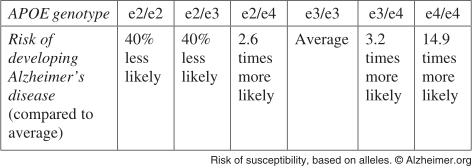
  2. The table shows the risk of developing Alzheimer's disease for various APOE genotypes compared to average risk in the population.


  1. Analyse the data to assess the risk of developing Alzheimer's disease associated with the e2, e3 and e4 alleles.   (4 marks)

    --- 10 WORK AREA LINES (style=lined) ---

Show Answers Only

i.     Multiple alleles

  • Alleles are the different variations of the same gene.
  • While most genes only have two alleles, dominant and recessive, some genes have 3 or more versions of itself. This phenomena is referred to as the gene having “multiple alleles”.

ii.  Analysis of data 

  • The table indicates that the alleles follow a hierarchy and have influence over the risk of Alzheimer’s, with certain combinations masking effects of others or amplifying them.
  • The e2 allele in both a homozygous genotype and coupled with e3 reduces the risk of Alzheimer’s by 40%. This suggests that the e2 allele is the one which reduces the risk of Alzheimer’s and can mask the effect of e3.
  • However, when coupled with e4, the risk of developing Alzheimer’s is 2.6 times more likely. This suggests that e4 is the more dominant allele.
  • The e4/e3 genotype also makes Alzheimer’s 3.2 times more likely in those individuals, and the e4/e4 genotypes makes it 14.9 times more likely. We can then make the conclusion that the e4 allele makes Alzheimer’s much more common in any genotype where it is present.
  • The e3 allele seems to be completely neutral and almost completely masked by both e2 and e4. In its homozygous genotype, it has no effect on the risk of developing Alzheimer’s, and when heterozygous with either e2 or e4, has little to no effect on the risk in comparison the e2 and e4’s homozygous genotypes.
  • It would then be accurate to conclude that the allele hierarchy is e3<e2<e4, with e3 being neutral and having no known effect, e2 reducing the risk of Alzheimer’s and e4 greatly increasing the risk of developing Alzheimer’s.
Show Worked Solution

i.     Multiple alleles

  • Alleles are the different variations of the same gene.
  • While most genes only have two alleles, dominant and recessive, some genes have 3 or more versions of itself. This phenomena is referred to as the gene having “multiple alleles”. 

♦♦♦ Mean mark (i) 24%.

ii.  Analysis of data 

  • The table indicates that the alleles follow a hierarchy and have influence over the risk of Alzheimer’s, with certain combinations masking effects of others or amplifying them.
  • The e2 allele in both a homozygous genotype and coupled with e3 reduces the risk of Alzheimer’s by 40%. This suggests that the e2 allele is the one which reduces the risk of Alzheimer’s and can mask the effect of e3.
  • However, when coupled with e4, the risk of developing Alzheimer’s is 2.6 times more likely. This suggests that e4 is the more dominant allele.
  • The e4/e3 genotype also makes Alzheimer’s 3.2 times more likely in those individuals, and the e4/e4 genotypes makes it 14.9 times more likely. We can then make the conclusion that the e4 allele makes Alzheimer’s much more common in any genotype where it is present.
  • The e3 allele seems to be completely neutral and almost completely masked by both e2 and e4. In its homozygous genotype, it has no effect on the risk of developing Alzheimer’s, and when heterozygous with either e2 or e4, has little to no effect on the risk in comparison the e2 and e4’s homozygous genotypes.
  • It would then be accurate to conclude that the allele hierarchy is e3<e2<e4, with e3 being neutral and having no known effect, e2 reducing the risk of Alzheimer’s and e4 greatly increasing the risk of developing Alzheimer’s.

♦♦ Mean mark (ii) 40%.

Filed Under: Epidemiology, Genetic Variation / Inheritance Tagged With: Band 5, Band 6, smc-3648-70-Allele Frequency Data, smc-3661-10-Analysing Results

BIOLOGY, M6 2022 HSC 32

Researchers have identified a gene that determines the inflammatory response of lung cells to infection with a virus. An allele of this gene is associated with increased inflammation and increased chance of death from the virus.

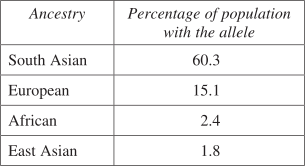
The table shows the percentage presence of the allele in people with different ancestries.
 

Explain how mutation, natural selection, genetic drift and gene flow could have led to these differences in the gene pools of populations with differing ancestry.   (7 marks)

--- 15 WORK AREA LINES (style=lined) ---

Show Answers Only

Mutation

  • A mutation is a mechanism of change which permanently alters DNA, changing genotype and phenotype of the ‘host’.
  • In this case, a mutation has occurred which has altered the gene responsible for the inflammatory response in the lungs in response to a virus, making death more common for people who contract the virus as the gene is now faulty.
  • Other mechanisms of variation such as natural selection, gene flow and genetic drift, are responsible for the allele frequency distribution.

Natural selection

  • Refers to the process where selection pressures such as predators, climate, or in this case the lung virus, favour certain individuals, which then means that their alleles can be carried into further generations.
  • It is highly likely that the virus was never present in South Asia, hence the high frequency in South Asian people (60.3%); the allele was negligible.
  • The virus most likely was present in Europe, Africa and East Asia (<15%) and was responsible for almost eliminating the allele in these populations.

Gene flow

  • Gene Flow is the movement of alleles into new populations, usually via migration.
  • Interbreeding between the migrated individual in the new population with the allele, in conjunction with processes such as natural selection can cause the allele to be prominent in the new population.
  • The allele could have originated in South Asia, and gene flow may be responsible for the other frequencies, especially in Europe.

Genetic drift

  • This occurs when populations experience drastic changes in allele frequencies due to random chance events.
  • These events, such as a natural disaster or re-establishing a new population, can eliminate or change the allele frequency and do not cater towards any genotype. 
  • It is possible genetic drift is responsible for the comparatively high allele frequency in South Asia, or the relatively low frequency in Africa and East Asia.
Show Worked Solution

Mutation

  • A mutation is a mechanism of change which permanently alters DNA, changing genotype and phenotype of the ‘host’.
  • In this case, a mutation has occurred which has altered the gene responsible for the inflammatory response in the lungs in response to a virus, making death more common for people who contract the virus as the gene is now faulty.
  • Other mechanisms of variation such as natural selection, gene flow and genetic drift, are responsible for the allele frequency distribution.

Natural selection

  • Refers to the process where selection pressures such as predators, climate, or in this case the lung virus, favour certain individuals, which then means that their alleles can be carried into further generations.
  • It is highly likely that the virus was never present in South Asia, hence the high frequency in South Asian people (60.3%); the allele was negligible.
  • The virus most likely was present in Europe, Africa and East Asia (<15%) and was responsible for almost eliminating the allele in these populations.

Gene flow

  • Gene Flow is the movement of alleles into new populations, usually via migration.
  • Interbreeding between the migrated individual in the new population with the allele, in conjunction with processes such as natural selection can cause the allele to be prominent in the new population.
  • The allele could have originated in South Asia, and gene flow may be responsible for the other frequencies, especially in Europe.

Genetic drift

  • This occurs when populations experience drastic changes in allele frequencies due to random chance events.
  • These events, such as a natural disaster or re-establishing a new population, can eliminate or change the allele frequency and do not cater towards any genotype. 
  • It is possible genetic drift is responsible for the comparatively high allele frequency in South Asia, or the relatively low frequency in Africa and East Asia.

♦♦♦ Mean mark 32%.

Filed Under: Genetic Variation / Inheritance, Mutation Tagged With: Band 5, Band 6, smc-3648-70-Allele Frequency Data, smc-3652-10-Mechanisms of Change/Variation, smc-3652-55-Mutation in Reproduction

BIOLOGY, M5 2021 HSC 10 MC

Cystic fibrosis is an autosomal recessive disorder caused by mutations in the CFTR gene. Many different recessive alleles cause cystic fibrosis.

The four most common alleles of the CFTR gene and their frequencies in the Australian population are shown in the table.
 

\begin{array}{|c|c|}
\hline \rule{0pt}{2.5ex}\quad \quad \textit{Allele} \quad \quad& \ \ \textit{Frequency of allele (%)}\ \ \\
\hline \rule{0pt}{2.5ex}\text{A} \rule[-1ex]{0pt}{0pt}& 98.33 \\
\hline \rule{0pt}{2.5ex}\text{al} \rule[-1ex]{0pt}{0pt}& 1.13 \\
\hline \rule{0pt}{2.5ex}\text{a2}\rule[-1ex]{0pt}{0pt}& 0.08 \\
\hline \rule{0pt}{2.5ex}\text{a3} \rule[-1ex]{0pt}{0pt}& 0.07 \\
\hline
\end{array}


What will be the most common genotype of cystic fibrosis patients in Australia?

  1. a1/a1
  2. a1/a2
  3. A/a1
  4. A/A
Show Answers Only

\(A\)

Show Worked Solution
  • A (dominant) where a single copy produces a normal phenotype.
  • a1 and a2 produce cystic fibrosis, with a1 having the highest frequency.
  • Most likely genotype of cystic fibrosis patient is a1/a1.

\(\Rightarrow A\)


♦♦♦ Mean mark 22%.

Filed Under: Genetic Variation / Inheritance Tagged With: Band 6, smc-3648-70-Allele Frequency Data

Copyright © 2014–2025 SmarterEd.com.au · Log in