SmarterEd

Aussie Maths & Science Teachers: Save your time with SmarterEd

  • Login
  • Get Help
  • About

BIOLOGY, M5 2025 HSC 33

The following diagram shows the cell division processes occurring in two related individuals.
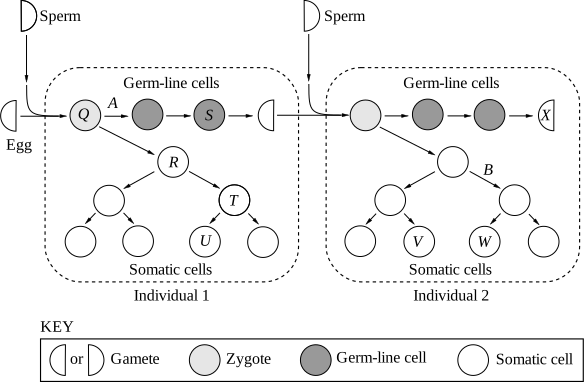
 

  1. Compare the cell division processes carried out by cells \(R\) and \(S\) in Individual 1.   (3 marks)

    --- 8 WORK AREA LINES (style=lined) ---

  2. Explain the relationship between Individuals 1 and 2.   (2 marks)

    --- 3 WORK AREA LINES (style=lined) ---

  3. \(A\) and \(B\) are two separate mutations. Analyse how mutations \(A\) and \(B\) affect the genetic information present in cells  \(U\), \(V\), \(W\) and \(X\).   (4 marks)

    --- 12 WORK AREA LINES (style=lined) ---
Show Answers Only

a.    Similarities:

  • Both cell R and cell S undergo cell division to produce daughter cells.

Differences:

  • Cell R undergoes mitosis producing two genetically identical diploid somatic cells (T and U).
  • Cell S undergoes meiosis producing four genetically different haploid gametes.
  • Mitosis in R maintains chromosome number for growth and repair.
  • Meiosis in S reduces chromosome number by half for sexual reproduction and genetic variation.

b.    Relationship between Individuals 1 and 2

  • Individual 2 is the offspring of Individual 1.
  • This is because Individual 1’s germ-line cell S produces a gamete (sperm) which fertilises an egg to form the zygote that develops into Individual 2.

c.    Mutation’s affect on genetic information

  • Mutation A occurs in the germ-line pathway after zygote Q. This means that mutation A is present in cell S and is passed to cell X.
  • Mutation A does not affect cells U, V or W because it occurred after the R/S split, so the R lineage and Individual 2’s somatic cells lack it.
  • Mutation B occurs in Individual 2’s somatic pathway. This results in mutation B being present in cells V and W only.
  • The significance is that only mutation A can be inherited by offspring, while mutation B cannot.
Show Worked Solution

a.    Similarities:

  • Both cell R and cell S undergo cell division to produce daughter cells.

Differences:

  • Cell R undergoes mitosis producing two genetically identical diploid somatic cells (T and U).
  • Cell S undergoes meiosis producing four genetically different haploid gametes.
  • Mitosis in R maintains chromosome number for growth and repair.
  • Meiosis in S reduces chromosome number by half for sexual reproduction and genetic variation.

b.    Relationship between Individuals 1 and 2

  • Individual 2 is the offspring of Individual 1.
  • This is because Individual 1’s germ-line cell S produces a gamete (sperm) which fertilises an egg to form the zygote that develops into Individual 2.

c.    Mutation’s affect on genetic information

  • Mutation A occurs in the germ-line pathway after zygote Q. This means that mutation A is present in cell S and is passed to cell X.
  • Mutation A does not affect cells U, V or W because it occurred after the R/S split, so the R lineage and Individual 2’s somatic cells lack it.
  • Mutation B occurs in Individual 2’s somatic pathway. This results in mutation B being present in cells V and W only.
  • The significance is that only mutation A can be inherited by offspring, while mutation B cannot.

Filed Under: Cell Replication, Mutation Tagged With: Band 5, Band 6, smc-3649-20-Meiosis, smc-3649-30-Mitosis, smc-3652-20-Somatic vs. Germ-Line

BIOLOGY, M5 2025 HSC 17 MC

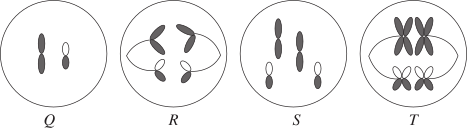
Some phases of cell division in an organism are shown.
  

What is the correct sequence of the process?

  1. Q, S, R, T
  2. Q, R, S, T
  3. S, T, R, Q
  4. S, R, T, Q
Show Answers Only

\(C\)

Show Worked Solution
  • C is correct: The sequence represents meiotic or mitotic division: S (prophase) → T (metaphase) → R (anaphase) → Q (telophase).

Other Options:

  • A is incorrect: Places Q (telophase) at the beginning instead of end.
  • B is incorrect: Places Q (telophase) at the beginning and wrong sequence.
  • D is incorrect: Places R (anaphase) before T (metaphase), reversing the actual order.

Filed Under: Cell Replication Tagged With: Band 4, smc-3649-30-Mitosis

BIOLOGY, M5 2024 HSC 14 MC

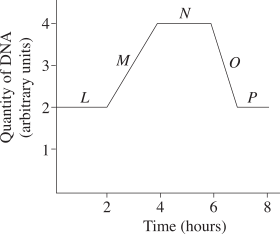
The graph shows the quantity of DNA in one mammalian cell over time.
 

Which of the statements about the cell's activity is correct?

  1. The cell is dividing during section \(O\).
  2. The cell is inactive for the first two hours.
  3. The cell takes one hour to replicate its DNA.
  4. The cell becomes diploid only during section \(N\).
Show Answers Only

\(A\)

Show Worked Solution
  • Section \(O\) shows the DNA quantity decreasing sharply, which occurs during cell division (mitosis).
  • At this stage, the parent cell splits into two daughter cells, each receiving half of the DNA content.

\(\Rightarrow A\)

♦ Mean mark 50%.

Filed Under: Cell Replication Tagged With: Band 5, smc-3649-30-Mitosis

BIOLOGY, M5 2021 HSC 17 MC

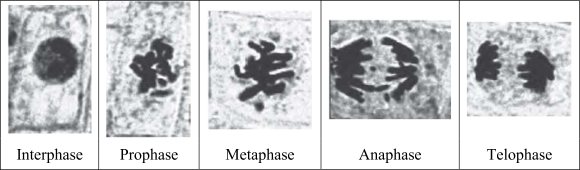
The images show the sequence of changes in the chromosomes (stained black) during mitosis in plant cells.

Which statement is true for mitosis?

  1. Crossing over occurs during prophase.
  2. Sister chromatids separate during anaphase.
  3. Two daughter cells are produced during telophase.
  4. Homologous pairs of chromosomes line up in metaphase.
Show Answers Only

`B`

Show Worked Solution
  • Anaphase is the process in which the sister chromatids move away from one another to opposite poles of the spindle and thus separate in mitosis.

`=>B`

♦ Mean mark 45%.

Filed Under: Cell Replication Tagged With: Band 5, smc-3649-30-Mitosis

BIOLOGY, M5 2018 HSC 4 MC

Which of the following describes the daughter cells produced as a result of mitosis?

  1. Two genetically different cells
  2. Two genetically identical cells
  3. Four genetically different cells
  4. Four genetically identical cells
Show Answers Only

`B`

Show Worked Solution
  • Mitosis is the division of the nucleus which produces two identical sets of DNA, and therefore two identical daughter cells.

`=>B`

Filed Under: Cell Replication Tagged With: Band 4, smc-3649-30-Mitosis

Copyright © 2014–2025 SmarterEd.com.au · Log in