SmarterEd

Aussie Maths & Science Teachers: Save your time with SmarterEd

  • Login
  • Get Help
  • About

BIOLOGY, M7 2024 HSC 13 MC

Which of the following identifies plant responses to pathogens?

  1. Increased phagocytosis and programmed cell death
  2. Increased number of stomata and programmed cell death
  3. Production of antihistamines and increased thickness of cell walls
  4. Production of antimicrobial substances and increased thickness of cell walls
Show Answers Only

\(D\)

Show Worked Solution
  • Plants respond to pathogens by producing antimicrobial substances and strengthening their cell walls for enhanced physical defence.
  • The other options either describe animal immune responses (phagocytosis, antihistamines) or incorrect plant responses (increased stomata).

\(\Rightarrow D\)

♦ Mean mark 47%.

Filed Under: Immunity and Responses to Pathogens Tagged With: Band 5, smc-3657-40-Plant Responses

BIOLOGY, M7 2023 HSC 13 MC

Australian native plants can be infected by fungal and viral pathogens.

Which of the following is an active plant response to infection by pathogens?

  1. Phagocytosis
  2. Programmed cell death
  3. Formation of powdery spots
  4. Development of small stomata
Show Answers Only

\(B\)

Show Worked Solution

By Elimination:

  • Phagocytosis is a response in animals, not plants (Eliminate A).
  • The formation of powdery spots (commonly called powdery mildew) is a sign of fungal infection, not a response (Eliminate C).
  • Small stomata are an evolutionary adaptation to reduce water loss, not a response to infection (Eliminate D).

\(\Rightarrow B\)

♦ Mean mark 48%.

Filed Under: Immunity and Responses to Pathogens Tagged With: Band 5, smc-3657-40-Plant Responses

BIOLOGY, M7 EQ-Bank 25

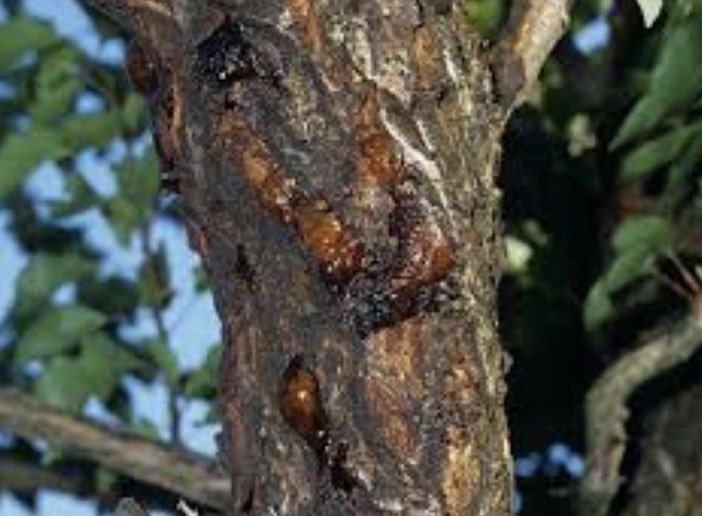
A silver birch tree, Butula pendula, has been attacked by a fungal stem canker. Fungal cankers are opportunistic plant pathogens that gain access to the inner layers of the stem as a result of damage to the protective outer layer of bark. The inner layers provide suitable conditions for the fungus to grow. Once established it destroys the bark cells that protect the tree. The tree responds to the presence of the canker under its bark by producing an excess of resinous sap at the wound site.
 

  1. Using the information provided, suggest a hypothesis to explain how the tree is responding to the presence of the canker.   (2 marks)

    --- 4 WORK AREA LINES (style=lined) ---

  2. Consider another plant with a different response to a specific pathogen.
  3. Compare the necessity and limitations of this plant's response with the response of the birch tree described above.   (4 marks)

    --- 8 WORK AREA LINES (style=lined) ---

Show Answers Only

a.    Hypothesis of birch tree response:

  • Excess sap production alters the growth conditions of the canker.
  • The sap will change the chemical environment around the wound site and inflame the site to reduce the spread of the pathogen, much similar to inflammation in humans. 

b.   Red river gum comparison

  • The river red gum responds to halo leaf spot cankers by dropping its leaves.
  • While this means the tree will have to expend energy and resources regrowing leaves, it simultaneously counteracts the canker as it blocks the ability of the leaves to photosynthesise.
  • By dropping the affected leaves, the tree can grow them quicker than if the leaves were left to die.
  • The birch tree will counteract a stem canker by producing excess sap. While this may not completely get rid of any pathogens, the tree cannot simply remove its own stems like the river red gum.
  • This method isolates the infected area, similar to inflammation, retarding its growth and potentially killing the fungus.
  • The isolation reduces the canker’s ability to adversely effect the birch tree’s supply of water and nutrients via the xylem and phloem of the tree.
  • This process occurs with the canker still attached to the tree, making the fungus relatively more difficult to kill.
Show Worked Solution

a.    Hypothesis of birch tree response:

  • Excess sap production alters the growth conditions of the canker.
  • The sap will change the chemical environment around the wound site and inflame the site to reduce the spread of the pathogen, much similar to inflammation in humans. 

b.   Red river gum comparison

  • The river red gum responds to halo leaf spot cankers by dropping its leaves.
  • While this means the tree will have to expend energy and resources regrowing leaves, it simultaneously counteracts the canker as it blocks the ability of the leaves to photosynthesise.
  • By dropping the affected leaves, the tree can grow them quicker than if the leaves were left to die.
  • The birch tree will counteract a stem canker by producing excess sap. While this may not completely get rid of any pathogens, the tree cannot simply remove its own stems like the river red gum.
  • This method isolates the infected area, similar to inflammation, retarding its growth and potentially killing the fungus.
  • The isolation reduces the canker’s ability to adversely effect the birch tree’s supply of water and nutrients via the xylem and phloem of the tree.
  • This process occurs with the canker still attached to the tree, making the fungus relatively more difficult to kill.

Filed Under: Immunity and Responses to Pathogens Tagged With: Band 4, Band 5, smc-3657-40-Plant Responses

Copyright © 2014–2025 SmarterEd.com.au · Log in