SmarterEd

Aussie Maths & Science Teachers: Save your time with SmarterEd

  • Login
  • Get Help
  • About

BIOLOGY, M7 SM-Bank 23

Smallpox is widely believed to be the cause of the significant population decline in Indigenous populations during early European arrival in Australia. Recent research suggests that it may have been chickenpox that caused the change in population numbers rather than smallpox. It is thought that chickenpox did not exist in Aboriginal and Torres Strait Islander communities before European arrival. Chickenpox is fairly mild in young children and is easily transmitted. It can be a fatal disease in adults who were not infected as children.

The graph below shows population numbers during the period 1780 –1850:

    • the estimated Aboriginal Australian population
    • the colonist population
    • the estimated total Australian population
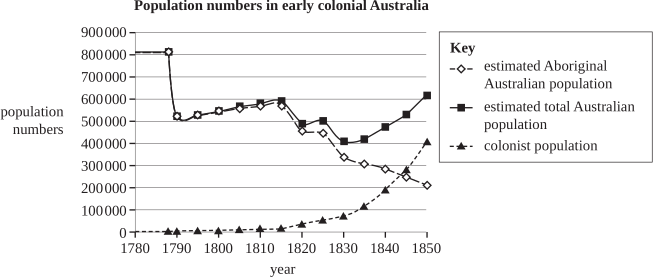
       

With reference to chickenpox, explain how infection may have caused such a large impact on the Aboriginal Australian population and yet did not affect the population numbers of the colonists significantly, and why the Aboriginal population increased from 1790 to 1810.  (3 marks)

Show Answers Only
  • Childhood immunity existed in colonists due to previous exposure prior to arrival in Australia.
  • No immunity existed for the Aboriginal Australian population due to no previous exposure.
  • Aboriginal children became mildly ill when exposed in the early days of colonialism and became immune.
  • Aboriginal adults caught chickenpox in the early days of colonialism and died in disproportionately high numbers.
  • The initial exposure caused a steep decline in overall Aboriginal population. However, once Aboriginal children were immune and susceptible adults had died, there was an increase of population numbers over the next 30 years, from 1790 – 1810.
Show Worked Solution
  • Childhood immunity existed in colonists due to previous exposure prior to arrival in Australia.
  • No immunity existed for the Aboriginal Australian population due to no previous exposure.
  • Aboriginal children became mildly ill when exposed in the early days of colonialism and became immune.
  • Aboriginal adults caught chickenpox in the early days of colonialism and died in disproportionately high numbers.
  • The initial exposure caused a steep decline in overall Aboriginal population. However, once Aboriginal children were immune and susceptible adults had died, there was an increase of population numbers over the next 30 years, from 1790 – 1810.

Filed Under: Prevention, Treatment and Control Tagged With: Band 4, smc-3658-40-Interpreting Data, smc-3658-60-Indigenous

BIOLOGY, M7 2022 HSC 26

Jelly Bush honey has been used by Aboriginal Peoples to treat cuts, sores and burns. Recent studies have shown that Jelly Bush honey has a very high level of methylglyoxal which is known to help fight infection.

A scientist wants to test the effectiveness of Jelly Bush honey using agar plates.

Design a safe procedure that the scientist could use in a laboratory to investigate the effectiveness of Jelly Bush honey as a pharmaceutical to inhibit bacterial growth.  (5 marks)

Show Answers Only

STEP 1: Sterilise 5 agar plates to remove contamination.

STEP 2: Set up the 5 agar plates as 1 blank (control), 1 with just bacteria* (control), 1 with bacteria and Jelly Bush honey, 1 with pure methylglyoxal and 1 with bacteria and a known antibiotic which will inhibit the bacterial growth.

*Bacteria must be a pathogen encountered during infection that is also native to Australia.

STEP 3: Store all agar plates in an incubator at 37°C and 1 atm for 5 days.

STEP 4: Record the amount of bacterial growth in each agar plate in comparison to the pure bacteria plate.

STEP 5: Repeat 3 times to ensure no other variables are responsible for inhibiting bacterial growth. 

Experiment summary:

  • This experiment is a valid way of determining Jelly Bush honey as a pharmaceutical as it tests it against pure methylglyoxal (and 2 controls).
  • This experiment should show evidence whether methylglyoxal or some other factor(s) within the honey contribute to its ability to fight infection.
Show Worked Solution

STEP 1: Sterilise 5 agar plates to remove contamination.

STEP 2: Set up the 5 agar plates as 1 blank (control), 1 with just bacteria* (control), 1 with bacteria and Jelly Bush honey, 1 with pure methylglyoxal and 1 with bacteria and a known antibiotic which will inhibit the bacterial growth.

  • *Bacteria must be a pathogen encountered during infection that is also native to Australia.

STEP 3: Store all agar plates in an incubator at 37°C and 1 atm for 5 days.

STEP 4: Record the amount of bacterial growth in each agar plate in comparison to the pure bacteria plate.

STEP 5: Repeat 3 times to ensure no other variables are responsible for inhibiting bacterial growth. 

Experiment summary:

  • This experiment is a valid way of determining Jelly Bush honey as a pharmaceutical as it tests it against pure methylglyoxal (and 2 controls).
  • This experiment should show evidence whether methylglyoxal or some other factor(s) within the honey contribute to its ability to fight infection.

♦ Mean mark 54%.

Filed Under: Prevention, Treatment and Control Tagged With: Band 4, Band 5, smc-3658-11-Pharmaceuticals, smc-3658-60-Indigenous

Copyright © 2014–2025 SmarterEd.com.au · Log in