SmarterEd

Aussie Maths & Science Teachers: Save your time with SmarterEd

  • Login
  • Get Help
  • About

CHEMISTRY, M5 2025 HSC 29

Consider the following reaction.

\(\ce{2NO2(g) \rightleftharpoons N2O4(g) \quad \quad \Delta H= -57.2 \ \text{kJ mol}^{-1}}\)

A sealed reaction vessel of fixed volume contains a mixture of \(\ce{NO2}\) and \(\ce{N2O4}\) gases at equilibrium.

Explain the impact of the addition of argon, an inert gas, on the temperature of the system.   (4 marks)

--- 8 WORK AREA LINES (style=blank) ---
Show Answers Only
  • The equilibrium expression for the reaction is:
  •    \(Q = \dfrac{\ce{[N2O4]}}{\ce{[NO2]^2}} = K_{eq}​\)
  • When argon is added at constant volume, the total pressure increases, but the concentrations of \(\ce{NO2}\) and \(\ce{N2O4}\) remain unchanged because the amount of each gas and the volume remain constant. Since the concentrations in the equilibrium expression do not change, the value of \(Q\) remains equal to \(K_{eq}\), so the equilibrium position does not shift.
  • Because the equilibrium does not shift, no extra forward or reverse reaction occurs, meaning there is no absorption or release of heat. Even though the reaction is exothermic, the system does not produce or consume heat if equilibrium is unchanged.
Show Worked Solution
  • The equilibrium expression for the reaction is:
  •    \(Q = \dfrac{\ce{[N2O4]}}{\ce{[NO2]^2}} = K_{eq}​\)
  • When argon is added at constant volume, the total pressure increases, but the concentrations of \(\ce{NO2}\) and \(\ce{N2O4}\) remain unchanged because the amount of each gas and the volume remain constant. Since the concentrations in the equilibrium expression do not change, the value of \(Q\) remains equal to \(K_{eq}\), so the equilibrium position does not shift.
  • Because the equilibrium does not shift, no extra forward or reverse reaction occurs, meaning there is no absorption or release of heat. Even though the reaction is exothermic, the system does not produce or consume heat if equilibrium is unchanged.

Filed Under: Factors that Affect Equilibrium Tagged With: Band 5, smc-3670-29-Pressure, smc-3670-35-Volume

CHEMISTRY, M5 2023 HSC 33

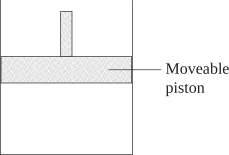
Gases \( \ce{A_2} \) and \( \ce{B_2} \) are placed in a closed container of variable volume, as shown.

The reaction between these substances is as follows.

\( \ce{A2(g) + 2B_2(g) \rightleftharpoons 2AB_2(g) \quad \Delta \textit{H} = -10 \text{kJ mol}^{-1}} \)

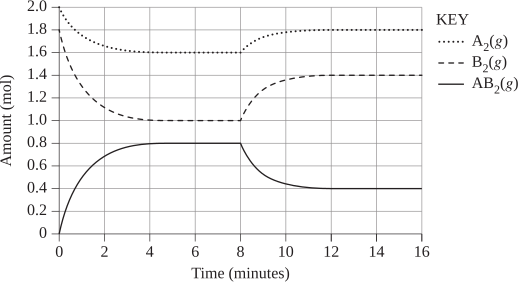
The following graph shows changes in the amounts (in mol) of these three substances over time in this container.
 

  1. Explain what is happening in this system between 6 minutes and 8 minutes.  (2 marks)

--- 4 WORK AREA LINES (style=lined) ---

  1. Explain TWO different factors that could result in the disturbance at 8 minutes.  (4 marks)

--- 8 WORK AREA LINES (style=lined) ---

Show Answers Only

a.   Between 6 and 8 minutes:

  • The system is in equilibrium.
  • The horizontal lines of each reactant in the graph indicate that the amount of reactants and products remain constant and hence the forward and reverse reactions are proceeding at the same rate.

b.    After 8 minutes \(\ce{AB2}\) is consumed, and \(\ce{A2}\) and \(\ce{B2}\) are produced. 

Factor 1:

  • An increase in temperature that decreases the equilibrium constant, \(\text{K}\).
  • In this case, the reaction quotient \(\text{Q}\) will be greater than \(\text{K}\). This will result in \(\ce{AB2}\) being consumed and \(\ce{A2}\) and \(\ce{B2}\) being produced until \(\text{Q}\) approaches \(\text{K}\) and the system reaches equilibrium again.

Factor 2:

  • Increase in volume of the container.
  • This will increase the reaction quotient \(\text{Q}\) while \(\text{K}\) stays the same. Again, this will cause \(\ce{AB2}\) to be consumed and \(\ce{A2}\) and \(\ce{B2}\) to be produced until \(\text{Q}\) approaches \(\text{K}\) and the system reaches equilibrium again.
Show Worked Solution

a.   Between 6 and 8 minutes:

  • The system is in equilibrium.
  • The horizontal lines of each reactant in the graph indicate that the amount of reactants and products remain constant and hence the forward and reverse reactions are proceeding at the same rate.

b.    After 8 minutes \(\ce{AB2}\) is consumed, and \(\ce{A2}\) and \(\ce{B2}\) are produced. 

Factor 1:

  • An increase in temperature that decreases the equilibrium constant, \(\text{K}\).
  • In this case, the reaction quotient \(\text{Q}\) will be greater than \(\text{K}\). This will result in \(\ce{AB2}\) being consumed and \(\ce{A2}\) and \(\ce{B2}\) being produced until \(\text{Q}\) approaches \(\text{K}\) and the system reaches equilibrium again.

Factor 2:

  • Increase in volume of the container.
  • This will increase the reaction quotient \(\text{Q}\) while \(\text{K}\) stays the same. Again, this will cause \(\ce{AB2}\) to be consumed and \(\ce{A2}\) and \(\ce{B2}\) to be produced until \(\text{Q}\) approaches \(\text{K}\) and the system reaches equilibrium again.

Filed Under: Factors that Affect Equilibrium, Static and Dynamic Equilibrium Tagged With: Band 4, smc-3669-10-Static/Dynamic Models, smc-3670-10-Temperature, smc-3670-35-Volume, smc-3670-60-Concentration diagrams

CHEMISTRY, M5 2016 HSC 14 MC

Consider the following endothermic reaction taking place in a closed vessel.

\(\ce{N_2O_4($g$) \rightleftharpoons 2NO_2($g$)}\)

Which of the following actions would cause more \(\ce{N_2O_4}\) to be produced?

  1. Adding a catalyst
  2. Decreasing the volume
  3. Decreasing the pressure
  4. Increasing the temperature
Show Answers Only

`B`

Show Worked Solution
  • By decreasing the volume, the equilibrium will shift to the left so that less gas molecules are present (Le Chatelier’s principle).

`=>B`

Filed Under: Factors that Affect Equilibrium Tagged With: Band 4, smc-3670-10-Temperature, smc-3670-29-Pressure, smc-3670-35-Volume, smc-3670-70-Max yield conditions, smc-3670-90-Catalyst

CHEMISTRY, M5 2017 HSC 16 MC

The following equilibrium is established in a closed system.

`text{CO}_(2)(g)+ text{H}_(2) text{O} (l) ⇌ text{H}_(2) text{CO}_(3)(aq) qquadqquad Delta H=-19.4 \ text{kJ mol}^(-1)`

How can the gas pressure in the system be decreased?

  1. Add more `text{CO}_2 (g)`
  2. Add hydroxide ions to the solution
  3. Decrease the volume of the container
  4. Increase the temperature of the system
Show Answers Only

`B`

Show Worked Solution
  • Gas pressure can be decreased if the equilibrium shifts to the right.
  • If hydroxide ions are added to the solution by adding NaOH, this will neutralise the carbonic acid and cause an equilibrium shift to the right.

`=>B`


♦♦ Mean mark 32%.

Filed Under: Factors that Affect Equilibrium Tagged With: Band 5, smc-3670-29-Pressure, smc-3670-35-Volume

CHEMISTRY, M5 2022 HSC 14 MC

Nitrogen dioxide can react with itself to produce dinitrogen tetroxide.

\( \ce{2NO2(g)  \rightleftharpoons  N2O4(g)\ \ \ \ \ \ $K_{eq}$ = 0.010} \)

In an experiment, 100.0 cm³ of \( \ce{NO2}\) is placed in a syringe. The plunger is then pushed in until the volume is 50.0 cm³, while maintaining a constant temperature. The system is allowed to return to equilibrium.

Which statement is true for the system at equilibrium?

  1. The value of `K_{eq}` has increased.
  2. The ratio `([\text{NO}_2])/([\text{N}_2\text{O}_4])` has decreased.
  3. The concentration of `\text{N}_2\text{O}_4` has decreased.
  4. The concentrations of `\text{NO}_2` and `\text{N}_2\text{O}_4` have doubled.
Show Answers Only

`B`

Show Worked Solution
  • As the volume is decreased, the pressure increases. According to Le Chatelier’s Principle, the equilibrium will shift toward the right with fewer moles of gas in order to counteract the change in equilibrium (ie decrease pressure).
  • As a result, \( \ce{[N2O4]} \) will increase and \( \ce{[NO2]} \) will decrease.
  • Therefore, `([\text{NO}_2])/([\text{N}_2\text{O}_4])` will decrease.

`=> B`


♦♦ Mean mark 35%.

Filed Under: Factors that Affect Equilibrium Tagged With: Band 5, smc-3670-29-Pressure, smc-3670-30-Concentration, smc-3670-35-Volume

Copyright © 2014–2025 SmarterEd.com.au · Log in