SmarterEd

Aussie Maths & Science Teachers: Save your time with SmarterEd

  • Login
  • Get Help
  • About

CHEMISTRY, M6 2015 VCE 23 MC

The following table shows the value of the ionisation constant of pure water at various temperatures and at a constant pressure.

\(\text{Temperature (°C)}\) \(0\) \(25\) \(50\) \(75\) \(100\)
\(K_W\) \( 1.1 \times 10^{-15}\) \( 1.0 \times 10^{-14}\) \( 5.5 \times 10^{-14}\) \( 2.0 \times 10^{-13}\) \( 5.6 \times 10^{-13}\)

Given this data, which one of the following statements about pure water is correct?

  1. The \(\ce{[OH–]}\) will decrease with increasing temperature.
  2. The \(\ce{[H3O+]}\) will increase with increasing temperature.
  3. Its pH will increase with increasing temperature.
  4. Its pH will always be exactly 7 at any temperature.
Show Answers Only

\(B\)

Show Worked Solution

\(\ce{2H2O(l) \rightleftharpoons H3O+(aq) + OH-(aq)} \)

  • Table shows that \(K_W\) increases as temperature increases.
  • Ionisation equation shifts right as temperature increases, causing an increase in \(\ce{[H3O+]}\) and \(\ce{[OH-]}\) (eliminate A).
  • pH decreases as \(\ce{[H3O+]}\) and temperature increase (eliminate C).
  • pH of water = 7 at 25°C only (eliminate D).

\(\Rightarrow B\)

♦ Mean mark 55%.

Filed Under: Properties of Acids and Bases Tagged With: Band 5, smc-3673-40-Properties of Common A/B

CHEMISTRY, M6 EQ-Bank 3 MC

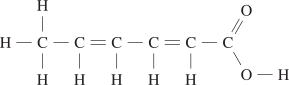
The structure of an organic compound is shown.
 

Which row of the table correctly shows how this compound reacts with bromine water and with blue litmus?
 

Show Answers Only

`D`

Show Worked Solution
  • Organic compound is sorbic acid.
  • Bromine water changes from a bright yellow to a colourless solution when it reacts with sorbic acid.
  • The acidic nature of the organic compound will turn blue litmus red.

`=>D`

Filed Under: Properties of Acids and Bases Tagged With: Band 3, smc-3673-40-Properties of Common A/B

CHEMISTRY, M6 2020 HSC 10 MC

Equimolar solutions of `text{NaCl}(aq), text{NH}_(4) text{Cl}(aq)` and `text{NaCH}_(3) text{COO}(aq)` were prepared.

In which of the following are these salt solutions listed from least to most acidic?

  1. `text{NaCl}(aq), text{NH}_(4) text{Cl}(aq), text{NaCH}_(3) text{COO}(aq)`
  2. `text{NaCl}(aq), text{NaCH}_(3) text{COO}(aq), text{NH}_(4) text{Cl}(aq)`
  3. `text{NH}_(4) text{Cl}(aq), text{NaCl}(aq), text{NaCH}_(3) text{COO}(aq)`
  4. `text{NaCH}_(3) text{COO}(aq), text{NaCl}(aq), text{NH}_(4) text{Cl}(aq)`
Show Answers Only

`D`

Show Worked Solution
  • \( \ce{NaCl} \) is a neutral salt, \( \ce{NH4Cl} \) is an acidic salt and \( \ce{NaCH3COO} \) is a basic salt.
  • Therefore, least to most acidic: \( \ce{NaCH3COO(aq), NaCl(aq), NH4Cl(aq)} \)

`=> D`


♦ Mean mark 42%.

Filed Under: Properties of Acids and Bases Tagged With: Band 5, smc-3673-40-Properties of Common A/B

Copyright © 2014–2025 SmarterEd.com.au · Log in