SmarterEd

Aussie Maths & Science Teachers: Save your time with SmarterEd

  • Login
  • Get Help
  • About

CHEMISTRY, M7 EQ-Bank 5 MC

Within a homologous series such as the alkanes, boiling points

  1. are all approximately the same.
  2. increase as the molar masses increase.
  3. are independent of intermolecular forces.
  4. decrease as the molecules become larger.
Show Answers Only

`B`

Show Worked Solution
  • Within a homologous series, boiling points increase as molecules get larger due to an increase in dispersion forces.

`=>B`

Filed Under: Hydrocarbons and Associated Reactions Tagged With: Band 4, smc-3677-30-Solubility and Boiling Point

CHEMISTRY, M7 2023 HSC 10 MC

Which of the following correctly lists the compounds in order of increasing boiling point?

  1. Heptane < heptan-2-one < heptan-1-o1 < heptanoic acid
  2. Heptane < heptan-1-o1 < heptan-2-one < heptanoic acid
  3. Heptanoic acid < heptan-2-one < heptan-1-o1 < heptane
  4. Heptanoic acid < heptan-1-o1 < heptan-2-one < heptane
Show Answers Only

\(A\)

Show Worked Solution
  • Compounds with functional groups capable of hydrogen bonding have higher boiling points (due to stronger bonds, more energy is required to break)

\(\Rightarrow A\)

Filed Under: Alcohols, Hydrocarbons and Associated Reactions, Reactions of Organic Acids and Bases Tagged With: Band 4, smc-3677-30-Solubility and Boiling Point, smc-3679-50-Solubility and Boiling Point, smc-3680-30-Boiling Point and Solubility

CHEMISTRY, M7 2019 HSC 9 MC

All of the following compounds have similar molar masses.

Which has the highest boiling point?

  1. Butane
  2. Ethanoic acid
  3. Propan-1-ol
  4. Propane
Show Answers Only

`B`

Show Worked Solution
  • Carboxyllic acids have a high affinity for hydrogen bonding, the strongest molecular force.
  • They therefore require more heat to break the intermolecular forces to convert liquid to gas versus other substances.

`=>B`

Filed Under: Alcohols, Hydrocarbons and Associated Reactions, Reactions of Organic Acids and Bases Tagged With: Band 4, smc-3677-30-Solubility and Boiling Point, smc-3679-50-Solubility and Boiling Point, smc-3680-30-Boiling Point and Solubility

CHEMISTRY, M7 2022 HSC 24

The following graph shows the boiling points of some 1-chloroalkanes.
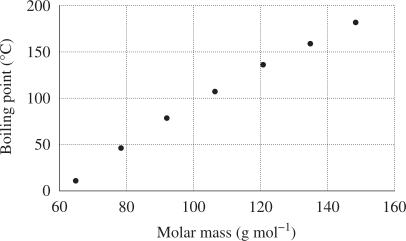
 

Explain the trend shown in the graph.   (3 marks)

--- 6 WORK AREA LINES (style=lined) ---

Show Answers Only
  • As the molar masses increase, the boiling point of 1-chloroalkanes increases.
  • This is due to molecules with a larger molar mass containing more electrons. This allows for a higher likelihood of unequal electron distribution, thus, causing stronger dispersion forces.
  • Since more energy is required to break stronger dispersion forces, 1-chloroalkanes with higher molar masses have higher boiling points.
Show Worked Solution
  • As the molar masses increase, the boiling point of 1-chloroalkanes increases.
  • This is due to molecules with a larger molar mass containing more electrons. This allows for a higher likelihood of unequal electron distribution, thus, causing stronger dispersion forces.
  • Since more energy is required to break stronger dispersion forces, 1-chloroalkanes with higher molar masses have higher boiling points.

Filed Under: Hydrocarbons and Associated Reactions Tagged With: Band 4, smc-3677-30-Solubility and Boiling Point

CHEMISTRY, M8 2021 HSC 21

Four organic liquids are used in an experiment. The four liquids are

    • hexane
    • hex-1-ene
    • propan-1-ol
    • propanoic acid
  1. State ONE safety concern associated with organic liquids and suggest ONE way to address this safety concern.   (2 marks)

    --- 4 WORK AREA LINES (style=lined) ---
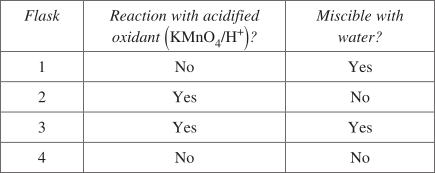
  2. The organic liquids are held separately in four flasks but the flasks are not labelled. Tests were conducted to identify these liquids. The outcomes of the tests are summarised below.   (2 marks)


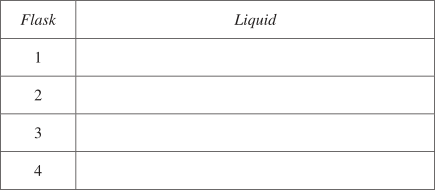
    Identify the FOUR liquids.
     
           
  3. What chemical test, other than those used in part (b), could be used to confirm the identification of ONE of the liquids? Include the expected observation in your answer.   (2 marks)

    --- 4 WORK AREA LINES (style=lined) ---
Show Answers Only

a.    A safety concern is that the organic liquids are flammable.

To address this, keep substance away from open flames and keep away from ignition sources.
 

b.    Flask 1: propanoic acid  (carboxylic acids can’t be oxidised and are polar)

Flask 2: hex-1-ene (alkenes can be oxidised and are non-polar)

Flask 3: propan-1-ol (primary alcohols can be oxidised and are polar)

Flask 4: hexane (alkanes don’t react with acidified oxidants and are non-polar)
 

c.   Hex-1-ene

  • Could be identified using the bromine water test.
  • The addition of brown bromine water to an alkene causes an addition reaction where the solution changes colours from brown to colourless.

Propanoic acid

  • Could be identified through a neutralisation reaction using `text{Na}_2text{CO}_3`.
  • Effervescent reaction will result.

Propan-1-ol

  • Could be identified through an oxidation reaction using acidified dichromate.
  • The reaction would cause the solution to change from green to orange.
Show Worked Solution

a.    A safety concern is that the organic liquids are flammable.

To address this, keep substance away from open flames and keep away from ignition sources.
 

b.    Flask 1: propanoic acid  (carboxylic acids can’t be oxidised and are polar)

Flask 2: hex-1-ene (alkenes can be oxidised and are non-polar)

Flask 3: propan-1-ol (primary alcohols can be oxidised and are polar)

Flask 4: hexane (alkanes don’t react with acidified oxidants and are non-polar)
 

c.   Hex-1-ene

  • Could be identified using the bromine water test.
  • The addition of brown bromine water to an alkene causes an addition reaction where the solution changes colours from brown to colourless.

Propanoic acid

  • Could be identified through a neutralisation reaction using `text{Na}_2text{CO}_3`.
  • Effervescent reaction will result.

Propan-1-ol

  • Could be identified through an oxidation reaction using acidified dichromate.
  • The reaction would cause the solution to change from green to orange.

Filed Under: Hydrocarbons and Associated Reactions, Organic Substances Tagged With: Band 3, Band 4, smc-3677-30-Solubility and Boiling Point, smc-3677-70-Reactions of Unsaturated Hydrocarbons, smc-3677-80-Reactions of Saturated Hydrocarbons, smc-3683-55-C=C Bonds

Copyright © 2014–2025 SmarterEd.com.au · Log in