SmarterEd

Aussie Maths & Science Teachers: Save your time with SmarterEd

  • Login
  • Get Help
  • About

CHEMISTRY, M7 2023 HSC 25

A student used the apparatus shown to investigate the combustion of octan-1-ol.
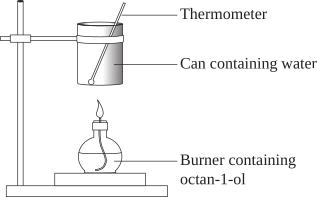


The following results were obtained by the student.

Mass of water heated = 205 g
Initial temperature of water = 23.7°C
Final temperature of water = 60.4°C

The following data are given.

Molar enthalpy of combustion of octan-1-ol = – 5294 kJ mol\(^{-1} \)
Molar mass of octan-1-ol = 130.23 g kJ mol\(^{-1}\)
  1. Assuming that no energy released by this combustion is lost to the surroundings, calculate the mass of octan-1-ol burnt.   (3 marks)

    --- 8 WORK AREA LINES (style=lined) ---

  1. Explain ONE advantage of using a biofuel compared to fossil fuels.   (2 marks)

    --- 4 WORK AREA LINES (style=lined) ---

Show Answers Only

a.   0.774 grams

b.    Advantage of biofuel vs fossil fuel

  • Combustion of biofuels derived from plants will have a lower greenhouse impact as the carbon dioxide released during combustion will replace that used in photosynthesis, unlike fossil fuels.

Other answers could include:

  • Biofuels are biodegradable and therefore pose a much reduced environmental threat than fossil fuels which are not.
  • Biofuels are more sustainable than fossil fuels as they are produced from renewable resources.
Show Worked Solution

a.   Find the heat absorbed by the water ((\q\)):

\(q\) \(=mc \Delta T \)  
  \(=205 \times 4.18 \times 36.7 \)  
  \(=31\ 488.23\ \text{J}\)  
  \(=31.448\ \text{kJ}\)  

 
\(\text{octan-1-ol}\ \Rightarrow \ce{C8H18O} \)

\(\ce{MM(C8H18O) = 12.01 \times 8 + 1.008 \times 18 + 16 = 130.224} \)

\(\ce{n\text{(octan-1-ol)}}= \dfrac{-31.448\ \text{kJ}}{-5294\ \text{kJ mol}^{-1}} =5.94 \times 10^{-3}\ \text{mol} \)

\(\ce{m\text{(octan-1-ol)}}= 5.94 \times 10^{-3} \times 130.224 = 0.774\ \text{g} \)
 

b.    Advantage of biofuel vs fossil fuel

  • Combustion of biofuels derived from plants will have a lower greenhouse impact as the carbon dioxide released during combustion will replace that used in photosynthesis, unlike fossil fuels.

Other answers could include:

  • Biofuels are biodegradable and therefore pose a much reduced environmental threat than fossil fuels which are not.
  • Biofuels are more sustainable than fossil fuels as they are produced from renewable resources.

Filed Under: Alcohols Tagged With: Band 4, smc-3679-10-Combustion, smc-3679-60-Biofuels

CHEMISTRY, M7 2017 HSC 28a

Outline TWO advantages and TWO disadvantages of using ethanol as an alternative fuel for motor vehicles.   (4 marks)

Show Answers Only

Advantages:

  • Ethanol can be produced from biomass. These renewable sources include crops such as sugarcane as opposed to other fuels such as petrol which come from non-renewable fossil fuels, which are finite resources.
  • Ethanol undergoes complete combustion more easily than octane, producing less soot \(\ce{(C(s))}\) which can adversely affect the efficiency and running of motors, and less \(\ce{CO(g)}\) which is poisonous.

Disadvantages:

  • Ethanol releases less energy, on a mole or per kilogram basis, than octane. This results in a greater mass of fuel being required to supply an equivalent amount of energy.
  • Producing ethanol from renewable crops requires a huge amount of arable land. This reduces the availability of land for other crops.
Show Worked Solution

Advantages:

  • Ethanol can be produced from biomass. These renewable sources include crops such as sugarcane as opposed to other fuels such as petrol which come from non-renewable fossil fuels, which are finite resources.
  • Ethanol undergoes complete combustion more easily than octane, producing less soot \(\ce{(C(s))}\) which can adversely affect the efficiency and running of motors, and less \(\ce{CO(g)}\) which is poisonous.

Disadvantages:

  • Ethanol releases less energy, on a mole or per kilogram basis, than octane. This results in a greater mass of fuel being required to supply an equivalent amount of energy.
  • Producing ethanol from renewable crops requires a huge amount of arable land. This reduces the availability of land for other crops.

♦ Mean mark 52%.

Filed Under: Alcohols Tagged With: Band 4, Band 5, smc-3679-60-Biofuels

CHEMISTRY, M7 2020 HSC 24

Biodiesel, an alternative fuel to diesel, may be produced from vegetable oil. The chemical reaction which converts oils from biomass into biodiesel is shown. `text{R}_1`, `text{R}_2` and `text{R}_3` are alkyl chains which may vary from 10 to 22 carbons in length.


  1. Which functional group is present in both the oil and the biodiesel?   (1 mark)

    --- 2 WORK AREA LINES (style=lined) ---

  2. Explain why biodiesel `(text{C}_14 text{H}_30 text{O}_2)` produces less soot than diesel `(text{C}_18 text{H}_38)` when combusted under the same conditions. Support your answer with balanced chemical equations.   (3 marks)

    --- 4 WORK AREA LINES (style=lined) ---

  3. The energy densities of biodiesel and diesel are 38 MJ kg ¯1 and 43 MJ kg ¯1 respectively. The densities of biodiesel and diesel are 0.90 kg L¯1 and 0.83 kg L¯1 respectively.

    When 60.0 L of diesel is combusted in a typical engine, 2141 MJ of energy is released.

    What volume of biodiesel would be required to produce the same amount of energy?   (2 marks)

    --- 2 WORK AREA LINES (style=lined) ---

  4. Explain TWO advantages and TWO disadvantages of using bioethanol (ethanol produced from biomass) as an alternative to a fossil fuel.    (4 marks)

    --- 8 WORK AREA LINES (style=lined) ---

Show Answers Only

a.   Ester functional group.
 

b.   \( \ce{C14H30O2(l) + 41/2 O2(g) → 14 CO2(g) + 15 H2O(l)}\)

\( \ce{C18H38(l) + 55/2 O2(g) → 18 CO2(g) + 19 H2O(l)}\)

  • Soot is produced when a fuel source undergoes incomplete combustion due to insufficient oxygen.
  • Since biodiesel already contains oxygen atoms within its structure, it would require less oxygen to undergo complete combustion compared to diesel, and is therefore less likely to produce soot.

c.   `text{m(biodiesel)} = 2141 / 38 = 56.3\ text{kg}`

`text{V(biodiesel)} = 56.3 / 0.90 = 63\ text{L  (nearest L)}`
 

d.    Advantages of bioethanol (two examples needed only):

  • Bioethanol is sustainable because it is produced from renewable resources, whereas petrol is produced from nonrenewable crude oil reserves.
  • Additionally, bioethanol is biodegradable whereas petrol isn’t. As a result, bioethanol would pose less of an environmental threat in comparison to petrol.
  • Ethanol produces less airborne particulates that are associated with lung cancer. 

Disadvantages of bioethanol (two examples needed only):

  • Bioethanol requires a large amount of arable land in order to grow crops to produce bioethanol. Thus, it would lead to soil erosion and environmental pollution.
  • More energy is also required to produce bioethanol because of the requirement for labour, fertilisation, and distillation of ethanol from fermentation.
  • If fossil fuels are used as the energy source within the manufacturing process of biofuel, it will not achieve carbon neutrality and will contribute to global warming.
Show Worked Solution

a.   Ester functional group.
 

b.   \( \ce{C14H30O2(l) + 41/2 O2(g) → 14 CO2(g) + 15 H2O(l)}\)

\( \ce{C18H38(l) + 55/2 O2(g) → 18 CO2(g) + 19 H2O(l)}\)

  • Soot is produced when a fuel source undergoes incomplete combustion due to insufficient oxygen.
  • Since biodiesel already contains oxygen atoms within its structure, it would require less oxygen to undergo complete combustion compared to diesel, and is therefore less likely to produce soot.

♦♦ Mean mark (a) 39%, (b) 49%.

c.   `text{m(biodiesel)} = 2141 / 38 = 56.3\ text{kg}`

`text{V(biodiesel)} = 56.3 / 0.90 = 63\ text{L  (nearest L)}`
 

d.    Advantages of bioethanol (two examples needed only):

  • Bioethanol is sustainable because it is produced from renewable resources, whereas petrol is produced from nonrenewable crude oil reserves.
  • Additionally, bioethanol is biodegradable whereas petrol isn’t. As a result, bioethanol would pose less of an environmental threat in comparison to petrol.
  • Ethanol produces less airborne particulates that are associated with lung cancer. 

Disadvantages of bioethanol (two examples needed only):

  • Bioethanol requires a large amount of arable land in order to grow crops to produce bioethanol. Thus, it would lead to soil erosion and environmental pollution.
  • More energy is also required to produce bioethanol because of the requirement for labour, fertilisation, and distillation of ethanol from fermentation.
  • If fossil fuels are used as the energy source within the manufacturing process of biofuel, it will not achieve carbon neutrality and will contribute to global warming.

♦ Mean mark (d) 55%.

Filed Under: Alcohols, Reactions of Organic Acids and Bases Tagged With: Band 4, Band 5, smc-3679-10-Combustion, smc-3679-60-Biofuels, smc-3680-10-Esters

Copyright © 2014–2025 SmarterEd.com.au · Log in