SmarterEd

Aussie Maths & Science Teachers: Save your time with SmarterEd

  • Login
  • Get Help
  • About

CHEMISTRY, M8 2025 HSC 18 MC

The concentration of silver ions in a solution is determined by titrating it with aqueous sodium chloride, using yellow potassium chromate as the indicator.

Which row of the table correctly identifies the colour change at the endpoint and the more soluble salt?

\begin{align*}
\begin{array}{l}
\rule{0pt}{2.5ex} \ & \\
 \ \rule[-1ex]{0pt}{0pt}& \\
\rule{0pt}{2.5ex}\textbf{A.}\rule[-1ex]{0pt}{0pt}\\
\rule{0pt}{2.5ex}\textbf{B.}\rule[-1ex]{0pt}{0pt}\\
\rule{0pt}{2.5ex}\textbf{C.}\rule[-1ex]{0pt}{0pt}\\
\rule{0pt}{2.5ex}\textbf{D.}\rule[-1ex]{0pt}{0pt}\\
\end{array}
\begin{array}{|c|c|}
\hline
\rule{0pt}{2.5ex}\ \ \text{Colour change} \ \ & \text{More soluble salt} \\
\text{at endpoint}\rule[-1ex]{0pt}{0pt}& \text{} \\
\hline
\rule{0pt}{2.5ex}\text{Red to yellow}\rule[-1ex]{0pt}{0pt}& \ce{Ag2CrO4}\\
\hline
\rule{0pt}{2.5ex}\text{Yellow to red}\rule[-1ex]{0pt}{0pt}& \ce{Ag2CrO4}\\
\hline
\rule{0pt}{2.5ex}\text{Red to yellow}\rule[-1ex]{0pt}{0pt}& \ce{AgCl} \\
\hline
\rule{0pt}{2.5ex}\text{Yellow to red}\rule[-1ex]{0pt}{0pt}& \ce{AgCl} \\
\hline
\end{array}
\end{align*}
Show Answers Only

\(B\)

Show Worked Solution
  • The two key reactions that take place in this titration are
  •    \(\ce{Ag+(aq) + Cl-(aq) -> AgCl(s)}\)
  •    \(\ce{2Ag+(aq) + CrO4^{2-}(aq) -> Ag2CrO4(s)}\)
  • For the titration to occur effectively all of the \(\ce{Cl-}\) ions must react with \(\ce{Ag+}\) ion and be precipitated out of the solution as the sodium chloride is Titrant (known volume and known concentration).
  • Only once all of the \(\ce{Cl-}\) ions are used up will silver ions begin to react the chromate ions signally the endpoint of the titration.
  • Hence, \(\ce{Ag2CrO4}\) is the more soluble salt and as the potassium chromate is initially yellow, the colour change must be from yellow to red.

\(\Rightarrow B\)

Filed Under: Inorganic Substances Tagged With: Band 5, smc-3682-70-Precipitation Titrations

CHEMISTRY, M5 2023 HSC 16 MC

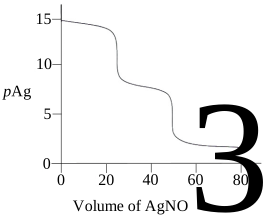
A solution contains potassium iodide and potassium chloride. It was analysed by performing a precipitation titration using silver nitrate. The titration curve for this reaction is shown, where  \( \ce{pAg}=-\log _{10}\left[\ce{Ag}^{+}\right]\).
 

Why is this a valid and correct procedure for quantifying the amount of each anion present in the mixture?

  1. \( \ce{AgCl} \) would precipitate out first, followed by \( \ce{AgI} \).
  2. \( \ce{AgI}\) would precipitate out first, followed by \( \ce{AgCl} \).
  3. Both \( \ce{AgI} \) and \( \ce{AgCl} \) precipitate out of the solution together.
  4. Neither \( \ce{AgCl} \) nor \( \ce{AgI} \) would precipitate out of the solution.
Show Answers Only

\(B\)

Show Worked Solution
  • This procedure is only correct and valid if the ions precipitated out at different times.
  • Therefore \( \ce{AgI}\) would precipitate out first as it is less soluble than \( \ce{AgCl} \).

\(\Rightarrow B\)

♦ Mean mark 41%.

Filed Under: Inorganic Substances, Solution Equilibria Tagged With: Band 5, smc-3672-25-Solubility rules, smc-3682-70-Precipitation Titrations

CHEMISTRY, M8 2023 HSC 30

A water sample contains at least one of the following anions at concentrations of 1.0 mol L\(^{-1} \).

    • bromide \( \ce{(Br}^{-}) \)
    • carbonate \( \ce{(CO}_3{ }^{2-}) \)

Outline a sequence of tests that could be performed in a school laboratory to confirm the identity of the anion or anions present. Include expected observations and TWO balanced chemical equations in your answer.   (4 marks)

--- 11 WORK AREA LINES (style=lined) ---

Show Answers Only

Test 1: Add aqueous nitric acid

  • Bubbles indicate carbonate present. Acid removes carbonate for further testing of sample
  •    \(\ce{2H+(aq) + CO3^{2−}(aq) \rightarrow CO2(g) + H2O(l)}\)

Test 2: Add silver nitrate solution

  • Creamy precipitate indicates bromide present
  •    \(\ce{Ag+(aq) + Br−(aq) \rightarrow AgBr(s)}\) 

Answer could include:

  • Add excess silver nitrate solution – precipitate produced
  • Add dilute nitric acid to the precipitate
    • If bubbles are formed and a brown precipitate dissolves then carbonate was present
    • If a creamy precipitate remains then bromide was present
Show Worked Solution

Test 1: Add aqueous nitric acid

  • Bubbles indicate carbonate present. Acid removes carbonate for further testing of sample
  •    \(\ce{2H+(aq) + CO3^{2−}(aq) \rightarrow CO2(g) + H2O(l)}\)

Test 2: Add silver nitrate solution

  • Creamy precipitate indicates bromide present
  •    \(\ce{Ag+(aq) + Br−(aq) \rightarrow AgBr(s)}\)
♦ Mean mark 53%.

Answer could include:

  • Add excess silver nitrate solution – precipitate produced
  • Add dilute nitric acid to the precipitate
    • If bubbles are formed and a brown precipitate dissolves then carbonate was present
    • If a creamy precipitate remains then bromide was present

Filed Under: Inorganic Substances Tagged With: Band 5, smc-3682-70-Precipitation Titrations

CHEMISTRY, M8 EQ-Bank 22

A bottle of solution is missing its label. It is either \(\ce{Pb(NO_3)_2, Ba(NO_3)_2 or Fe(NO_3)_2}\).

Using only \(\ce{HCl, NaOH}\) and \(\ce{H_2SO_4}\) solutions, outline a sequence of steps that could be followed to confirm the identity of the solution in the bottle. Include observed results and ionic equations in your answer.   (4 marks)

Show Answers Only

Step 1: Prepare samples of the original solution and \(\ce{HCl, NaOH}\)  and  \(\ce{H_2SO_4}\)  solutions and then follow the flow chart below.

Show Worked Solution

Step 1: Prepare samples of the original solution and \(\ce{HCl, NaOH}\)  and  \(\ce{H_2SO_4}\) solutions and then follow the flow chart below. 

Filed Under: Inorganic Substances Tagged With: Band 4, smc-3682-70-Precipitation Titrations

CHEMISTRY, M8 EQ-Bank 24

A common antacid tablet contains aluminium hydroxide to neutralise stomach acid. In order for the antacid to be effective, each 500 mg tablet must contain a minimum of 200 mg of aluminium hydroxide.

Two antacid tablets were crushed and reacted with 70 mL of 0.60 mol L¯ 1 hydrochloric acid. After the antacid had reacted with the acid, the remaining hydrochloric acid was titrated against 0.60 mol L¯ 1 sodium hydroxide. The average volume of sodium hydroxide used was 35 mL.

Calculate the amount of aluminium hydroxide present in each tablet and justify whether the tablets will be effective as an antacid.   (4 marks)

Show Answers Only

\(\text{Tablets will be effective (See Worked Solutions)}\)

Show Worked Solution

\(\ce{3HCl(aq) + Al(OH)3(aq) \rightarrow AlCl3(s) + 3H2O(l)} \)

\(\ce{n(HCl^-) = c \times V = 0.6 \times 0.070 = 0.042 mol} \)

\(\ce{n(Na(OH)) = c \times V = 0.6 \times 0.035 = 0.021 mol} \)

\(\ce{Moles reacted with antacid = 0.042 – 0.021 = 0.021 mol} \)
 

\(\ce{Mole ratio = 3:1}\)

\[\ce{Moles of Al(OH)3 in 2 tablets = \frac{0.021}{3} = 0.007 mol}\]

\(\ce{Formula weight of Al(OH)3 = 27 + 3 \times (1 + 16) = 78 g}\)

\(\ce{m(Al(OH)3) in 2 tablets = 0.007 \times 78 = 0.546 g}\)

\[\ce{m(Al(OH)3) in 1 tablet = \frac{0.546}{2} = 273 g}\]

\(\text{Since 273 > 200, tablets will be effective.}\)

Filed Under: Inorganic Substances Tagged With: Band 4, smc-3682-70-Precipitation Titrations

CHEMISTRY, M8 2020 HSC 31

A water sample was analysed to determine the chloride ion content. 100.0 mL of this water was added to 25.00 mL of 0.100 mol L¯1 \( \ce{AgNO3(aq)}\).

The mixture was filtered and the filtrate was titrated against 0.0500 mol L¯1 \( \ce{KSCN(aq)} \) according to the following reaction.

\( \ce{Ag+(aq) + SCN-(aq) -> AgSCN(s)} \)

The titration was repeated three times and the average titre was 28.65 mL.

Calculate the concentration of chloride ions in the water, expressed in mg L¯1.   (4 marks)

Show Answers Only

`378\ text{mg L}^(–1)`

Show Worked Solution

`text{n(SCN}^–) = text{c} xx text{V} = 0.0500 xx 0.02865 = 1.43 xx 10^(−3)\ text{mol}`

`text{n(Ag}^+ text{) excess} = 1.43 xx 10^(−3)\ text{mol}`

`text{n(Ag}^+ text{) added} = 0.100 xx 0.02500 = 2.50 xx 10^(−3)\ text{mol}`

`text{n(Ag}^+ text{) reacted}` `= text{n(Ag}^+ text{) added} − text{n(Ag}^+ text{) excess}`
  `= 2.50 xx 10^(−3)\ text{mol}− 1.43 xx 10^(−3)\ text{mol}`
  `= 1.07 xx 10^(−3)\ text{mol}`

 
`text{n(Cl}^– ) = 1.07 xx 10^(−3)\ text{mol}`

`text{m(Cl}^– ) = text{n} xx text{MM} = 1.07 xx 10^(−3) xx 35.45  = 0.0378\ text{g} = 37.8\ text{mg}`

`[text{Cl}^– ] = text{m} / text{V} = [37.8\ text{mg}] / [0.100\ text{L}] = 378\ text{mg L}^(–1)`


♦♦ Mean mark 44%.

Filed Under: Inorganic Substances Tagged With: Band 5, smc-3682-70-Precipitation Titrations

Copyright © 2014–2025 SmarterEd.com.au · Log in