SmarterEd

Aussie Maths & Science Teachers: Save your time with SmarterEd

  • Login
  • Get Help
  • About

CHEMISTRY, M8 2025 HSC 30

Phosgene is used in industry as a starting material to synthesise useful polymers. Phosgene \(\ce{(Cl2CO)}\) is a gas at room temperature and is highly toxic.

  1. Justify a suitable precaution when using phosgene.   (2 marks)

    --- 5 WORK AREA LINES (style=lined) ---

  2. Phosgene is synthesised by the reaction of carbon monoxide \(\ce{(CO)}\) and chlorine \(\ce{(Cl2)}\) in the gas phase.
      1. \(\ce{Cl2(g) + CO(g) \rightleftharpoons Cl2CO(g)}\)
  3. Explain why an excess of carbon monoxide and a catalyst are used in the industrial synthesis of phosgene.   (3 marks)

    --- 8 WORK AREA LINES (style=lined) ---
Show Answers Only

a.    Precaution when using phosgene inside a fume hood:

  • As phosgene is a highly toxic gas at room temperature. working in a fume hood prevents inhalation by safely removing the gas from the breathing zone and venting it outside the laboratory.
  • This measure significantly reduces the risk of poisoning and exposure.

b.   Role of excess carbon monoxide:

  • An excess of carbon monoxide is used to increase the rate of production of phosgene.
  • According to Le Chatelier’s principle, increasing the concentration of \(\ce{CO}\) shifts the equilibrium to the right, favouring the formation of \(\ce{Cl2CO}\) and increasing the overall yield of phosgene.

Role of catalyst:

  • A catalyst is used to increase the rate of reaction by providing an alternative reaction pathway with a lower activation energy.
  • This allows phosgene to be produced more rapidly and efficiently without affecting the equilibrium position.
  • In industrial settings, this increases production speed and reduces energy costs.
Show Worked Solution

a.    Precaution when using phosgene inside a fume hood:

  • As phosgene is a highly toxic gas at room temperature. working in a fume hood prevents inhalation by safely removing the gas from the breathing zone and venting it outside the laboratory.
  • This measure significantly reduces the risk of poisoning and exposure.

b.   Role of excess carbon monoxide:

  • An excess of carbon monoxide is used to increase the rate of production of phosgene.
  • According to Le Chatelier’s principle, increasing the concentration of \(\ce{CO}\) shifts the equilibrium to the right, favouring the formation of \(\ce{Cl2CO}\) and increasing the overall yield of phosgene.

Role of catalyst:

  • A catalyst is used to increase the rate of reaction by providing an alternative reaction pathway with a lower activation energy.
  • This allows phosgene to be produced more rapidly and efficiently without affecting the equilibrium position.
  • In industrial settings, this increases production speed and reduces energy costs.

Filed Under: Chemical Synthesis and Design Tagged With: Band 4, smc-3684-20-Reaction conditions, smc-3684-30-Yield and purity, smc-3684-50-Enviro/social/economic issues

CHEMISTRY, M8 2024 HSC 31

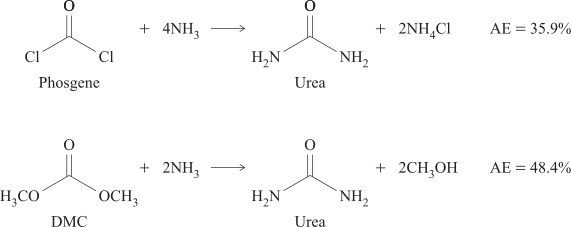
The atom economy ( AE ) of a reaction is a measure of the mass of atoms in the starting materials that are incorporated into the desired product. Higher AE means lower mass of waste products.

Urea can be produced in a variety of ways. One way is to react ammonia (high toxicity) with phosgene (high toxicity). Another way is to react ammonia with dimethyl carbonate (DMC, low toxicity). The chemical equations and AE for these two processes are provided.
 

Which of these two processes is preferable for urea production? Justify your answer with reference to the information provided.   (3 marks)

--- 8 WORK AREA LINES (style=lined) ---
Show Answers Only

  • The atom economy for the reaction utilizing dimethyl carbonate (DMC) is 48.4%, which is significantly higher compared to the 35.9% achieved in the reaction using phosgene.
  • Consequently, the process involving DMC generates a lower mass of waste products and relies on a less hazardous starting material.
  • Additionally, the DMC-based synthesis requires only 2 moles of ammonia, compared to the 4 moles needed for the phosgene process.
  • These factors highlight the synthesis of urea via DMC as the preferable method for urea production as it offers advantages in terms of atom economy, reduced toxicity of reactants, and minimized use of harmful chemicals.

Show Worked Solution

  • The atom economy for the reaction utilizing dimethyl carbonate (DMC) is 48.4%, which is significantly higher compared to the 35.9% achieved in the reaction using phosgene.
  • Consequently, the process involving DMC generates a lower mass of waste products and relies on a less hazardous starting material.
  • Additionally, the DMC-based synthesis requires only 2 moles of ammonia, compared to the 4 moles needed for the phosgene process.
  • These factors highlight the synthesis of urea via DMC as the preferable method for urea production as it offers advantages in terms of atom economy, reduced toxicity of reactants, and minimized use of harmful chemicals.

Filed Under: Chemical Synthesis and Design Tagged With: Band 4, smc-3684-20-Reaction conditions, smc-3684-40-Industrial uses, smc-3684-50-Enviro/social/economic issues

CHEMISTRY, M8 2023 HSC 26

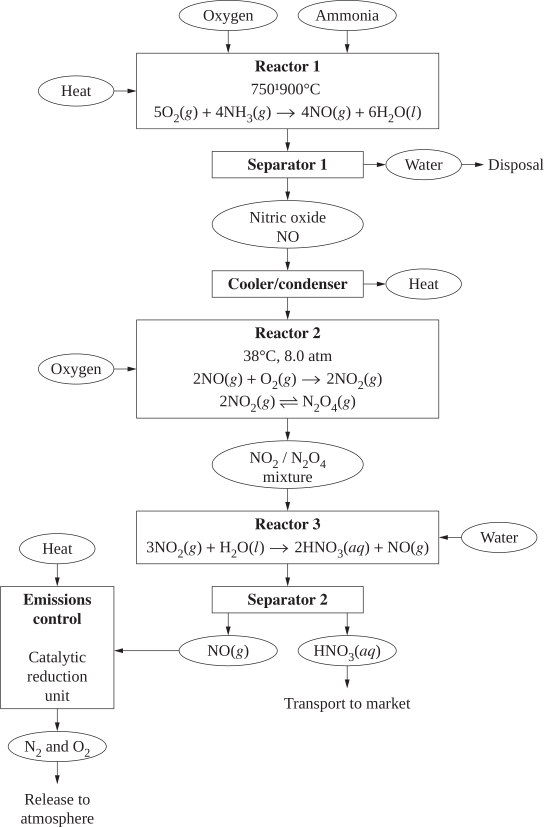
Nitric acid can be produced industrially using the process shown.
 

  1. A mixture of \( \ce{NO2} \) and \( \ce{N2O4} \) enters Reactor 3 , where only \(\ce{NO}_2\) is consumed by the reaction with water.
  2. Explain, with respect to Le Chatelier's principle, what happens to the \( \ce{N2O4} \).  (2 marks)

--- 6 WORK AREA LINES (style=lined) ---

  1. Explain TWO improvements that can be made to the design of the process shown.  (3 marks)

--- 8 WORK AREA LINES (style=lined) ---
Show Answers Only

a.    Consider the equilibrium system in reactor 2:

\(\ce{2NO2(g) \rightleftharpoons N2O4(g)}\)

  • \(\ce{NO2}\) is a reactant in Reactor 3 and is consumed by the reaction in Reactor 3, disrupting the equilibrium.
  • Le Chatelier’s Principle states that the position of equilibrium will shift to the left (as per the equilibrium equation above) to counter the depletion of \(\ce{NO2}\).
  • This shift results in the further depletion of \(\ce{N2O4}\). This process will eventually see all of the \(\ce{N2O4}\) decomposing to form \(\ce{NO2}\). 

b.   Design improvements:

  • A catalyst could be used in Reactor 1 to lower the activation energy required for the reaction to occur. This would decrease the required temperature, making the process more energy efficient.
  • Water is disposed of in Separator 3 and is required as a reactant in Reactor 3. A design improvement would be to recycle (rather than dispose) this water for use in Reactor 3. 

Other answers could include:

  • Capture the heat energy released from the cooler/condenser step between the processes in Reactor 1 and Reactor 2. This should be engineered so it can then be used in the Emissions control step, thus reducing the energy consumption of the overall nitric acid production.
  • The \(\ce{NO}\) produced in Reactor 3 that is then further processed for safe release into the atmosphere as \(\ce{N2(g)}\) and \(\ce{O2(g)}\) could be recycled and used as a reactant in Reactor 2, helping conserve resources.

Show Worked Solution

a.    Consider the equilibrium system in reactor 2:

\(\ce{2NO2(g) \rightleftharpoons N2O4(g)}\)

  • \(\ce{NO2}\) is a reactant in Reactor 3 and is consumed by the reaction in Reactor 3, disrupting the equilibrium.
  • Le Chatelier’s Principle states that the position of equilibrium will shift to the left (as per the equilibrium equation above) to counter the depletion of \(\ce{NO2}\).
  • This shift results in the further depletion of \(\ce{N2O4}\). This process will eventually see all of the \(\ce{N2O4}\) decomposing to form \(\ce{NO2}\).
♦♦ Mean mark (a) 37%.

b.   Design improvements:

  • A catalyst could be used in Reactor 1 to lower the activation energy required for the reaction to occur. This would decrease the required temperature, making the process more energy efficient.
  • Water is disposed of in Separator 3 and is required as a reactant in Reactor 3. A design improvement would be to recycle (rather than dispose) this water for use in Reactor 3. 

Other answers could include:

  • Capture the heat energy released from the cooler/condenser step between the processes in Reactor 1 and Reactor 2. This should be engineered so it can then be used in the Emissions control step, thus reducing the energy consumption of the overall nitric acid production.
  • The \(\ce{NO}\) produced in Reactor 3 that is then further processed for safe release into the atmosphere as \(\ce{N2(g)}\) and \(\ce{O2(g)}\) could be recycled and used as a reactant in Reactor 2, helping conserve resources.

♦ Mean mark (b) 49%.

Filed Under: Chemical Synthesis and Design Tagged With: Band 5, page-break-before-question, smc-3684-40-Industrial uses, smc-3684-50-Enviro/social/economic issues

CHEMISTRY, M8 2020 HSC 23

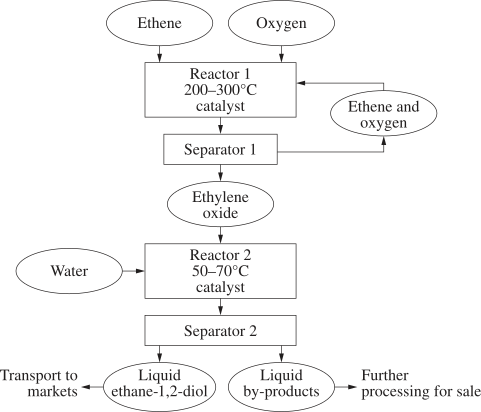
The flow chart summarises an industrial process for the synthesis of ethane-1,2-diol.


Explain THREE factors that may have been considered in the design of this industrial process. Make specific reference to the flow chart.   (4 marks)

Show Answers Only
  • A catalyst is utilised in reactions 1 and 2 to increase the rate of reaction by lowering the activation energy.
  • Additionally, moderate temperatures are utilised to increase the average kinetic energy of the molecules, increasing the likelihood of successful collisions.
  • These factors reduce energy consumption and make the process more economically viable.
  • Separators were used to separate and recycle the unused reactant gases. Ensuring that the resources were not wasted, again increases the efficiency and economic sustainability of the design.
  • The availability of reagents should be taken into account by locating the process close to a pretrochemical or industrial plant, where ethylene and oxygen gases are readily available. 

Other possible answers:

  • It is critical that the market for the major end product, ethane-1,2-diol, is assessed beforehand. This would involve researching demand for the product, expected market price, and the associated methods and costs of transport of the product to the end customers.
  • The usage and demand for the by-products of this process is another key factor that addresses the wastage and economics of production.
Show Worked Solution
  • A catalyst is utilised in reactions 1 and 2 to increase the rate of reaction by lowering the activation energy.
  • Additionally, moderate temperatures are utilised to increase the average kinetic energy of the molecules, increasing the likelihood of successful collisions.
  • These factors reduce energy consumption and make the process more economically viable.
  • Separators were used to separate and recycle the unused reactant gases. Ensuring that the resources were not wasted, again increases the efficiency and economic sustainability of the design.
  • The availability of reagents should be taken into account by locating the process close to a pretrochemical or industrial plant, where ethylene and oxygen gases are readily available. 

Other possible answers:

  • It is critical that the market for the major end product, ethane-1,2-diol, is assessed beforehand. This would involve researching demand for the product, expected market price, and the associated methods and costs of transport of the product to the end customers.
  • The usage and demand for the by-products of this process is another key factor that addresses the wastage and economics of production.

Filed Under: Chemical Synthesis and Design Tagged With: Band 4, smc-3684-10-Availability of reagents, smc-3684-40-Industrial uses, smc-3684-50-Enviro/social/economic issues

Copyright © 2014–2025 SmarterEd.com.au · Log in