SmarterEd

Aussie Maths & Science Teachers: Save your time with SmarterEd

  • Login
  • Get Help
  • About

PHYSICS, M5 2017 HSC 29

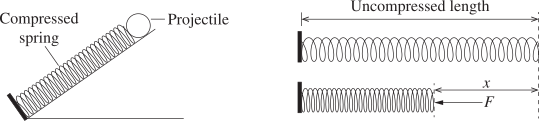
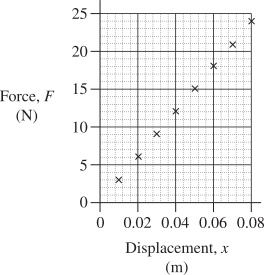
A spring is used to construct a device to launch a projectile. The force `(F)` required to compress the spring is measured as a function of the displacement `(x)` by which the spring is compressed.
 

The potential energy stored in the compressed spring can be calculated from  `E_p=(1)/(2) kx^(2)`, where `k` is the gradient of the force-displacement graph shown.
 

  1. A projectile of mass 0.04 kg is launched using this device with the spring compressed by 0.08 m. Calculate the launch velocity.   (4 marks)

--- 11 WORK AREA LINES (style=lined) ---

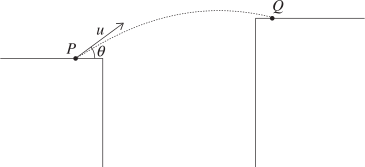
  1. Calculate the range of a projectile launched by this device from ground level at an angle of 60° to the horizontal with a velocity of 10 `text{m s}^(-1)`.   (3 marks)

--- 9 WORK AREA LINES (style=lined) ---

Show Answers Only

a.   `6.9  text{m s}^(-1)`

b.   `8.8  text{m}`

Show Worked Solution

a.   `k=  text{gradient}=(24-6)/(0.08-0.02)=300`

Finding the potential energy stored in the compressed spring:

`E_(p)=(1)/(2)kx^(2)=(1)/(2)xx300 xx0.08^(2)=0.96  text{J}`

  
As this potential energy is converted into kinetic energy when the projectile is launched:

`E_(k)` `=0.96  text{J}`
 `(1)/(2)mv^(2)` `=0.96`
`v^(2)` `=(2 xx0.96)/(0.04)`
`v` `=6.9  text{m s}^(-1)`


b.   Time to reach the highest point `(v_(y)=0)`:

`v_(y)` `=u_(y)+a_(y)t`
`0` `=10xx sin 60^(@)-9.8t`
`t` `=(10xx sin 60^(@))/(9.8)=0.88  text{s}`


The time of flight is twice the time taken to reach the highest point:

`t=2 xx0.88=1.77\ text{s}`

 
Find range:

`s_(x)=u_(x)t=10xx cos 60^(@)xx 1.77=8.8\ text{m}`


Mean mark (b) 59%.

Filed Under: Projectile Motion Tagged With: Band 4, smc-3690-25-Range, smc-3690-50-Kinetic Energy

PHYSICS, M5 2019 HSC 30

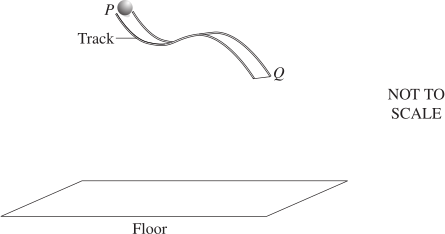
A ball, initially at rest in position `P`, travels along a frictionless track to point `Q` and then falls to strike the floor below.
 

At the instant the ball leaves the track at `Q` it has a velocity of 1.5 `text{m s}^(-1)` at an angle of 50° to the horizontal.

  1. Calculate the difference in height between `P` and `Q`.   (3 marks)

--- 6 WORK AREA LINES (style=lined) ---

  1. The ball takes 0.5 s to reach the floor after leaving the track at `Q`.
  2. Calculate the height of `Q` above the floor.   (3 marks)

--- 6 WORK AREA LINES (style=lined) ---

Show Answers Only

a.   `h=0.11\ \text{m}`

b.   `h=1.8\ \text{m}`

Show Worked Solution

a. `Delta U` `=Delta E_(k)`
  `mgDeltah` `=(1)/(2)mv^2-(1)/(2)m u^2`
  `mgDeltah` `=(1)/(2)mv^2\ \ (u=0)`
  `Delta h` `=(v^2)/(2g)=(1.5^(2))/(2xx9.8)=0.1145\ \text{m}`


♦ Mean mark part (a) 41%.

b.   `u_(y)=u sin theta=1.50  sin 50^(@)=1.15\ text{m s}^(-1)`

  `s_(y)` `=ut+(1)/(2)at^(2)`
    `=1.15 xx0.5+(1)/(2)(9.80)xx0.5^(2)`
    `= 1.8\ text{m}`

 
`:.\ \text{Height of Q = 1.8 m}`

Filed Under: Projectile Motion Tagged With: Band 4, Band 5, smc-3690-40-Vertical Displacement, smc-3690-50-Kinetic Energy

PHYSICS, M5 2021 HSC 34

A 3.0 kg mass is launched from the edge of a cliff.
 

The kinetic energy of the mass is graphed from the moment it is launched until it hits the ground at `X`. The kinetic energy of the mass is provided for times `t_0, t_1` and `t_2`.
 

  1. Account for the relative values of kinetic energy at `t_0, t_1` and `t_2`.    (4 marks)

--- 10 WORK AREA LINES (style=lined) ---

  1. The horizontal component of the velocity of the mass during its flight is 13.76 `text{m s}^(-1)`.    (3 marks)
  2. Calculate the time of flight of the mass.

--- 10 WORK AREA LINES (style=lined) ---

Show Answers Only

a.   Relative values of kinetic energy at `t_0, t_1` and `t_2`:

  • After the mass is launched at ` t_0`, downwards gravitational acceleration decreases the vertical velocity of the mass until it is zero at `t_1`.
  • The kinetic energy of the mass is at a minimum here but not zero due to the horizontal velocity of the mass, which remains constant until the projectile hits the ground.
  • After `t_1`, the kinetic energy of the mass increases as its gravitational potential (GPE) energy is converted to kinetic energy. This occurs as gravity increases the vertical velocity of the mass until it strikes the ground at `t_2`.
  • The GPE of the mass at `t_2` is lower than its GPE at`t_0`.
  • The mass has greater kinetic energy at `t_2` than at `t_0.`

b.   4.8 seconds

Show Worked Solution

a.   Relative values of kinetic energy at `t_0, t_1` and `t_2`:

  • After the mass is launched at ` t_0`, downwards gravitational acceleration decreases the vertical velocity of the mass until it is zero at `t_1`.
  • The kinetic energy of the mass is at a minimum here but not zero due to the horizontal velocity of the mass, which remains constant until the projectile hits the ground.
  • After `t_1`, the kinetic energy of the mass increases as its gravitational potential (GPE) energy is converted to kinetic energy. This occurs as gravity increases the vertical velocity of the mass until it strikes the ground at `t_2`.
  • The GPE of the mass at `t_2` is lower than its GPE at`t_0`.
  • The mass has greater kinetic energy at `t_2` than at `t_0.` 

b.   Find  `u_y` when `t=0`:

`KE` `=(1)/(2)mv^(2)`  
`v^2` `=2 xx 864/(3)=576`  
`v` `=24`  

 
Using Pythagoras:

`24^(2)=u_(y)^(2)+13.76^(2)\ \ =>\ \ u_(y)=19.66\ text{m s}^(-1)`
 
Find  `v_y`  at  `t_2`:`

`1393` `=(1)/(2) xx 3v^(2)`  
`v^2` `=2 xx 1393/(3)=928.7`  
`v` `=30.47`  

 
Using Pythagoras:

`30.47^(2)=v_(y)^(2)+13.76^(2)\ \ =>\ \ v_(y)=27.19\ text{m s}^(-1)`

`v_(y)` `=u_(y)+a_(g)t`  
  `t` `=(27.19-(-19.66))/(9.8)=4.8\ \text{sec}`  

Filed Under: Projectile Motion Tagged With: Band 4, smc-3690-45-Time of Flight, smc-3690-50-Kinetic Energy

Copyright © 2014–2025 SmarterEd.com.au · Log in