SmarterEd

Aussie Maths & Science Teachers: Save your time with SmarterEd

  • Login
  • Get Help
  • About

PHYSICS, M6 EQ-Bank 27

The diagram shows two rings `A` and `B`, connected to a balancing arm which swings freely on a pivot. Ring `A` has a split in it as shown.
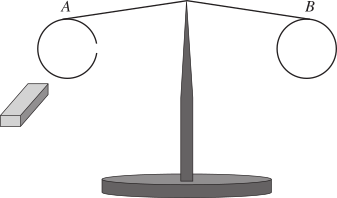
 

When a bar magnet is pushed into one of the rings, the whole balancing arm begins to rotate on the pivot. When the magnet is pulled out, the balancing arm begins to rotate in the opposite direction. When the magnet is pushed in and out of the other ring, the apparatus does not move at all.

Account for these observations using Lenz's Law and conservation of energy.  (5 marks)

--- 15 WORK AREA LINES (style=lined) ---

Show Answers Only
  • When the magnet is pushed into ring `B`, a current is induced in the ring (Faraday’s Law). 
  • The induced current is in the direction such that the magnetic field it produces opposes the original change caused by the moving magnet (Lenz’s Law).
  • When the magnet is pushed into ring `B`, a like pole is produced which causes the magnet and the ring to repel. When the magnet is pulled out of ring `B`, an opposite pole is produced which causes the magnet and the ring to attract.
  • This is consistent with the law of conservation of energy as follows:
    • If the current were in the opposite direction then the field produced would cause a movement that increases the change in flux through the ring.
    • This would thereby produce an even greater induced current which in turn would accelerate the ring even more, in turn leading to an even greater change in flux through the ring.
    • This cycle would continue producing more kinetic and heat energy in the ring than was initially in the system thereby violating the law of conservation of energy. 
  • When the magnet is pushed into ring `A`, no movement of the ring is observed because the gap in the ring prevents a current from being induced.
  • In this instance, no magnetic field is created which means there is no attractive or repulsive force between the ring and the magnet.
Show Worked Solution
  • When the magnet is pushed into ring `B`, a current is induced in the ring (Faraday’s Law). 
  • The induced current is in the direction such that the magnetic field it produces opposes the original change caused by the moving magnet (Lenz’s Law).
  • When the magnet is pushed into ring `B`, a like pole is produced which causes the magnet and the ring to repel. When the magnet is pulled out of ring `B`, an opposite pole is produced which causes the magnet and the ring to attract.
  • This is consistent with the law of conservation of energy as follows:
    • If the current were in the opposite direction then the field produced would cause a movement that increases the change in flux through the ring.
    • This would thereby produce an even greater induced current which in turn would accelerate the ring even more, in turn leading to an even greater change in flux through the ring.
    • This cycle would continue producing more kinetic and heat energy in the ring than was initially in the system thereby violating the law of conservation of energy. 
  • When the magnet is pushed into ring `A`, no movement of the ring is observed because the gap in the ring prevents a current from being induced.
  • In this instance, no magnetic field is created which means there is no attractive or repulsive force between the ring and the magnet.

Filed Under: Applications of the Motor Effect Tagged With: Band 4, Band 5, smc-3695-60-Lenz's Law and the Law of Conservation of Energy

Copyright © 2014–2025 SmarterEd.com.au · Log in