SmarterEd

Aussie Maths & Science Teachers: Save your time with SmarterEd

  • Login
  • Get Help
  • About

PHYSICS, M7 EQ-Bank 22

Diagram 1 shows the absorption spectrum of light produced by an incandescent filament, after it has been shone through a quantity of hydrogen gas. Diagrams 2 and 3 show the spectra obtained from two stars: Croesus and Dromus. The dark lines in the diagrams are absorption bands.
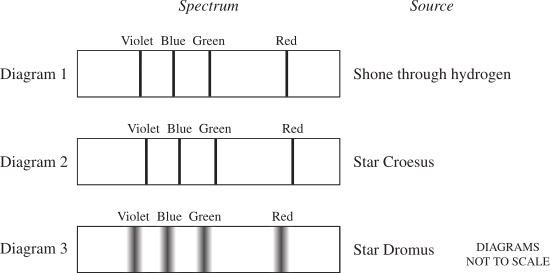
 

Explain what the spectrum of each star, Croesus and Dromus, tells us about the motion of that star.  (3 marks)

--- 6 WORK AREA LINES (style=lined) ---
Show Answers Only
  • The spectra from Croesus is red shifted which indicates it is moving away from Earth.
  • The thin spectra lines from Croesus also indicate that it is not rotating.
  • The centre of spectral lines from Dromus are blue shifted which indicates it is moving towards Earth. 
  • Dromus’ spectral lines are wide and blurry (simultaneously red and blue shifting), which indicates that it is rotating.
Show Worked Solution
  • The spectra from Croesus is red shifted which indicates it is moving away from Earth.
  • The thin spectra lines from Croesus also indicate that it is not rotating.
  • The centre of spectral lines from Dromus are blue shifted which indicates it is moving towards Earth. 
  • Dromus’ spectral lines are wide and blurry (simultaneously red and blue shifting), which indicates that it is rotating.

Filed Under: Electromagnetic Spectrum Tagged With: Band 4, smc-3696-30-Stars

PHYSICS, M7 EQ-Bank 4 MC

Betelgeuse is a red giant star in our galaxy. The following are facts about this star:

Fact 1: Its distance from us is 640 light years.

Fact 2: It has a surface temperature of 3500 K.

Fact 3: Its atmosphere contains titanium dioxide.

Fact 4: It is moving away from us at a speed of `21.9 \ text{km s}^(-1)`.

Which of the given facts about Betelgeuse CANNOT be determined from its spectrum?

  1. Fact 1
  2. Fact 2
  3. Fact 3
  4. Fact 4
Show Answers Only

`A`

Show Worked Solution

By elimination:

  • The star’s surface temperature can be found by determining the peak wavelength from its spectrum then using Wein’s Law. (Eliminate B)
  • The atmospheric composition of the star can be found by matching its spectra to the known spectra of gases. (Eliminate C)
  • Comparing the spectral lines of the star with those of corresponding compounds on Earth, the degree of red shift can be calculated. Applying the doppler effect, the recessional velocity of the star can be determined. (Eliminate D)

`=>A`

Filed Under: Electromagnetic Spectrum Tagged With: Band 4, smc-3696-30-Stars

PHYSICS, M7 2019 HSC 22

Spectra can be used to determine the chemical composition and surface temperature of stars.

Describe how spectra provide information about OTHER features of stars.   (3 marks)

--- 8 WORK AREA LINES (style=lined) ---

Show Answers Only
  • Spectra provide information about the linear velocity of a star relative to Earth. A shift towards higher wavelengths indicates that a star is moving away from Earth. A shift towards lower wavelengths indicates a star is moving towards earth.
  • Darkened, broader spectral lines indicate that a star has a high density due to high pressures in the star’s atmosphere. Narrower spectral lines indicate a lower density star.
  • Blurring and broadening of the edges of spectral lines indicate a star has a high rotational velocity due to simultaneous red and blue doppler shifting. More defined, narrower spectral lines indicate a star with lower rotational velocity.
Show Worked Solution
  • Spectra provide information about the linear velocity of a star relative to Earth. A shift towards higher wavelengths indicates that a star is moving away from Earth. A shift towards lower wavelengths indicates a star is moving towards earth.
  • Darkened, broader spectral lines indicate that a star has a high density due to high pressures in the star’s atmosphere. Narrower spectral lines indicate a lower density star.
  • Blurring and broadening of the edges of spectral lines indicate a star has a high rotational velocity due to simultaneous red and blue doppler shifting. More defined, narrower spectral lines indicate a star with lower rotational velocity.

Filed Under: Electromagnetic Spectrum Tagged With: Band 4, smc-3696-30-Stars

PHYSICS, M7 2019 HSC 2 MC

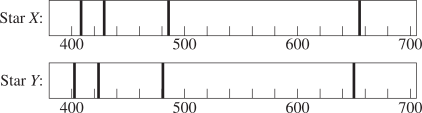
Two stars were observed from Earth. Their spectra are shown with the wavelength in nanometres.
 

Using these spectra, what can be concluded about the motion of the stars relative to Earth and their chemical compositions?
 

\begin{align*}
\begin{array}{l}
\rule{0pt}{2.5ex} \ \rule[-1ex]{0pt}{0pt}& \\
\rule{0pt}{2.5ex}\textbf{A.}\rule[-1ex]{0pt}{0pt}\\
\rule{0pt}{2.5ex}\textbf{B.}\rule[-1ex]{0pt}{0pt}\\
\rule{0pt}{2.5ex}\textbf{C.}\rule[-1ex]{0pt}{0pt}\\
\rule{0pt}{2.5ex}\textbf{D.}\rule[-1ex]{0pt}{0pt}\\
\end{array}
\begin{array}{|c|c|}
\hline
\rule{0pt}{1.5ex}\textit{Motion relative to Earth}\rule[-0.5ex]{0pt}{0pt}& \textit{Chemical composition} \\
\hline
\rule{0pt}{2.5ex}\text{The same}\rule[-1ex]{0pt}{0pt}&\text{The same}\\
\hline
\rule{0pt}{2.5ex}\text{Different}\rule[-1ex]{0pt}{0pt}& \text{The same}\\
\hline
\rule{0pt}{2.5ex}\text{The same}\rule[-1ex]{0pt}{0pt}& \text{Different} \\
\hline
\rule{0pt}{2.5ex}\text{Different}\rule[-1ex]{0pt}{0pt}& \text{Different} \\
\hline
\end{array}
\end{align*}

Show Answers Only

\(B\)

Show Worked Solution
  • Both stars have the same set of spectral lines → Chemical composition is the same.
  • Spectral lines at different wavelengths → Different doppler shift → Different motion relative to the earth.

\(\Rightarrow B\)

Filed Under: Electromagnetic Spectrum Tagged With: Band 3, smc-3696-10-Spectroscopy, smc-3696-30-Stars

PHYSICS, M7 2021 HSC 5 MC

The spectrum of an object is shown.
 

Which row of the table correctly identifies the most likely source of the spectrum and the features labelled \(Y\)?

\begin{align*}
\begin{array}{l}
\rule{0pt}{1.5ex} \ \rule[-0.5ex]{0pt}{0pt}& \\
\rule{0pt}{2.5ex}\textbf{A.}\rule[-1ex]{0pt}{0pt}\\
\rule{0pt}{2.5ex}\textbf{B.}\rule[-1ex]{0pt}{0pt}\\
\rule{0pt}{2.5ex}\textbf{C.}\rule[-1ex]{0pt}{0pt}\\
\rule{0pt}{2.5ex}\textbf{D.}\rule[-1ex]{0pt}{0pt}\\
\end{array}
\begin{array}{|l|l|}
\hline
\rule{0pt}{1.5ex}\text{Source of spectrum}\rule[-0.5ex]{0pt}{0pt}& \textit{Features labelled \(Y\)} \\
\hline
\rule{0pt}{2.5ex}\text{Star}\rule[-1ex]{0pt}{0pt}&\text{Absorption lines}\\
\hline
\rule{0pt}{2.5ex}\text{Discharge tube}\rule[-1ex]{0pt}{0pt}& \text{Absorption lines}\\
\hline
\rule{0pt}{2.5ex}\text{Star}\rule[-1ex]{0pt}{0pt}& \text{Emission lines} \\
\hline
\rule{0pt}{2.5ex}\text{Discharge tube}\rule[-1ex]{0pt}{0pt}& \text{Emission lines} \\
\hline
\end{array}
\end{align*}

Show Answers Only

\(A\)

Show Worked Solution
  • Overall shape resembles a blackbody curve so the source of the spectrum is a star. The wavelengths of lower intensity are absorption lines.

\(\Rightarrow A\)

Filed Under: Electromagnetic Spectrum, Origins of Elements Tagged With: Band 4, smc-3696-10-Spectroscopy, smc-3696-30-Stars, smc-3700-20-Spectra

Copyright © 2014–2025 SmarterEd.com.au · Log in