SmarterEd

Aussie Maths & Science Teachers: Save your time with SmarterEd

  • Login
  • Get Help
  • About

PHYSICS, M7 2019 VCE 17 MC

Which one of the following is true when incandescent light is compared to laser light?

  1. Laser light has a very wide spectrum; incandescent light has a very narrow spectrum.
  2. Both laser light and incandescent light have a very narrow spectrum.
  3. Laser light is incoherent; incandescent light is coherent.
  4. Laser light is coherent; incandescent light is incoherent.
Show Answers Only

\(D\)

Show Worked Solution
  • Incandescent light has a very wide spectrum (eliminate \(A\) and \(B\)).
  • Laser light is coherent while incandescent light is incoherent.

\(\Rightarrow D\)

Filed Under: Electromagnetic Spectrum Tagged With: Band 4, smc-3696-40-Electromagnetic Waves

PHYSICS, M7 2020 VCE 14

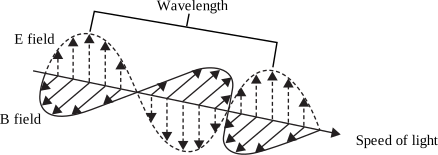
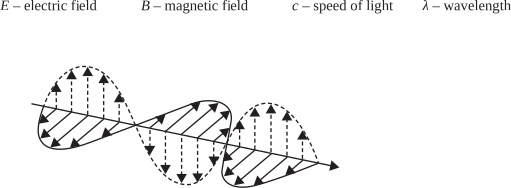
The diagram below shows a representation of an electromagnetic wave.

Correctly label the diagram below using the following symbols.   (3 marks)


--- 0 WORK AREA LINES (style=lined) ---

Show Answers Only

Show Worked Solution

  •  The wavelength is from the first peak on the electric wave to the second peak on the electric wave (not from an electric wave peak to magnetic wave peak).

Filed Under: Electromagnetic Spectrum Tagged With: Band 4, smc-3696-40-Electromagnetic Waves

PHYSICS, M7 2023 HSC 6 MC

An electron would produce an electromagnetic wave when it is

  1. stationary.
  2. in a stable hydrogen atom.
  3. moving at a constant velocity.
  4. moving at a constant speed in a circular path.
Show Answers Only

\(D\)

Show Worked Solution
  • Maxwell predicted that an accelerating charge will produce an electromagnetic wave.
  • As the electron moves at a constant speed in a circular path it must be experiencing an acceleration.

\(\Rightarrow D\)

♦ Mean mark 52%.

Filed Under: Electromagnetic Spectrum Tagged With: Band 5, smc-3696-40-Electromagnetic Waves, smc-3696-50-Maxwell

PHYSICS, M7 EQ-Bank 6 MC

Which statement describes how an electromagnetic wave is propagated?

  1. An oscillating electric field causes a constant magnetic field parallel to the electric field.
  2. An oscillating magnetic field causes an oscillating electric field parallel to the magnetic field.
  3. An oscillating electric field causes an oscillating magnetic field perpendicular to the electric field.
  4. An oscillating magnetic field causes a constant electric field perpendicular to the magnetic field.
Show Answers Only

`C`

Show Worked Solution
  • As per Maxwell’s predictions, an oscillating electric field induces an oscillating magnetic field perpendicular to the electric field.
  • This oscillating magnetic field induces an oscillating electric field perpendicular to it. This process continues and an electromagnetic wave is propagated.

`=>C`

Filed Under: Electromagnetic Spectrum Tagged With: Band 4, smc-3696-40-Electromagnetic Waves

PHYSICS, M7 2019 HSC 25

The diagram shows a model of electromagnetic waves.


Relate this model to predictions made by Maxwell.   (4 marks)

--- 8 WORK AREA LINES (style=lined) ---

Show Answers Only
  • The diagram shows alternating electric and magnetic fields oscillating perpendicular to each other. This relates to Maxwell’s prediction of mutual inductance; that a changing electric field induces a changing magnetic field and vice versa.
  • The diagram shows the electromagnetic wave propagating with velocity `v `. This relates to Maxwell’s prediction of a range of waves with different wavelengths, all travelling at the same speed where `c=(1)/(sqrt(mu_(0)epsilon_(0)))`.
  • The diagram also shows an electromagnetic wave emanating from an oscillating charge. This is consistent with Maxwell’s prediction that an oscillating electric charge produces a changing electric field, which in turn produces a changing magnetic field. These fields continue to mutually induce each other, producing an electromagnetic wave.
Show Worked Solution
  • The diagram shows alternating electric and magnetic fields oscillating perpendicular to each other. This relates to Maxwell’s prediction of mutual inductance; that a changing electric field induces a changing magnetic field and vice versa.
  • The diagram shows the electromagnetic wave propagating with velocity `v `. This relates to Maxwell’s prediction of a range of waves with different wavelengths, all travelling at the same speed where `c=(1)/(sqrt(mu_(0)epsilon_(0)))`.
  • The diagram also shows an electromagnetic wave emanating from an oscillating charge. This is consistent with Maxwell’s prediction that an oscillating electric charge produces a changing electric field, which in turn produces a changing magnetic field. These fields continue to mutually induce each other, producing an electromagnetic wave.

♦ Mean mark 44%.

Filed Under: Electromagnetic Spectrum Tagged With: Band 5, smc-3696-40-Electromagnetic Waves, smc-3696-50-Maxwell

Copyright © 2014–2025 SmarterEd.com.au · Log in