SmarterEd

Aussie Maths & Science Teachers: Save your time with SmarterEd

  • Login
  • Get Help
  • About

PHYSICS, M8 2020 VCE 17

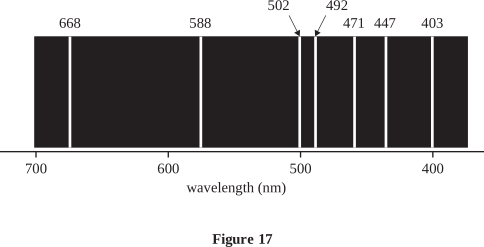
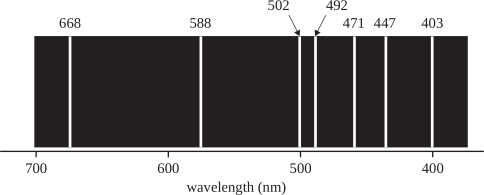
The diagram shows the emission spectrum for helium gas.
 

  1. Which spectral line indicates the photon with the lowest energy?  (1 mark)

--- 1 WORK AREA LINES (style=lined) ---

  1. Calculate the frequency of the photon emitted at the 588 nm line. Show your working.  (2 marks)

--- 6 WORK AREA LINES (style=lined) ---

  1. Explain why only certain wavelengths and, therefore, certain energies are present in the helium spectrum.  (2 marks)

--- 4 WORK AREA LINES (style=lined) ---
Show Answers Only

a.    \(668\ \text{nm}\)

b.    \(5.1 \times 10^{14}\ \text{Hz}\)

c.   Wavelengths of \(\ce{He}\) spectrum:

  • Electrons in the helium atom exist within electron shells.
  • Electrons in each shell have a fixed amount of energy. 
  • The electrons can absorb certain amounts of energy and move up into the next energy shell which is equal to the difference in energy between the shells.
  • When electrons fall back to their original energy state, they emit a photon with energy equal to the difference in energy between the shells.
  • As these are always fixed energy levels, only certain wavelengths and energies are emitted and therefore present in the helium spectrum.

Show Worked Solution

a.    \(E=\dfrac{hc}{\lambda}\),  therefore \(E \propto \dfrac{1}{\lambda}\)

  • The photon with the lowest energy will have the highest wavelength.
  • Lowest energy spectral line = 668 nm

b.    Convert: 588 nm = 588 × 10\(^{-9}\) m

\(f=\dfrac{c}{\lambda}=\dfrac{3 \times 10^8}{588 \times 10^{-9}}=5.1 \times 10^{14}\ \text{Hz}\)
 

c.   Wavelengths of \(\ce{He}\) spectrum:

  • Electrons in the helium atom exist within electron shells.
  • Electrons in each shell have a fixed amount of energy. 
  • The electrons can absorb certain amounts of energy and move up into the next energy shell which is equal to the difference in energy between the shells.
  • When electrons fall back to their original energy state, they emit a photon with energy equal to the difference in energy between the shells.
  • As these are always fixed energy levels, only certain wavelengths and energies are emitted and therefore present in the helium spectrum.
♦♦ Mean mark (c) 34%.

Filed Under: Quantum Mechanical Nature of the Atom Tagged With: Band 4, Band 5, smc-3702-20-Electron Transitions, smc-3702-30-Photon Energy

PHYSICS, M8 2020 VCE 16

A beam of electrons travelling at 1.72 × 10\(^5\) m s\(^{-1}\) illuminates a crystal, producing a diffraction pattern as shown below. Ignore relativistic effects.
 

  1. Calculate the kinetic energy of one of the electrons. Show your working.   (2 marks)

    --- 5 WORK AREA LINES (style=lined) ---

  2. The electron beam is now replaced by an X-ray beam. The resulting diffraction pattern has the same spacing as that produced by the electron beam.

    Calculate the energy of one X-ray photon. Show your working.   (3 marks)

    --- 6 WORK AREA LINES (style=lined) ---

Show Answers Only

a.    \(0.084\ \text{eV}\)

b.    \(293\ \text{eV}\)

Show Worked Solution

a.     \(KE\) \(=\dfrac{1}{2}mv^2\)
    \(=\dfrac{1}{2} \times 9.109 \times 10^{-31} \times (1.72 \times 10^5)^2\)
    \(=1.3474\times 10^{-20}\ \text{J}\)
    \(=\dfrac{1.3474 \times 10^{-20}}{1.602 \times 10^{-19}}\)
    \(=0.084\ \text{eV}\)


b.     \(\lambda_e\) \(=\dfrac{h}{mv}\)
    \(=\dfrac{6.626 \times 10^{-34}}{9.109 \times 10^{-31} \times 1.72 \times 10^5}\)
    \(=4.23 \times 10^{-9}\ \text{m}\)
    \(=\lambda_{\text{x-ray}}\)


  \(E_{\text{x-ray}}\) \(=\dfrac{hc}{\lambda}\)
    \(=\dfrac{6.626 \times 10^{-34} \times 3 \times 10^8}{4.23 \times 10^{-9}}\)
    \(=4.7 \times 10^{-17}\ \text{J}\)
    \(=\dfrac{4.7 \times 10^{-17}}{1.602 \times 10^{-19}}\)
    \(=293\ \text{eV}\)
♦ Mean mark (b) 41%.

Filed Under: Quantum Mechanical Nature of the Atom Tagged With: Band 4, Band 5, smc-3702-30-Photon Energy, smc-3702-40-De Broglie

PHYSICS, M8 2021 VCE 19

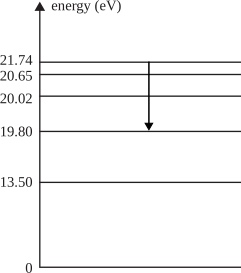
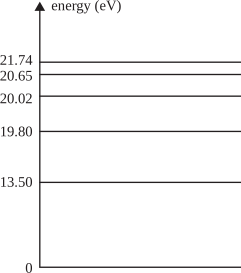
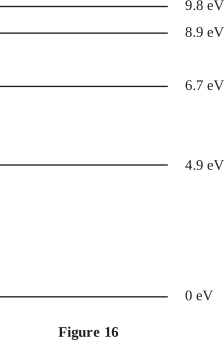
A simplified diagram of some of the energy levels of an atom is shown in the diagram.
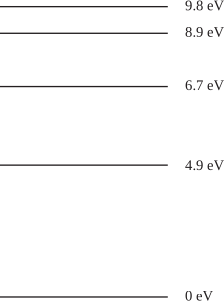
 

  1. Identify the transition on the energy level diagram that would result in the emission of a 565 nm photon. Show your working.   (2 marks)

--- 6 WORK AREA LINES (style=lined) ---

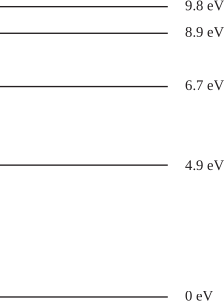
  1. A sample of the atoms is excited into the 9.8 eV state and a line spectrum is observed as the states decay. Assume that all possible transitions occur.

    What is the total number of lines in the spectrum? Explain your answer. You may use the diagram below to support your answer.   (2 marks)
     

--- 6 WORK AREA LINES (style=lined) ---

Show Answers Only

a.    The energy transition from 8.9 eV to 6.7 eV.

b.    9 spectral lines.

Show Worked Solution

a.    \(E=hf=\dfrac{hc}{\lambda}=\dfrac{6.626 \times 10^{-34} \times 3 \times 10^8}{565 \times 10^{-9}}=3.52 \times 10^{-19}\ \text{J}\)

\(\text{Convert to eV}\ =\dfrac{3.52 \times 10^{-19}}{1.602 \times 10^{-19}}=2.2\ \text{eV}\)

  • The energy transition from 8.9 eV to 6.7 eV will result in the emission of a 565 nm photon.
  • Note: This could have also been shown on the diagram as a downwards arrow from 8.9 eV to 6.7 eV.
     
♦ Mean mark (a) 50%.

b.    Decay from the 9.8 eV state:

  • Each photon emitted that has its own unique energy will result in a spectrum line.
  • There are 4 possible transitions from 9.8 eV, 3 from 8.9 eV, 2 from 6.7 eV and 1 from 4.9 eV, resulting in 10 different transitions.
  • However, the transition from 9.8 eV to 4.9 eV and 4.9 eV to 0 eV will produce a photon of the same energy, hence they will have the same spectral line. 
  • Therefore, there will be 9 lines in the spectrum.
♦♦ Mean mark (b) 31%.

Filed Under: Quantum Mechanical Nature of the Atom Tagged With: Band 5, smc-3702-20-Electron Transitions, smc-3702-30-Photon Energy

PHYSICS, M8 2022 VCE 15

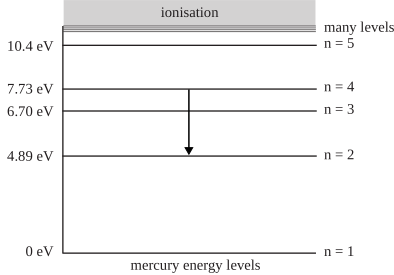
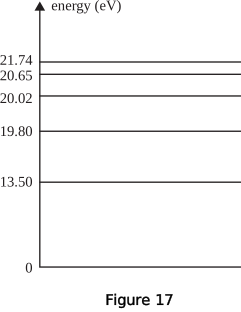
The diagram shows some of the energy levels of excited neon atoms. These energy levels are not drawn to scale.
 

  1. Show that the energy transition required for an emitted photon of wavelength 640 nm is 1.94 eV.   (1 mark)

--- 4 WORK AREA LINES (style=lined) ---

  1. On the diagram, draw an arrow to show the transition that would emit the photon described in part a.   (1 mark)

--- 0 WORK AREA LINES (style=blank) ---

Show Answers Only

a.    \(E=hf=\dfrac{hc}{\lambda}=\dfrac{6.626 \times 10^{-34} \times 3 \times 10^8}{640 \times 10^{-9}}=3.106 \times 10^{-19}\ \text{J}\)

\(\text{Convert to electron volts} =\dfrac{3.106 \times 10^{-19}}{1.602 \times 10^{-19}}=1.94\ \text{eV}\)
 

b.   
       

Show Worked Solution

a.    \(E=hf=\dfrac{hc}{\lambda}=\dfrac{6.626 \times 10^{-34} \times 3 \times 10^8}{640 \times 10^{-9}}=3.106 \times 10^{-19}\ \text{J}\)

\(\text{Convert to electron volts} =\dfrac{3.106 \times 10^{-19}}{1.602 \times 10^{-19}}=1.94\ \text{eV}\)
 

b.
       

Filed Under: Quantum Mechanical Nature of the Atom Tagged With: Band 4, smc-3702-20-Electron Transitions, smc-3702-30-Photon Energy

PHYSICS, M8 2021 VCE 18*

A monochromatic light source is emitting green light with a wavelength of 550 nm. The light source emits 2.8 × 10\(^{16}\) photons every second.

Calculate the power of the light source in Watts?   (2 marks)

--- 5 WORK AREA LINES (style=lined) ---

Show Answers Only

\(1.0 \times 10^{-2}\ \text{W}\)

Show Worked Solution

\(\text{Energy per photon:}\)

\(E=\dfrac{hc}{\lambda}= \dfrac{6.626 \times 10^{-34} \times 3 \times 10^8}{550 \times 10^{-9}}=3.614 \times 10^{-19}\ \text{J}\)

\(\therefore \ \text{Power} =3.614 \times 10^{-19} \times 2.8 \times 10^{16}=1.0 \times 10^{-2}\ \text{W}\)

♦ Mean mark 47%.

Filed Under: Quantum Mechanical Nature of the Atom Tagged With: Band 5, smc-3702-30-Photon Energy

PHYSICS, M8 2022 VCE 17 MC

Gamma radiation is often used to treat cancerous tumours. The energy of a gamma photon emitted by radioactive cobalt-60 is 1.33 MeV.

Which one of the following is closest to the frequency of the gamma radiation?

  1. \(1.33 \times 10^{6}\ \text{Hz}\)
  2. \(3.21 \times 10^{20}\ \text{Hz}\)
  3. \(3.21 \times 10^{21}\ \text{Hz}\)
  4. \(2.01 \times 10^{39}\ \text{Hz}\)
Show Answers Only

\(B\)

Show Worked Solution
  • \(\text{Convert 1.33 MeV to joules:}\)
  •    \((1.33 \times 10^{6} \times 1.602 \times 10^{-19} =2.13 \times 10^{-13}\ \text{J}\)
  • \(\text{Using}\ \ E=hf\):
  •    \(f=\dfrac{E}{h} = \dfrac{2.13 \times 10^{-13}}{6.626 \times 10^{-34}}=3.21 \times 10^{20}\ \text{Hz}\)

\(\Rightarrow B\)

Filed Under: Quantum Mechanical Nature of the Atom Tagged With: Band 4, smc-3702-30-Photon Energy

PHYSICS, M8 2023 VCE 16

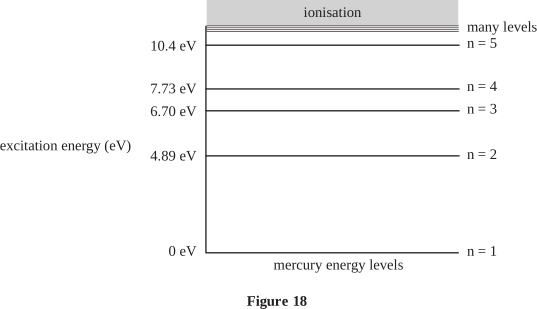
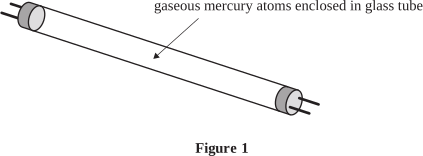
Fluorescent lights, when operating, contain gaseous mercury atoms, as shown in Figure 1.
 

Analysis of the light produced by fluorescent lights shows a number of emission spectral lines, including a prominent line representing a wavelength of 436.6 nm.

  1. Calculate the energy of the photons represented by the emission spectral line representing a wavelength of 436.6 nm.   (2 marks)

--- 4 WORK AREA LINES (style=lined) ---

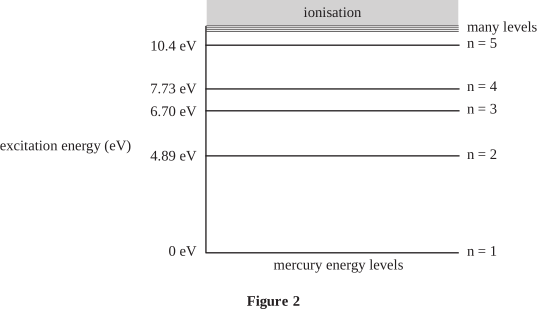
Figure 2 shows the lowest five energy levels for mercury.
 

  1. On the energy level diagram in Figure 2, draw an arrow showing the energy level transition that corresponds to the production of the spectral line representing a wavelength of 436.6 nm.   (1 mark)

    --- 0 WORK AREA LINES (style=lined) ---

Show Answers Only

a.    \(E=2.84\ \text{eV}\)

b.    
       

Show Worked Solution

a.    \(E=\dfrac{hc}{\lambda}=\dfrac{6.626 \times 10^{-34} \times 3 \times 10^8}{436.6 \times 10^{-9}}=4.549 \times 10^{-19}\ \text{J}\)

\(\text{Convert to eV:}\)

\(E= \dfrac{4.549 \times 10^{-19}}{1.602 \times 10^{-19}} = 2.84\ \text{eV}\)
 

b.    
Filed Under: Quantum Mechanical Nature of the Atom Tagged With: Band 4, smc-3702-20-Electron Transitions, smc-3702-30-Photon Energy

PHYSICS, M8 EQ-Bank 24

The table shows the quantum numbers of the four lowest states of the hydrogen atom, together with the energies of those states.

\begin{array}{|c|c|}
\hline \rule{0pt}{2.5ex}\textit{Quantum number,} \ n \rule[-1ex]{0pt}{0pt}& \quad \textit{Energy}\ \text{(joules)} \quad  \\
\hline \rule{0pt}{2.5ex}1 \text { (ground state) } \rule[-1ex]{0pt}{0pt}& 0 \\
\hline \rule{0pt}{2.5ex}2 \rule[-1ex]{0pt}{0pt}& 1.63 \times 10^{-18} \\
\hline \rule{0pt}{2.5ex}3 \rule[-1ex]{0pt}{0pt}& 1.94 \times 10^{-18} \\
\hline \rule{0pt}{2.5ex}4 \rule[-1ex]{0pt}{0pt}& 2.04 \times 10^{-18} \\
\hline
\end{array}

Using appropriate calculations, explain a quantum transition that will absorb a photon of wavelength 102 nm?   (3 marks)

Show Answers Only

See Worked Solutions

Show Worked Solution

Calculating the energy of the photon:

\(E\) \(=h f\)  
  \(=\dfrac{h c}{\lambda}\)  
  \(=\dfrac{\left(6.626 \times 10^{-34}\right)\left(3 \times 10^8\right)}{1.02 \times 10^{-7}}\)  
  \(=1.949 \times 10^{-18} \  \text{J}\)  
     
  •  When a photon with wavelength 102 nm strikes an electron in the ground state of the hydrogen atom, it will transfer its energy to the electron causing it to occupy a shell with greater energy. 
  • The electron absorbing the photon will therefore transition between shells one (ground state) and three, which is approximately the energy difference between these levels as shown in the table.

Filed Under: Quantum Mechanical Nature of the Atom Tagged With: Band 5, smc-3702-20-Electron Transitions, smc-3702-30-Photon Energy

PHYSICS, M7 2019 HSC 13 MC

A laser has a power output of 30 mW and emits light with a wavelength of 650 nm.

How many photons does this laser emit per second?

  1. `4.6 × 10^(14)`
  2. `9.8 × 10^(16)`
  3. `3.1 × 10^(19)`
  4. `9.3 × 10^(21)`
Show Answers Only

`B`

Show Worked Solution
`E` `=hf`  
  `=(hc)/(lambda)`  
  `=((6.626 xx10^(-34))(3 xx10^(8)))/(6.5 xx10^(-7))`  
  `=3.1 xx10^(-19)\ \text{J}`  

 
`text{Photons}=(P)/(E)=(30 xx10^(-3))/(3.1 xx10^(-19))=9.8 xx10^(16)`

`=>B`


♦ Mean mark 43%.

Filed Under: Light: Quantum Model, Quantum Mechanical Nature of the Atom Tagged With: Band 5, smc-3698-10-Photoelectric Effect, smc-3702-30-Photon Energy

Copyright © 2014–2025 SmarterEd.com.au · Log in