SmarterEd

Aussie Maths & Science Teachers: Save your time with SmarterEd

  • Login
  • Get Help
  • About

PHYSICS, M8 2025 HSC 21

A scientist has two unlabelled sources of radiation. Once source emits alpha particles and the other emits beta particles.

Outline TWO methods that could be used to determine which source is the alpha emitter, and which source is the beta emitter.   (3 marks)

--- 8 WORK AREA LINES (style=blank) ---
Show Answers Only

Method 1:

  • Pass the radiation through a thin material to a detector.
  • Observe any radiation count changes.
  • The beta source count will be reduced by a lesser amount less than the alpha source count.

Method 2:

  • Pass the two radiation types through a magnetic field.
  • Alpha particles (positive charge) will be deflected slightly in one direction.
  • Beta particles (negative charge) will be deflected strongly in the opposite direction.
  • This difference allows you to identify which source is emitting alphas and which is emitting betas.

Answers could also include:

  • Passing radiation through an electric field.
  • Use of a cloud chamber.
Show Worked Solution

Method 1:

  • Pass the radiation through a thin material to a detector.
  • Observe any radiation count changes.
  • The beta source count will be reduced by a lesser amount less than the alpha source count.

Method 2:

  • Pass the two radiation types through a magnetic field.
  • Alpha particles (positive charge) will be deflected slightly in one direction.
  • Beta particles (negative charge) will be deflected strongly in the opposite direction.
  • This difference allows you to identify which source is emitting alphas and which is emitting betas.

Answers could also include:

  • Passing radiation through an electric field.
  • Use of a cloud chamber.

Filed Under: Properties of the Nucleus Tagged With: Band 3, smc-3703-30-Types of Radiation

PHYSICS, M8 2022 VCE 3 MC

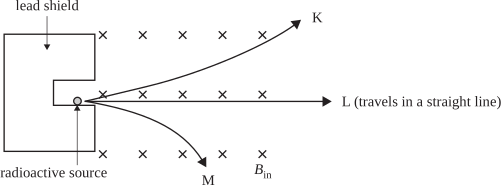
Particles emitted from a radioactive source travel through a magnetic field, \(B_{\text {in }}\), directed into the page, as shown schematically in the diagram below.

Three particles, \(\text{K, L}\) and \(\text{M}\), follow the paths indicated by the arrows.
 

Which of the following correctly identifies the charges on particles \(\text{K, L}\) and \(\text{M}\)?

\begin{align*}
\begin{array}{l}
\rule{0pt}{2.5ex} \ \rule[-1ex]{0pt}{0pt}& \\
\rule{0pt}{2.5ex}\textbf{A.}\rule[-1ex]{0pt}{0pt}\\
\rule{0pt}{2.5ex}\textbf{B.}\rule[-1ex]{0pt}{0pt}\\
\rule{0pt}{2.5ex}\textbf{C.}\rule[-1ex]{0pt}{0pt}\\
\rule{0pt}{2.5ex}\textbf{D.}\rule[-1ex]{0pt}{0pt}\\
\end{array}
\begin{array}{|c|c|c|}
\hline \rule{0pt}{1.5ex}\textbf{K} \rule[-0.5ex]{0pt}{0pt}&\textbf{L} & \textbf{M} \\
\hline \rule{0pt}{2.5ex}\text{positive} \rule[-1ex]{0pt}{0pt}& \text{no charge} & \text{negative} \\
\hline \rule{0pt}{2.5ex}\text{positive} \rule[-1ex]{0pt}{0pt}& \text{negative} & \text{negative} \\
\hline \rule{0pt}{2.5ex}\text{negative} \rule[-1ex]{0pt}{0pt}& \text{no charge} & \text{positive} \\
\hline \rule{0pt}{2.5ex}\text{no charge} \rule[-1ex]{0pt}{0pt}& \text{no charge} & \text{no charge} \\
\hline
\end{array}
\end{align*}

Show Answers Only

\(A\)

Show Worked Solution
  • \(\text{L}\) must have no charge as it travels through the magnetic field with no deflection.
  • Using the right-hand rule, the force on a positive charge would be up the page, hence \(\text{K}\) must be the positive charge.

\(\Rightarrow A\)

Filed Under: Properties of the Nucleus Tagged With: Band 3, smc-3703-30-Types of Radiation

PHYSICS, M8 2023 HSC 11 MC

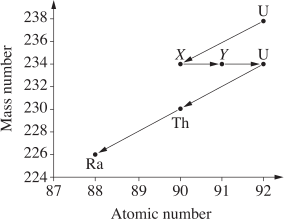
The chart shows part of a nuclear decay series beginning with uranium.


Which option correctly identifies \(X\) and \(Y\) and the process by which each was produced?

\begin{align*}
\begin{array}{l}
\rule{0pt}{2.5ex} \ \rule[-1ex]{0pt}{0pt}& \\
\rule{0pt}{2.5ex}\textbf{A.}\\
\textbf{}\rule[-1ex]{0pt}{0pt}\\
\rule{0pt}{2.5ex}\textbf{B.}\\
\textbf{}\rule[-1ex]{0pt}{0pt}\\
\rule{0pt}{2.5ex}\textbf{C.}\\
\textbf{}\rule[-1ex]{0pt}{0pt}\\
\rule{0pt}{2.5ex}\textbf{D.}\\
\textbf{}\rule[-1ex]{0pt}{0pt}\\
\end{array}
\begin{array}{|l|l|}
\hline
\rule{0pt}{2.5ex}\quad \quad \quad X\rule[-1ex]{0pt}{0pt}&\quad \quad \quad Y\\
\hline
\rule{0pt}{2.5ex}{ }_{\ \ 90}^{234}\text{Th}&{ }_{\ \ 91}^{234}\text{Pa}\\
\text{alpha decay} \quad \quad  \rule[-1ex]{0pt}{0pt}&\text{beta decay}\quad \quad \\
\hline
\rule{0pt}{2.5ex}{ }_{\ \ 90}^{234}\text{Th}& { }_{\ \ 91}^{234}\text{Pa}\\
\text{alpha decay}\quad \rule[-1ex]{0pt}{0pt}&\text{alpha decay}\quad \\
\hline
\rule{0pt}{2.5ex}{ }_{\ \ 91}^{234}\text{Pa}& { }_{\ \ 91}^{234}\text{Pa}\\
\text{beta decay}\quad \rule[-1ex]{0pt}{0pt}&\text{beta decay}\quad \\
\hline
\rule{0pt}{2.5ex}{ }_{\ \ 91}^{234}\text{Pa}& { }_{\ \ 90}^{234}\text{Th} \\
\text{beta decay}\quad \rule[-1ex]{0pt}{0pt}&\text{alpha decay}\quad \\
\hline
\end{array}
\end{align*} 

Show Answers Only

\(A\)

Show Worked Solution
  • During the decay process producing \(X\), the Atomic number decreases by 2 to 90 and the Mass number decreases by 4 to 234
  • Alpha decay producing  \({ }_{\ \ 90}^{234}\text{Th}\)
  • During the decay process producing \(Y\), the Atomic number increases by 1 to 91 and the Mass number does not change. 
  • Beta decay producing \({ }_{\ \ 91}^{234}\text{Pa}\)

\(\Rightarrow A\)

Filed Under: Properties of the Nucleus Tagged With: Band 3, smc-3703-30-Types of Radiation, smc-3703-40-Radioactive Decay

PHYSICS, M8 EQ-Bank 17 MC

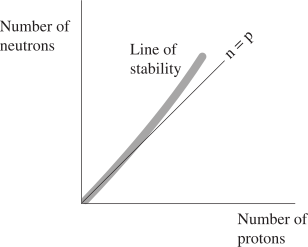
The graph shown plots isotopes in terms of their numbers of protons and neutrons. When an isotope undergoes nuclear decay, it will move to a different location on the graph. The movement can be represented with an arrow.
 

Which arrow would correctly describe beta negative `(beta^(-))` decay on the graph?
 

Show Answers Only

`A`

Show Worked Solution
  • In `beta^(-)` decay, a neutron is converted into a proton and an electron.
  • The number of neutrons decreases by one and the number of protons increase by one.
  • This corresponds to a movement downwards and to the right on the graph.

`=>A`

Filed Under: Properties of the Nucleus Tagged With: Band 5, smc-3703-30-Types of Radiation

PHYSICS M6 2022 HSC 3 MC

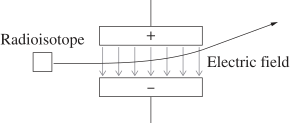
A radioisotope emits radiation which is deflected by an electric field, as shown.


What type of radiation is this?

  1. Alpha
  2. Gamma
  3. Beta positive (positron)
  4. Beta negative (electron)
Show Answers Only

`D`

Show Worked Solution
  • The radiation experiences a force of attraction towards the positive plate and is therefore negatively charged.

`=>D`

Filed Under: Charged Particles, Conductors and Electric/Magnetic Fields, Properties of the Nucleus Tagged With: Band 3, smc-3693-10-Charged Particles in EF, smc-3703-30-Types of Radiation

PHYSICS, M8 2020 HSC 8 MC

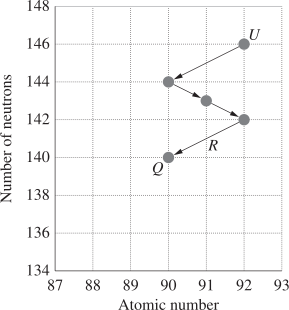
A uranium isotope, \(U\), undergoes four successive decays to produce \(Q\).
 

Which row of the table correctly shows the decay process \(R\) and product \(Q\) ?

\begin{align*}
\begin{array}{l}
\rule{0pt}{2.5ex} \ \rule[-1ex]{0pt}{0pt}& \\
\rule{0pt}{2.5ex}\textbf{A.}\rule[-1ex]{0pt}{0pt}\\
\rule{0pt}{2.5ex}\textbf{B.}\rule[-1ex]{0pt}{0pt}\\
\rule{0pt}{2.5ex}\textbf{C.}\rule[-1ex]{0pt}{0pt}\\
\rule{0pt}{2.5ex}\textbf{D.}\rule[-1ex]{0pt}{0pt}\\
\end{array}
\begin{array}{|c|c|}
\hline \rule{0pt}{2.5ex}\textit{Process R} \rule[-1ex]{0pt}{0pt}& \textit{Product Q} \\
\hline \rule{0pt}{2.5ex} \alpha \rule[-1ex]{0pt}{0pt}& \text {Pa-230 } \\
\hline \rule{0pt}{2.5ex} \beta \rule[-1ex]{0pt}{0pt}& \text {Pa-234 } \\
\hline \rule{0pt}{2.5ex} \alpha \rule[-1ex]{0pt}{0pt}& \text {Th-230 } \\
\hline \rule{0pt}{2.5ex} \beta \rule[-1ex]{0pt}{0pt}& \text {Th-234 } \\
\hline
\end{array}
\end{align*} 

Show Answers Only

\(C\)

Show Worked Solution
  • Decay process \(R\)  reduces the number of both protons and neutrons by two → alpha decay.
  • Thorium has atomic number 90.

\(\Rightarrow C\)

Filed Under: Properties of the Nucleus Tagged With: Band 3, smc-3703-30-Types of Radiation

PHYSICS, M8 2021 HSC 19 MC

Rh-106 is a metallic, beta-emitting radioisotope with a half-life of 30 seconds.

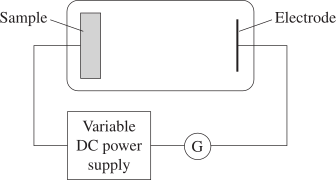
A sample of Rh-106 and an electrode are placed inside an evacuated chamber. They are connected to a galvanometer and a variable DC power supply.
 

A student measures the current, `I`, when the power supply is set to zero. They then measure the stopping voltage, `V_s`. The stopping voltage is the minimum voltage needed to prevent current flowing.

A few minutes later, these measurements are repeated.

How do the TWO sets of measurements compare?

  1. Only `I` changes.
  2. Only `V_s` changes.
  3. Both `I` and `V_s` change.
  4. Neither `I` nor `V_s` changes.
Show Answers Only

`A`

Show Worked Solution
  • Due to the short half life of the isotope, there will be significantly less present when the second reading is made.
  • Lower rate of emission of electrons → lower recorded current.
  • The energy of emitted electrons will remain the same → voltage will not change.

`=>A`


♦ Mean mark 29%.

Filed Under: Properties of the Nucleus Tagged With: Band 5, smc-3703-30-Types of Radiation, smc-3703-40-Radioactive Decay

Copyright © 2014–2025 SmarterEd.com.au · Log in