SmarterEd

Aussie Maths & Science Teachers: Save your time with SmarterEd

  • Login
  • Get Help
  • About

ENGINEERING, CS 2025 HSC 22b

A building is being partially demolished and replaced. Part of the original structure will be retained.

Engineers want to retain some steel components of the building.

Describe a suitable process which could be used to detect surface cracks in ONE steel component of the building.   (3 marks)

--- 9 WORK AREA LINES (style=lined) ---
Show Answers Only
  • Magnetic particle inspection (MPI) is a non-destructive testing method suitable for detecting surface cracks in steel components.
  • The steel component is first cleaned and then magnetised using an electromagnet or permanent magnet. Iron oxide particles suspended in a liquid carrier are then applied to the surface.
  • Where surface cracks exist, magnetic flux leaks outward and attracts the particles, forming a visible cluster that clearly marks the location and extent of any defect.
  • The component is then inspected under white or ultraviolet light, and the severity of any cracking is assessed before a repair or replacement decision is made.
Show Worked Solution
  • Magnetic particle inspection (MPI) is a non-destructive testing method suitable for detecting surface cracks in steel components.
  • The steel component is first cleaned and then magnetised using an electromagnet or permanent magnet. Iron oxide particles suspended in a liquid carrier are then applied to the surface.
  • Where surface cracks exist, magnetic flux leaks outward and attracts the particles, forming a visible cluster that clearly marks the location and extent of any defect.
  • The component is then inspected under white or ultraviolet light, and the severity of any cracking is assessed before a repair or replacement decision is made.

Filed Under: Engineering Materials Tagged With: Band 4, smc-3715-10-Specialised testing, smc-3715-40-Cracking

ENGINEERING, CS 2017 HSC 14 MC

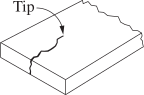
A highly stressed steel plate develops a fatigue crack while in service.
 

Which of the following is the most effective temporary method to slow or stop the crack's growth?

  1. Weld the crack as it is
  2. Drill a hole ahead of the tip of the crack
  3. Drill a hole through the start of the crack
  4. Weld a small steel plate over the tip of the crack
Show Answers Only

`B`

Show Worked Solution
  • A and D are possible permanent solutions, but as the question requests the most effective temporary method it must be B or C.
  • Drilling a hole at the tip of the crack is a more effective solution as it prevents the crack from penetrating further, while drilling a hole at the start would not prevent the cracks growth.

`=>B`

Filed Under: Engineering Materials Tagged With: Band 4, smc-3715-40-Cracking

ENGINEERING, CS 2022 HSC 6 MC

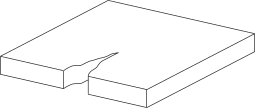
The diagram shows a steel plate with a crack developing.
 

Which of the following would best prevent the crack from growing?

  1. Welding the crack
  2. Riveting a plate over the crack
  3. Drilling a hole at the end of the crack
  4. Filling the crack with an industrial adhesive
Show Answers Only

`C`

Show Worked Solution
  • Drilling a stop hole at the end of a crack can be effective in arresting crack growth as it reduces stress concentration at the crack tip.

`=>C`

Mean mark 59%.

Filed Under: Engineering Materials Tagged With: Band 4, smc-3715-40-Cracking

Copyright © 2014–2026 SmarterEd.com.au · Log in