SmarterEd

Aussie Maths & Science Teachers: Save your time with SmarterEd

  • Login
  • Get Help
  • About

ENGINEERING, PPT 2023 HSC 24a

Roller coaster support structures can be made from either timber or steel.

Compare the properties of the two materials in roller coaster support structures.  (2 marks)

--- 4 WORK AREA LINES (style=lined) ---
Show Answers Only

  • Unlike steel, timber has the ability to flex and bend, which can absorb some of the forces exerted by the roller coaster.
  • However, timber has less mechanical strength than steel and is more susceptible to rot and insect damage over time.

Answers could include:

  • Steel frames are much more easily fabricated and assembled than timber frames, which can save time and costs in the construction process.
  • Steel is much more resistant to fire than timber, which makes it a safer material to use in roller coasters.
  • Steel has greater mechanical strength and is a more durable material than timber. It is able to withstand the higher stresses and forces exerted on a roller coaster.

Show Worked Solution

  • Unlike steel, timber has the ability to flex and bend, which can absorb some of the forces exerted by the roller coaster.
  • However, timber has less mechanical strength than steel and is more susceptible to rot and insect damage over time.

Answers could include:

  • Steel frames are much more easily fabricated and assembled than timber frames, which can save time and costs in the construction process.
  • Steel is much more resistant to fire than timber, which makes it a safer material to use in roller coasters.
  • Steel has greater mechanical strength and is a more durable material than timber. It is able to withstand the higher stresses and forces exerted on a roller coaster.

Filed Under: Historical and Societal Influences Tagged With: Band 2, smc-3717-30-Historical materials

ENGINEERING, CS 2019 HSC 16 MC

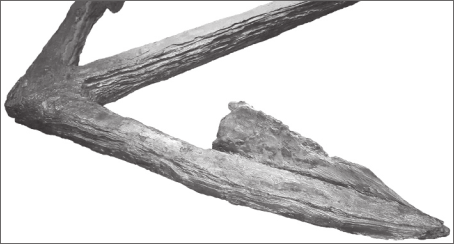
The image shows part of a large anchor recovered from waters off Western Australia. The anchor's approximate date of manufacture was 1790 .
 

This anchor is most likely made from

  1. cast iron.
  2. cast steel.
  3. wrought iron.
  4. laminated silicon steel.
Show Answers Only

`C`

Show Worked Solution

By Elimination:

  • In 1790 mild steel and silicon steel did not exist (eliminate `B` and `D`).
  • Since it is less brittle, wrought iron would have been used as anchors are subjected to sudden impacts against rocks (eliminate `A`).

`=>C`


Mean mark 52%.

Filed Under: Historical and Societal Influences, Historical and Societal Influences, Materials Tagged With: Band 5, smc-3713-30-Historical materials, smc-3715-60-Laminates, smc-3717-30-Historical materials, smc-3719-10-Manufacturing - Ferrous

ENGINEERING, PPT 2022 HSC 21a

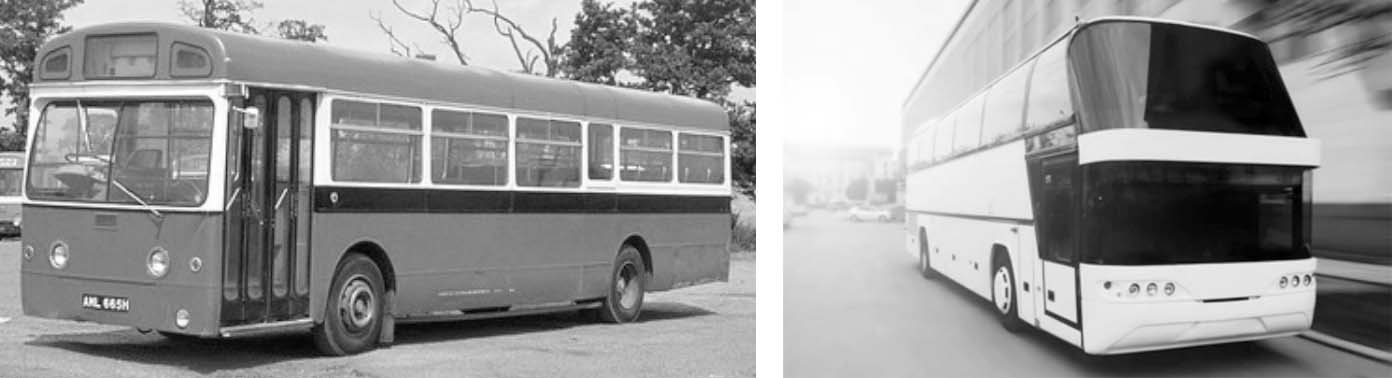
The following images show an older bus and a contemporary bus.
 

  1. Older buses had flat, toughened glass windscreen panels.
  2. How is toughened glass manufactured?   (2 marks)

--- 5 WORK AREA LINES (style=lined) ---

  1. Contemporary buses have windscreens which curve around the front of the bus.
  2. Describe the manufacturing process used to make these windscreens.   (3 marks)

--- 6 WORK AREA LINES (style=lined) ---

Show Answers Only

i.    Toughened glass is formed by:-

  • heating the glass to annealing temperature (approximately 600 degrees) and quenching/rapidly cooling the outside layers using a jet of water.
  • Alternatively toughened glass can be created by soaking the glass in potassium nitrate for an extended period.

ii.    Production of curved glass panels:

  • Windscreens are produced by placing a flat sheet of glass above a metal mould.
  • The glass is then evenly heated until it falls and takes the shape of the mould, and then allowed to cool.
  • Once cooled, the glass is then laminated.
  • Laminating involves placing a layer of polymer between two identically shaped sheets of glass, in this case curved windshields.
Show Worked Solution

i.    Toughened glass is formed by:-

  • heating the glass to annealing temperature (approximately 600 degrees) and quenching/rapidly cooling the outside layers using a jet of water.
  • Alternatively toughened glass can be created by soaking the glass in potassium nitrate for an extended period.

♦ Mean mark (i) 43%.

ii.    Production of curved glass panels:

  • Windscreens are produced by placing a flat sheet of glass above a metal mould.
  • The glass is then evenly heated until it falls and takes the shape of the mould, and then allowed to cool.
  • Once cooled, the glass is then laminated.
  • Laminating involves placing a layer of polymer between two identically shaped sheets of glass, in this case curved windshields.

♦ Mean mark (ii) 39%.

Filed Under: Historical and Societal Influences, Materials Tagged With: Band 5, smc-3717-30-Historical materials, smc-3719-60-Ceramics/Glass, smc-3719-70-Polymers

Copyright © 2014–2025 SmarterEd.com.au · Log in