Outline the importance of engineers working collaboratively during a construction project. (2 marks)
--- 5 WORK AREA LINES (style=lined) ---
Aussie Maths & Science Teachers: Save your time with SmarterEd
Outline the importance of engineers working collaboratively during a construction project. (2 marks)
--- 5 WORK AREA LINES (style=lined) ---
Which of the following is a key benefit of engineers adhering to AS 1100 when producing engineering drawings?
\(A\)
\(\Rightarrow A\)
A tiger is a type of cat.
Consider the following statement.
'If I have a tiger, then I have a cat.'
The contrapositive of this statement is
\(C\)
\(\text{Statement: If} \ \ X \Rightarrow Y\)
\(\text{Contrapositive: If} \ \neg \ Y \ \Rightarrow \neg \ X\)
\(\text{If I don’t have a cat} \ \ \Rightarrow \ \ \text{I don’t have a tiger.}\)
\(\Rightarrow C\)
The position vectors of particles \(P\) and \(Q\) at time \(t\) seconds are given by
\begin{align*}
{\underset{\sim}{r}}_P(t)=\left(t^3+a t^2\right) \underset{\sim}{i}-\underset{\sim}{j} \ \ \text {and} \ \ {\underset{\sim}{r}}_Q(t)=(b t+2 t) \underset{\sim}{i}+\left(2 t^2+c t+t\right) \underset{\sim}{j},
\end{align*}
where \(t \geq 0\) and \(a, b, c \in R\).
The particles collide when \(t=1\).
--- 5 WORK AREA LINES (style=lined) ---
When the particles collide, their velocities are at right angles to each other.
--- 10 WORK AREA LINES (style=lined) ---
--- 7 WORK AREA LINES (style=lined) ---
a. \(\text{\(P\) and \(Q\) collide at \(\ t=1\).}\)
\(\text{Equate co-efficients of} \ \underset{\sim}{j}:\)
\(2+c+1=-1 \ \ \Rightarrow \ \ c=-4\)
b. \(a=-\dfrac{3}{2},-1\)
c. \(a=-1, \ b=-2\)
a. \(\text{\(P\) and \(Q\) collide at \(\ t=1\).}\)
\(\text{Equate co-efficients of} \ \underset{\sim}{j}:\)
\(2+c+1=-1 \ \ \Rightarrow \ \ c=-4\)
b. \(r_P=\left(t^3+a t^2\right)\underset{\sim}{i}-\underset{\sim}{j} \ \ \Rightarrow \ \ \dot{r}_P=\left(3 t^2+2 a t\right) \underset{\sim}{i}\)
\(r_Q=(b t+2 t) \underset{\sim}{i}+\left(2 t^2-3 t\right)\underset{\sim}{j} \ \ \Rightarrow \ \ \dot{r}_Q=(b+2)\underset{\sim}{i}+(4 t-3)\underset{\sim}{j}\)
\(\text {Velocities are perpendicular at} \ \ t=1:\)
\(\displaystyle \dot{r}_p \cdot \dot{r}_Q=\binom{3+2 a}{0}\binom{b+2}{1}=(3+2 a)(b+2)=0\ \ldots\ (1)\)
\(\text{Equating co-efficients of \(\underset{\sim}{i}\) at \(\ t=1\):}\)
\(1+a=b+2\)
\(\text{Substitute into (1) above:}\)
\((3+2 a)(1+a)=0\)
\(a=-\dfrac{3}{2},-1\)
c. \(\ddot{r}_P=(6 t+2 a)\underset{\sim}{i}, \ \ddot{r}_Q=4 \underset{\sim}{j}\)
\(\text{At \(\ t=1\), magnitudes of \(\ddot{r}_P\) and \(\ddot{r}_Q\) are equal.}\)
\(6+2 a=4 \ \ \Rightarrow \ \ a=-1\)
\(1-1=b+2 \ \ \Rightarrow \ \ b=-2\)
Declan is a filmmaker and content creator.
He has taken out a reducing balance loan to fund a new production.
Interest is calculated monthly and Declan makes monthly repayments.
Three rows of the amortisation table for Declan’s loan are shown below.
\begin{array}{|c|c|c|c|c|}
\hline
\hline \rule{0pt}{2.5ex}\quad \textbf{Payment} \quad & \quad\textbf{Payment} \quad & \quad\textbf{Interest} \quad& \textbf{Principal} & \quad\textbf{Balance}\quad\\
\textbf{number} & \textbf{(\$)} \rule[-1ex]{0pt}{0pt}& \textbf{(\$)} & \quad\textbf{reduction (\$)} \quad& \textbf{(\$)}\\
\hline \hline \rule{0pt}{2.5ex}0 \rule[-1ex]{0pt}{0pt}& 0.00 & 0.00 & 0.00 & 850\,000.00 \\
\hline \hline \rule{0pt}{2.5ex}1\rule[-1ex]{0pt}{0pt} & 15\,730.88 & 2975.00 & 12\,755.88 & 837\,244.12 \\
\hline \hline \rule{0pt}{2.5ex}2 \rule[-1ex]{0pt}{0pt}& 15\,730.88 & 2930.35 & 12\,800.53 & 824\,443.59 \\
\hline
\end{array}
--- 1 WORK AREA LINES (style=lined) ---
--- 2 WORK AREA LINES (style=lined) ---
\begin{array}{|c|c|c|c|c|}
\hline
\hline \rule{0pt}{2.5ex}\quad \textbf{Payment} \quad & \quad\textbf{Payment} \quad & \quad\textbf{Interest} \quad& \textbf{Principal} & \quad\textbf{Balance}\quad\\
\textbf{number} & \textbf{(\$)} \rule[-1ex]{0pt}{0pt}& \textbf{(\$)} & \quad\textbf{reduction (\$)} \quad& \textbf{(\$)}\\
\hline \hline \rule{0pt}{2.5ex}0 \rule[-1ex]{0pt}{0pt}& 0.00 & 0.00 & 0.00 & 850\,000.00 \\
\hline \hline \rule{0pt}{2.5ex}1\rule[-1ex]{0pt}{0pt} & 15\,730.88 & 2975.00 & 12\,755.88 & 837\,244.12 \\
\hline \hline \rule{0pt}{2.5ex}2 \rule[-1ex]{0pt}{0pt}& 15\,730.88 & 2930.35 & 12\,800.53 & 824\,443.59 \\
\hline \hline \rule{0pt}{2.5ex}3 \rule[-1ex]{0pt}{0pt}& 15\,730.88 & & & \\
\hline
\end{array}
--- 4 WORK AREA LINES (style=lined) ---
a. \(\$ 850\,000\)
b. \(\text{Interest is lower (payment 2 vs payment 1) because it is based on}\)
\(\text{a reduced balance.}\)
c. \(\text{Interest}=\dfrac{4.2}{100} \times \dfrac{1}{12} \times 824\, 443.59=\$ 2885.55\)
\(\text{Principal reduction}=15\,730.88-2885.55=\$ 12\,845.33\)
\(\text{Balance}=824\,443.59-12\,845.33=\$811\,598.26\)
a. \(\$ 850\,000\)
b. \(\text{Interest is lower (payment 2 vs payment 1) because it is based on}\)
\(\text{a reduced balance.}\)
c. \(\text{Monthly interest}=\dfrac{4.2}{12}=0.35\%\)
\(\text{Calculating missing values in the table:}\)
\(\text{Interest}=\dfrac{0.35}{100} \times 824\, 443.59=\$ 2885.55\)
\(\text{Principal reduction}=15\,730.88-2885.55=\$ 12\,845.33\)
\(\text{Balance}=824\,443.59-12\,845.33=\$811\,598.26\)
An early learning centre contains three rooms, Nursery \((N)\), Toddler \((T)\) and Pre-kinder \((P)\).
The Nursery and Toddler rooms each have capacity for eight children and the Pre-kinder room has capacity for 20 children, as shown in matrix \(C\) below.
\begin{align*}
C=\left[\begin{array}{c}
8 \\
8 \\
20
\end{array}\right] \begin{aligned}
& N \\
& T \\
& P
\end{aligned}
\end{align*}
Matrix \(E\) shows enrolment numbers for each room for one week, Monday to Friday.
\begin{aligned}
& \quad \ \ \ Mon \quad Tue\quad Wed \ \ \ Thu \ \ \ Fri \\
E&=\begin{bmatrix}
6 & \quad 8 & \quad 8 & \quad 8 & \quad 5 \\
7 & \quad 8 & \quad 7 & \quad 8 & \quad 6 \\
18 & \ \ \ 18 &\ \ \ 17 &\ \ \ 15 &\ \ \ 13
\end{bmatrix}\begin{array}{l}
N \\
T \\
P
\end{array}\\
\end{aligned}
--- 1 WORK AREA LINES (style=lined) ---
--- 2 WORK AREA LINES (style=lined) ---
--- 4 WORK AREA LINES (style=lined) ---
a. \(\text{Order of matrix} \ \ E=3 \times 5\)
b. \(\text { Total enrolments for each day of the week.}\)
c.
\(F=\begin{bmatrix}1.25 & 0 & 0 \\ 0 & 1.5 & 0 \\ 0 & 0 & 0.9\end{bmatrix}\)
a. \(\text{Order of matrix} \ \ E=3 \times 5\)
b. \(\text { Total enrolments for each day of the week.}\)
c.
\(F=\begin{bmatrix}1.25 & 0 & 0 \\ 0 & 1.5 & 0 \\ 0 & 0 & 0.9\end{bmatrix}\)
At a fast-food restaurant, team members use headsets to communicate.
There are six different headsets: \(A, B, C, D, E\) and \(F\).
These headsets work on different frequencies, which means some staff members cannot directly communicate with each other.
The matrix below shows which headsets can directly communicate with each other.
\begin{aligned}
& \quad \quad \quad \quad \textit{receiver} \\
& \quad \ \ A \ \ \ B \ \ \ C \ \ \ D \ \ \ E\ \ \ F \\
\textit{sender}\ \ & \begin{array}{l}
A \\
B \\
C \\
D \\
E \\
F
\end{array}\begin{bmatrix}
0 & 1 & 0 & 1 & 0 & 1 \\
1 & 0 & 0 & 1 & 0 & 1 \\
0 & 0 & 0 & 0 & 1 & 1 \\
1 & 1 & 0 & 0 & 1 & 0 \\
0 & 0 & 1 & 1 & 0 & 0 \\
1 & 1 & 1 & 0 & 0 & 0
\end{bmatrix}\\
\end{aligned}
In this matrix:
Which one of the following sequences allows a message to be communicated from headset \(A\) to headset \(E\) ?
\(C\)
\(\text{Option A: \(A\) cannot connect with \(C\) (elminate)}\)
\(\text{Option B: \(B\) cannot connect with \(E\) (eliminate)}\)
\(\text{Option C: All links work }\checkmark \)
\(\text{Option D: \(F\) cannot connect with \(D\) (eliminate)}\)
\(\Rightarrow C\)
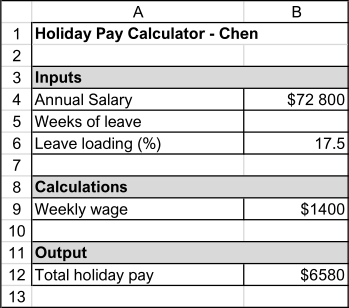
Chen earns an annual salary of $72 800. He is entitled to four weeks annual leave with 17.5% leave loading. A spreadsheet is used to calculate his total holiday pay.
Total holiday pay = 4 × weekly wage + 4 × weekly wage × 17.5%
A spreadsheet showing Chen's holiday pay calculation is shown.
--- 1 WORK AREA LINES (style=lined) ---
--- 2 WORK AREA LINES (style=lined) ---
--- 5 WORK AREA LINES (style=lined) ---
a. \(4\)
b. \(=\text{B4}/52\)
c. \(\text{Total holiday pay}=\text{weekly wage}\times 4 +\ \text{weekly wage}\times 4\ \times 17.5\%\)
\(\text{Total holiday pay}=1400\times 4+1400\times 4\times\dfrac{17.5}{100}=5600+980=$6580\)
a. \(\text{Chen gets 4 weeks leave }\rightarrow\ 4\)
b. \(\text{Weekly wage }=\dfrac{\text{Annual salary}}{52}\)
\(\text{Formula: }=\text{B4}/52\)
c. \(\text{Total holiday pay}=\text{weekly wage}\times 4 +\ \text{weekly wage}\times 4\ \times 17.5\%\)
\(\text{Total holiday pay}=1400\times 4+1400\times 4\times\dfrac{17.5}{100}=5600+980=$6580\)
Consider the universal set \(U=\{x\) is a positive integer and \(x \leqslant 24\}\)
Three sets are defined as
\begin{aligned}
& A=\{x \text { is a factor of } 24\} \\
& B=\{x \text { is a perfect square}\} \\
& C=\{x \text { is divisible by } 3\}
\end{aligned}
--- 1 WORK AREA LINES (style=lined) ---
--- 2 WORK AREA LINES (style=lined) ---
--- 5 WORK AREA LINES (style=lined) ---
a. \(A=\{1,2,3,4,6,8,12,24\}\)
b. \(A \cap B=\{1,4\}\)
c. \((A \cup B) \cap C^c=\{1,2,4,8,16\}\)
a. \(A=\{1,2,3,4,6,8,12,24\}\)
b. \(B=\{1,4,9,16\}\)
\(A \cap B=\{1,4\}\)
c. \(A \cup B=\{1,2,3,4,6,8,9,12,16,24\}\)
\(C=\{3,6,9,12,15,18,21,24\}\)
\(C^c=\{1,2,4,5,7,8,10,11,13,14,16,17,19,20,22,23\}\)
\((A \cup B) \cap C^c=\{1,2,4,8,16\}\)
Consider the universal set \(U=\{x\) is a positive integer and \(x \leqslant 15\}\)
Three sets are defined as:
\begin{aligned}
& A=\{x \text { is a multiple of } 3\} \\
& B=\{x \text{ is a prime number}\} \\
& C=\{x \text{ is even}\}
\end{aligned}
--- 1 WORK AREA LINES (style=lined) ---
--- 3 WORK AREA LINES (style=lined) ---
--- 4 WORK AREA LINES (style=lined) ---
a. \(A=\{3,6,9,12,15\}\)
b. \(B \cap C = \{2\} \)
c. \(A \cup \overline{C}=\{1,3,5,6,7,9,11,12,13,15\}\)
a. \(A=\{3,6,9,12,15\}\)
b. \(B=\{2,3,5,7,11,13\}\)
\(C=\{2,4,6,8,10,12,14\}\)
\(B \cap C = \{2\} \)
c. \(\text{Find} \ \ A \cup \overline{C}:\)
\(\overline{C}=\{1,3,5,7,9,11,13\}\)
\(A \cup \overline{C}=\{1,3,5,6,7,9,11,12,13,15\}\)
Consider the universal set \(U=\{1,2,3,4,5,6,7,8,9,10\}\).
Two sets, \(A\) and \(B\), are given as
\(A= \{1,3,4,7,9\}\)
\(B =\{2,4,7,10\}\)
--- 2 WORK AREA LINES (style=lined) ---
--- 4 WORK AREA LINES (style=lined) ---
a. \(A \cup B = \{1,2,3,4,7,9,10\}\)
b. \(A \cap \overline{B} = \{3, 4, 9\}\)
a. \(A= \{1,3,4,7,9\},\ \ B=\{2,4,7,10\}\)
\(A \cup B = \{1,2,3,4,7,9,10\}\)
b. \(\overline{B} = \{1,3,5,6,8,9\}\)
\(A \cap \overline{B} = \{3, 4, 9\}\)
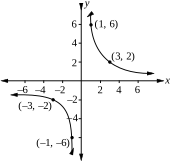
Consider the function \(f(x)=\dfrac{6}{x}\).
--- 3 WORK AREA LINES (style=lined) ---
--- 0 WORK AREA LINES (style=lined) ---
--- 10 WORK AREA LINES (style=lined) ---
a. \(y=\dfrac{6}{x} \ \Rightarrow \ x \neq 0\)
\(\text{Vertical asymptote at} \ \ x=0.\)
\(\text{As}\ x \rightarrow \infty, \ y \rightarrow 0^{+}\)
\(\text{As}\ x \rightarrow -\infty, \ y \rightarrow 0^{-}\)
\(\text{Horizontal asymptote at} \ \ y=0.\)
b. \(\text{Table of values:}\)
\begin{array}{|c|c|c|c|c|c|c|}
\hline \rule{0pt}{2.5ex} \ \ \ x \ \ \ \rule[-1ex]{0pt}{0pt}& -\ 3 \ & \ -1 \ & \quad 1 \quad & \ \ \ 3 \ \ \ \\
\hline \rule{0pt}{2.5ex} y \rule[-1ex]{0pt}{0pt} & -2 & -6 & 6 & 2 \\
\hline
\end{array}
Which of the following is an environmental factor that determines why some groups in Australia experience health inequities?
\(D\)
Other Options:
Evaluate \(e^3\), giving your answer to 3 significant figures. (1 mark)
--- 2 WORK AREA LINES (style=lined) ---
\(e^3=20.1 \ \text{(3 sig fig)}\)
\(e^3=20.085 \ldots=20.1 \ \text{(3 sig fig)}\)
Evaluate \(5^{\tfrac{1}{3}}\), giving your answer to 3 significant figures. (1 mark)
--- 2 WORK AREA LINES (style=lined) ---
\(5^{\tfrac{1}{3}}=1.71 \ \text{(3 sig fig)}\)
\(\text{By calculator:}\)
\(5^{\tfrac{1}{3}}=1.709 \ldots=1.71 \ \text{(3 sig fig)}\)
Rachel is purchasing a new refrigerator priced at $3200. The store offers finance terms of 30% deposit and repayments of $65 per week for 40 weeks.
--- 2 WORK AREA LINES (style=lined) ---
a. \($960\)
b. \($2600\)
c. \($3560\)
a. \(\text{Deposit}=\dfrac{30}{100}\times 3200=$960\)
b. \(\text{Total repayments}=65\times 40=$2600\)
| c. | \(\text{Total cost}\) | \(=\text{Deposit}+\text{Total repayments}\) |
| \(=960+2600=$3560\) |
Olivia is purchasing a car with a sale price of $24 800. She needs to pay a 25% deposit. Calculate the amount of the deposit Olivia needs to pay. (1 mark)
--- 2 WORK AREA LINES (style=lined) ---
\($6200\)
\(\text{Deposit}=\dfrac{25}{100}\times 24\,800=$6200\)
Sarah is purchasing a car for sale at $28 000. She must pay a 20% deposit.
What is the amount of the deposit Sarah needs to pay?
\(B\)
\(\text{Deposit}=20\%\times $28\,000=$5600\)
\(\Rightarrow B\)
George has constructed a yearly budget shown below.
| Income | Expenses | ||
| Salary | $68 450.00 | Groceries | $7280.00 |
| Interest | $825.60 | Clothing | $3960.00 |
| Council Rates | $1740.00 | ||
| Electricity | $1890.00 | ||
| Entertainment | $4320.00 | ||
| Insurance | $2650.00 | ||
| Loan repayments | $15 840.00 | ||
| Motor vehicle costs | $3180.00 | ||
| Telephone | $960.00 | ||
| Work related costs | $1250.00 | ||
| Balance | |||
| Total | Total | ||
--- 4 WORK AREA LINES (style=lined) ---
--- 3 WORK AREA LINES (style=lined) ---
--- 2 WORK AREA LINES (style=lined) ---
a. \(\text{Income}=$69\,275.60,\ \text{Expenses}=$43\,070.00\)
b. \(\text{Balance}=$26\,205.60\)
c. \(\text{Savings}=$504\ \text{(nearest dollar)}\)
a. \(\text{Income}=68\,450.00+825.60=$69\,275.60\)
\(\text{Expenses}\)
\(=7280.00+3960.00+1740.00+1890.00+4320.00\)
\(+2650.00+15840.00+3180.00+960.00+1250.00\)
\(=$43\,070.00\)
| b. | \(\text{Balance}\) | \(=\text{Income}-\text{Expenses}\) |
| \(=$69\,275.60-$43\,070.00=$26\,205.60\) |
c. \(\text{Weekly savings}=\dfrac{$26\,205.60}{52}=$503.953…\ =$504\ \text{(nearest dollar)}\)
It is currently 2:17 pm. A train is due to arrive at 3:08 pm.
How long do you need to wait for the train?
\(B\)
\(\text{Method 1: Break into steps}\)
\(\rightarrow\text{From 2:17 pm to 3:00 pm: }\ 60-17 = 43 \text{ minutes} \)
\(\rightarrow\text{From 3:00 pm to 3:08 pm: }\ 8 \text{ minutes} \)
\(\rightarrow\text{Total: }\ 43+8 = 51 \text{ minutes} \)
\(\text{Method 2: Calculate directly}\)
\(\rightarrow 3:08-2:17 = 51 \text{ minutes} \)
\(\Rightarrow B\)
Convert 180 seconds to minutes.
\(B\)
\(\text{To convert seconds to minutes divide by 60.}\)
\( 180 \text{ seconds} = \dfrac{180}{60} \text{ minutes} = 3 \text{ minutes} \)
\(\Rightarrow B\)
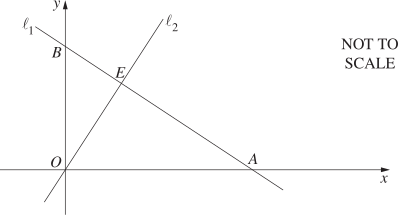
The diagram shows a line `l_1`, with equation `3x + 4y-12 = 0`, which intersects the `y`-axis at `B`.
A second line `l_2`, with equation `4x-3y = 0`, passes through the origin `O` and intersects `l_1` at `E`.
--- 3 WORK AREA LINES (style=lined) ---
--- 5 WORK AREA LINES (style=lined) ---
a. `\text{See Worked Solution}`
b. `\text{See Worked Solution}`
a. `B\ text(is)\ y text(-intercept of)\ l_1`
`text(When)\ x = 0:`
`(3 xx 0) + 4y-12=0\ \ =>\ \ y=3`
`:.\ B\ text(is)\ (0,3)`
| b. | `l_1:\ \ 3x + 4y -12` | `= 0` |
| `4y` | `= -3x + 12` | |
| `y` | `= -3/4x + 3` |
`m(l_1)=-3/4`
| `l_2:\ \ 4x-3y` | `= 0` |
| `3y` | `= 4x` |
| `y` | `= 4/3 x` |
`m(l_2)=4/3`
`m (l_1) xx m (l_2)= -3/4 xx 4/3= -1`
`:.\ l_1\ text(and)\ l_2\ text(are perpendicular)`
Simplify \(\left(2 k^3\right)^2\). (1 mark)
--- 2 WORK AREA LINES (style=lined) ---
\(4 k^6\)
| \(\left(2 k^3\right)^2\) | \(=2^2 \times\left(k^3\right)^2\) |
| \(=4 k^6\) |
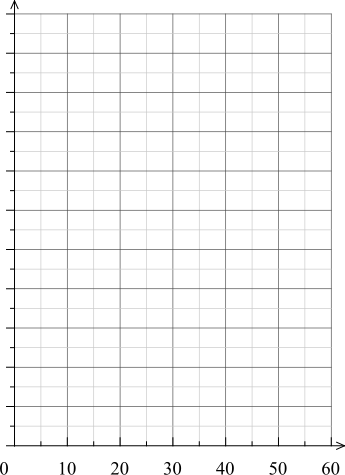
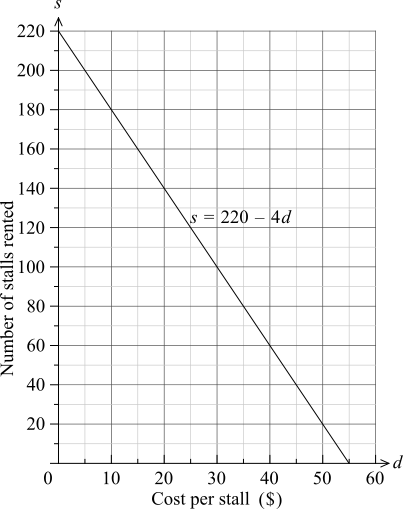
Jerico is the manager of a weekend market in which there are 220 stalls for rent. From past experience, Jerico knows that if he charges \(d\) dollars to rent a stall. then the number of stalls, \(s\), that will be rented is given by:
\(s=220-4d\)
--- 2 WORK AREA LINES (style=lined) ---
--- 0 WORK AREA LINES (style=lined) ---
\begin{array} {|c|c|c|}
\hline
\rule{0pt}{2.5ex} \quad d\quad \rule[-1ex]{0pt}{0pt} & \rule{0pt}{2.5ex} \quad 10\quad\rule[-1ex]{0pt}{0pt} & \rule{0pt}{2.5ex} \quad 30\quad & \rule{0pt}{2.5ex} \quad 50\quad \\
\hline
\rule{0pt}{2.5ex} \quad s\quad \rule[-1ex]{0pt}{0pt} & \ & \ & \\
\hline
\end{array}
--- 0 WORK AREA LINES (style=lined) ---
--- 4 WORK AREA LINES (style=lined) ---
a. \(190\ \text{stalls will be rented}\)
b.
\begin{array} {|c|c|c|}
\hline
\rule{0pt}{2.5ex} \quad d\quad \rule[-1ex]{0pt}{0pt} & \rule{0pt}{2.5ex} \quad 10\quad\rule[-1ex]{0pt}{0pt} & \rule{0pt}{2.5ex} \quad 30\quad & \rule{0pt}{2.5ex} \quad 50\quad \\
\hline
\rule{0pt}{2.5ex} \quad s\quad \rule[-1ex]{0pt}{0pt} & 180 \ & 100 \ & 20 \\
\hline
\end{array}
c.
d. \(\text{When}\ d=60, s=220-4\times 60=-20\)
\(\therefore\ \text{It does not make sense to charge }$60\ \text{ per stall}\)
\(\text{as you cannot have a negative number of stalls.}\)
a. \(s=220-4d=220-4\times 7.50=190\)
\(\therefore 190\ \text{stalls will be rented}\)
b.
\begin{array} {|c|c|c|}
\hline
\rule{0pt}{2.5ex} \quad d\quad \rule[-1ex]{0pt}{0pt} & \rule{0pt}{2.5ex} \quad 10\quad\rule[-1ex]{0pt}{0pt} & \rule{0pt}{2.5ex} \quad 30\quad & \rule{0pt}{2.5ex} \quad 50\quad \\
\hline
\rule{0pt}{2.5ex} \quad s\quad \rule[-1ex]{0pt}{0pt} & 180 \ & 100 \ & 20 \\
\hline
\end{array}
c.
d. \(\text{When}\ d=60, s=220-4\times 60=-20\)
\(\therefore\ \text{It does not make sense to charge }$60\ \text{ per stall}\)
\(\text{as you cannot have a negative number of stalls.}\)
What is the pH of a 0.25 mol L\(^{-1}\) solution of hydrochloric acid?
\(D\)
| \(\text{pH}\) | \(=-\log_{10}(\ce{[H+]})\) | |
| \(=-\log_{10}(0.25)\) | ||
| \(=0.60\) |
\(\Rightarrow D\)
Consider the statement:
If \(x^2-2 x \geq 0\), then \(x \leq 0\).
Which of the following is the contrapositive of the statement?
\(A\)
\(\text{Statement: If}\ \ p\ \Rightarrow \ q\)
\(\text{Contrapositive statement: If}\ \ \neg\ q\ \Rightarrow \ \neg\ p\)
\(\therefore\ \text{If}\ \ x>0\ \ \Rightarrow\ \ x^2-2 x<0\).
\(\Rightarrow A\)
--- 4 WORK AREA LINES (style=lined) ---
--- 3 WORK AREA LINES (style=lined) ---
i. \(\abs{2 \underset{\sim}{i}-2 \underset{\sim}{j}+\underset{\sim}{k}}=\sqrt{2^2+(-2)^2+1^2}=3\)
\({\underset{\sim}{F}}_1=\dfrac{12}{3}\left(\begin{array}{c}2 \\ -2 \\ 1\end{array}\right)=\left(\begin{array}{c}8 \\ -8 \\ 4\end{array}\right)\)
\({\underset{\sim}{F}}_1=8\underset{\sim}{i}-8 \underset{\sim}{j}+4 \underset{\sim}{k}\)
ii. \({\underset{\sim}{F}}_3={\underset{\sim}{F}}_1+{\underset{\sim}{F}}_2=\left(\begin{array}{c}8 \\ -8 \\ 4\end{array}\right)+\left(\begin{array}{c}-6 \\ 12 \\ 4\end{array}\right)=\left(\begin{array}{l}2 \\ 4 \\ 8\end{array}\right)\)
\({\underset{\sim}{F}}_3=2 \underset{\sim}{i}+4 \underset{\sim}{j}+8 \underset{\sim}{k}\)
iii. \({\underset{\sim}{F}}_3 \cdot d=\left(\begin{array}{l}2 \\ 4 \\ 8\end{array}\right)\left(\begin{array}{l}1 \\ 1 \\ 2\end{array}\right)=2+4+16=22\)
i. \(\abs{2 \underset{\sim}{i}-2 \underset{\sim}{j}+\underset{\sim}{k}}=\sqrt{2^2+(-2)^2+1^2}=3\)
\({\underset{\sim}{F}}_1=\dfrac{12}{3}\left(\begin{array}{c}2 \\ -2 \\ 1\end{array}\right)=\left(\begin{array}{c}8 \\ -8 \\ 4\end{array}\right)\)
\({\underset{\sim}{F}}_1=8\underset{\sim}{i}-8 \underset{\sim}{j}+4 \underset{\sim}{k}\)
ii. \({\underset{\sim}{F}}_3={\underset{\sim}{F}}_1+{\underset{\sim}{F}}_2=\left(\begin{array}{c}8 \\ -8 \\ 4\end{array}\right)+\left(\begin{array}{c}-6 \\ 12 \\ 4\end{array}\right)=\left(\begin{array}{l}2 \\ 4 \\ 8\end{array}\right)\)
\({\underset{\sim}{F}}_3=2 \underset{\sim}{i}+4 \underset{\sim}{j}+8 \underset{\sim}{k}\)
iii. \({\underset{\sim}{F}}_3 \cdot d=\left(\begin{array}{l}2 \\ 4 \\ 8\end{array}\right)\left(\begin{array}{l}1 \\ 1 \\ 2\end{array}\right)=2+4+16=22\)
Points \(A\) and \(B\) are \((-3,1)\) and \((1,4)\) respectively.
Which of the following is a vector equation of the line \(A B\) with parameter \(\lambda\) ?
\(D\)
\(\overrightarrow{AB}=\displaystyle \binom{1}{4}-\binom{-3}{1}=\binom{4}{3}\)
\(\text{Line} \ \ AB:\)
\(\displaystyle \binom{x}{y}=\binom{-3}{1}+\lambda\binom{4}{3}\)
\(\Rightarrow D\)
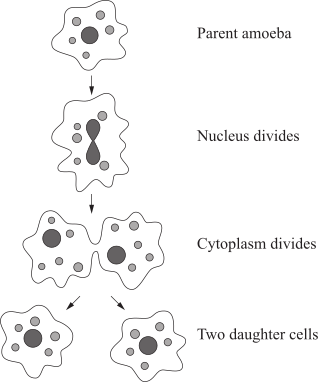
Amoeba reproduce by the process shown.
Which of the following is a characteristic of the daughter cells?
\(B\)
Other Options:
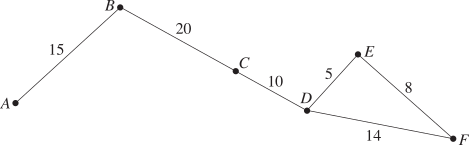
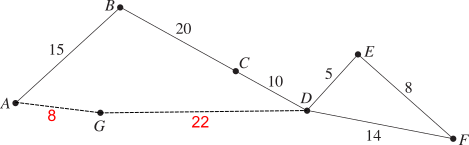
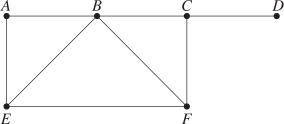
The time, in minutes, it takes to travel by road between six towns is recorded and shown in the network diagram below.
--- 3 WORK AREA LINES (style=lined) ---
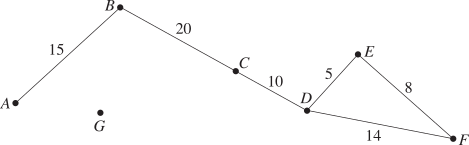
New roads are built to connect a town \(G\) to towns \(A\) and \(D\). The table gives the times it takes to travel by the new roads.
\begin{array} {|c|c|c|}
\hline
\rule{0pt}{2.5ex} \textit{Town} \rule[-1ex]{0pt}{0pt} & \textit{Time} \text{(minutes)} \rule[-1ex]{0pt}{0pt} & \textit{Town} \\
\hline
\rule{0pt}{2.5ex} A \rule[-1ex]{0pt}{0pt} & 8 \rule[-1ex]{0pt}{0pt} & G \\
\hline
\rule{0pt}{2.5ex} G \rule[-1ex]{0pt}{0pt} & 22 \rule[-1ex]{0pt}{0pt} & D \\
\hline
\end{array}
--- 0 WORK AREA LINES (style=lined) ---
--- 3 WORK AREA LINES (style=lined) ---
a. \(\text{Minimum travel time}\ = 15+20+10+5+8=58\ \text{minutes}\)
\(\text{Path: }A → B → C → D → E → F\)
b. \(\text{New roads}\ A → G\ \text{and }G → D \)
c. \(\text{Using the new roads }A → G\ \text{and }G → D:\)
\(\text{Minimum travel time}\ =8+22+5+8=43\ \text{minutes.}\)
\(\text{Therefore the original path is no longer the shortest path.}\)
a. \(\text{Minimum travel time}\ = 15+20+10+5+8=58\ \text{minutes}\)
\(\text{Path: }A → B → C → D → E → F\)
b. \(\text{New roads}\ A → G\ \text{and }G → D \)
c. \(\text{Using the new roads }A → G\ \text{and }G → D:\)
\(\text{Minimum travel time}\ =8+22+5+8=43\ \text{minutes.}\)
\(\text{Therefore the original path is no longer the shortest path.}\)
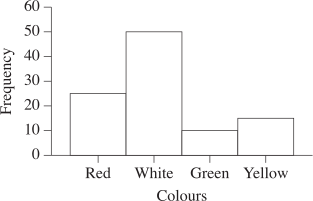
A spinner made up of 4 colours is spun 100 times. The frequency histogram shows the results.
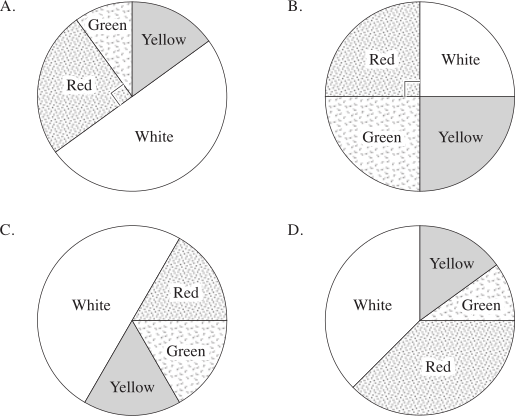
Which of these spinners is most likely to give the results shown?
\(A\)
| \(P(\text{White})\) | \(=\dfrac{50}{100}=\dfrac{1}{2}\) |
| \(P(\text{Red})\) | \(=\dfrac{25}{100}=\dfrac{1}{4}\) |
| \(P(\text{Yellow})\) | \(=\dfrac{15}{100}=\dfrac{3}{20}\) |
| \(P(\text{Green})\) | \(=\dfrac{10}{100}=\dfrac{2}{20}=\dfrac{1}{10}\) |
\(\text{Eliminate Options B and D as white}\ \neq \dfrac{1}{2}\ \text{of spinner.}\)
\(\text{Eliminate Option C as red}\ \neq \dfrac{1}{4}\ \text{of spinner.}\)
\(\Rightarrow A\)
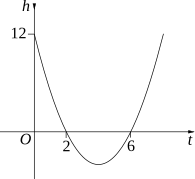
The graph of a quadratic function represented by the equation \(h=t^2-8 t+12\) is shown.
--- 6 WORK AREA LINES (style=lined) ---
--- 3 WORK AREA LINES (style=lined) ---

a. \(\text{Turning point at} \ \ (4,-4)\)
b. \(t=8\)
a. \(\text{Strategy 1 (no calculus)}\)
\(\text{Axis of quadratic occurs when}\ \ t= \dfrac{2+6}{2} = 4\)
\(\text{At} \ \ t=4:\)
\(h=4^2-8 \times 4+12=-4\)
\(\therefore \ \text{Turning point at} \ \ (4,-4)\)
\(\text{Strategy 2 (using calculus)}\)
\(h=t^2-8 t+12\)
\(h^{\prime}=2 t-8\)
\(\text{Find \(t\) when} \ \ h^{\prime}=0:\)
\(2 t-8=0 \ \Rightarrow \ t=4\)
b. \(\text {When} \ \ h=12:\)
| \(t^2-8 t+12\) | \(=12\) |
| \(t(t-8)\) | \(=0\) |
\(\therefore \ \text{Other value:} \ \ t=8\)
Alex used a cloud storage service for one month.
The plan has a base monthly cost of $25. The service also charges 45 cents per GB uploaded and 12 cents per GB downloaded.
During the month, Alex uploaded 180 GB and downloaded 350 GB.
What was the total bill for the month? (2 marks)
--- 5 WORK AREA LINES (style=lined) ---

`$148.00`
`text(Upload charge = 180 × 45c = $81.00)`
`text(Download charge = 350 × 12c = $42.00)`
| `:.\ text(Total bill)` | `= 25 + 81 + 42` |
| `= $148.00` |
Describe why planning is crucial for athletes to meet their sleep, nutrition and hydration needs alongside their training commitments. (3 marks)
--- 9 WORK AREA LINES (style=lined) ---
Outline the general sleep guidelines recommended for athletes to reduce fatigue and support optimal recovery. (3 marks)
--- 9 WORK AREA LINES (style=lined) ---
Describe the general daily fluid intake recommendations for athletes and the indicators used to monitor hydration status. (3 marks)
--- 9 WORK AREA LINES (style=lined) ---
Outline the general principles of nutrient timing for endurance athletes before, during and after performance. (3 marks)
--- 9 WORK AREA LINES (style=lined) ---
Describe the main functions of the three macronutrients for athletes and how each contributes to athletic performance. (3 marks)
--- 9 WORK AREA LINES (style=lined) ---
Outline why athletes need to follow dietary guidelines specific to their sport to improve performance. (3 marks)
--- 9 WORK AREA LINES (style=lined) ---
Outline the main structural changes that occur in muscle fibres during the hypertrophy process following strength training. (3 marks)
--- 9 WORK AREA LINES (style=lined) ---
Outline the main characteristics that distinguish slow twitch muscle fibres from fast twitch muscle fibres in terms of their structure and function. (3 marks)
--- 9 WORK AREA LINES (style=lined) ---
Why are warm-up and cool-down components considered essential parts of every training session for both aerobic and strength training programs? (3 marks)
--- 9 WORK AREA LINES (style=lined) ---
A football player has been using the same strength training routine for 12 weeks, performing identical exercises, sets and repetitions in each session. Their coach suggests applying the variety principle to improve training effectiveness.
Outline three different ways the variety principle could be applied to the football player's strength training program. (3 marks)
--- 9 WORK AREA LINES (style=lined) ---
A 20-year-old athlete wants to train within their aerobic training zone to improve cardiovascular fitness. They calculate their maximum heart rate as 200 beats per minute and know that the aerobic threshold is approximately 70% of maximum heart rate.
Describe the characteristics of training at the aerobic threshold and what happens when the athlete exercises above this intensity level. (3 marks)
--- 9 WORK AREA LINES (style=lined) ---
A tennis coach uses drills and modified games to help players improve their backhand technique. The coach notices that players perform well during drills but struggle to use the backhand effectively during actual match play.
Explain why modified games might be more effective than drills for developing the backhand skill in competitive situations. (3 marks)
--- 9 WORK AREA LINES (style=lined) ---
Which sector classification includes religious organisations and charity groups that operate health services?
\(D\)
Other Options:
Australia's Medicare system provides universal healthcare coverage to all citizens. Which factor explains why countries with similar universal healthcare systems might still have different health outcomes?
\(D\)
Other Options:
According to Australia's Health 2024 data, which health indicator shows Australia performing BELOW the OECD average?
\(C\)
Other Options:
Which of the following is a modifiable risk factor of cardiovascular disease?
\(B\)
Other Options:
Which principle of training refers to aligning training activities with the demands of a particular sport?
\(B\)
Other Options:
Which of the following best explains why breast cancer death rates are decreasing while incidence rates are increasing in Australia?
\(A\)
Other Options:
What is a benefit of emerging medical technologies?
\(C\)
Other Options:
Which of the following measures is NOT used to determine the health status of the population?
\(C\)
Other Options:
What is the purpose of epidemiology?
\(A\)
Other Options:
Which of the following is the main benefit of emerging treatments and technologies in health care
\(C\)
Other Options:
Which of the following best describes healthy ageing?
\(C\)
Other Options:
Which of the following best describes Medicare?
\(D\)
Other Options: