SmarterEd

Aussie Maths & Science Teachers: Save your time with SmarterEd

  • Login
  • Get Help
  • About

ENGINEERING, CS 2018 HSC 24a

The diagram shows a scaffold supporting planks. The planks can be made from laminated timber, aluminium alloy or galvanised steel.
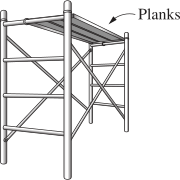
 

Outline an in-service advantage of each of these materials when used as a scaffold plank.   (3 marks)

--- 7 WORK AREA LINES (style=lined) ---

Show Answers Only

Answers could include one advantage from each material type below:

Laminated timber plank

  • Easily cut on-site to accommodate a non-standard opening.
  • Non-conductive.

Aluminium scaffold plank

  • Low density
  • Light weight makes aluminium planks easy to manoeuver on-site.

Galvanised steel planks

  • Can absorb energy through impact without shattering or fracturing (high impact resistance).
  • Appropriate for applications where the scaffold is likely to be exposed to falling loads eg concrete block laying, bricklaying, concreting and demolition work.
Show Worked Solution

Answers could include one advantage from each material type below:

Laminated timber plank

  • Easily cut on-site to accommodate a non-standard opening.
  • Non-conductive.

Aluminium scaffold plank

  • Low density
  • Light weight makes aluminium planks easy to manoeuver on-site.

Galvanised steel planks

  • Can absorb energy through impact without shattering or fracturing (high impact resistance).
  • Appropriate for applications where the scaffold is likely to be exposed to falling loads eg concrete block laying, bricklaying, concreting and demolition work.

Filed Under: Engineering Materials, Materials Tagged With: Band 4, smc-3715-60-Laminates, smc-3719-80-Compare properties

ENGINEERING, PPT 2017 HSC 21b

Gears used in automotive engines can be manufactured using ferrous alloys.

  1. Sand casting and powder metallurgy are methods that can be used.
  2. Compare the properties of the gears manufactured by each method.   (4 marks)

--- 6 WORK AREA LINES (style=lined) ---

  1. After manufacture the gears are case hardened.
  2. Describe how case hardening produces the required structure-property relationships for this application.   (3 marks)

--- 6 WORK AREA LINES (style=lined) ---

Show Answers Only

i.   Sandcasting

  • Weaker dimensional stability than powder metallurgy.
  • If not poured correctly, grains can be columnar.
  • Fatigue can be initiated through poor surface finish. 

Powder metallurgy

  • Greater dimensional stability.
  • A variety of gears that cannot be made using conventional methods can be produced using powder metallurgy.
  • A custom component can be initially produced as close as possible to the final shape of the product (near net shape forming).
  • Alloys can be produced with pores (self-lubricating). 

ii.  Case hardening

  • Gears are heated to red heat in a nitrogen and/or carbon environment.
  • Nitrogen and carbon disperse into the steel’s surface at these high temperatures, increasing the carbon content to a level where it is hardened by quenching.
  • Martensite is formed when the steel is quenched.
  • Hence, the inside remains soft and tough whilst the outer case becomes wear resistant and hard.
  • The outer casing may be tempered back for improved surface toughness or the gear can be used with the martensite casing.
Show Worked Solution

i.   Sandcasting

  • Weaker dimensional stability than powder metallurgy
  • If not poured correctly, grains can be columnar
  • Fatigue can be initiated through poor surface finish.

Powder metallurgy

  • Greater dimensional stability
  • A variety of gears that cannot be made using conventional methods can be produced using powder metallurgy
  • A custom component can be initially produced as close as possible to the final shape of the product (near net shape forming)
  • Alloys can be produced with pores (self-lubricating).

♦♦♦ Mean mark (i) 26%.

ii.  Case hardening

  • Gears are heated to red heat in a nitrogen and/or carbon environment.
  • Nitrogen and carbon disperse into the steel’s surface at these high temperatures, increasing the carbon content to a level where it is hardened by quenching.
  • Martensite is formed when the steel is quenched.
  • Hence, the inside remains soft and tough whilst the outer case becomes wear resistant and hard.
  • The outer casing may be tempered back for improved surface toughness or the gear can be used with the martensite casing.

♦♦♦ Mean mark (ii) 23%.

Filed Under: Materials Tagged With: Band 6, smc-3719-10-Manufacturing - Ferrous, smc-3719-80-Compare properties

ENGINEERING, PPT 2022 HSC 1 MC

What property of a material can be measured by testing its resistance to scratching?

  1. Hardness
  2. Stiffness
  3. Strength
  4. Toughness
Show Answers Only

`A`

Show Worked Solution

`=>A`

Filed Under: Materials Tagged With: Band 4, smc-3719-80-Compare properties

Copyright © 2014–2025 SmarterEd.com.au · Log in