SmarterEd

Aussie Maths & Science Teachers: Save your time with SmarterEd

  • Login
  • Get Help
  • About

ENGINEERING, AE 2024 HSC 22d

How does fibre metal laminate (FML) contribute to enhanced structural performance in aircraft?   (3 marks)

--- 7 WORK AREA LINES (style=lined) ---
Show Answers Only

  • FML offers several advantages over traditional aluminium alloys in aircraft construction.
  • Its key benefits include enhanced impact and fatigue resistance, better corrosion protection, and reduced weight.
  • The material’s strength comes from its directional layered construction, which can be customised for specific aircraft sections.
  • This ability to tailor FML’s properties during manufacturing makes it adaptable for various aircraft applications.

Show Worked Solution

  • FML offers several advantages over traditional aluminium alloys in aircraft construction.
  • Its key benefits include enhanced impact and fatigue resistance, better corrosion protection, and reduced weight.
  • The material’s strength comes from its directional layered construction, which can be customised for specific aircraft sections.
  • This ability to tailor FML’s properties during manufacturing makes it adaptable for various aircraft applications.
Mean mark 56%.

Filed Under: Materials Tagged With: Band 4, smc-3725-40-Composites, smc-3725-50-Property comparison

ENGINEERING, AE 2018 HSC 17 MC

Aircraft skins can be constructed using either fibre metal laminate (FML) or sheet aircraft-grade aluminium alloy.

FML is preferred in this application because it has

  1. higher density and lower Young's modulus.
  2. higher density and improved fatigue resistance.
  3. higher strength-to-weight ratio and lower Young's modulus.
  4. higher strength-to-weight ratio and improved fatigue resistance.
Show Answers Only

`D`

Show Worked Solution
  • Higher density and lower Young’s modulus are both negative material properties for aircraft skins, as these skins should be light (lower density) and rigid (higher stiffness/Young’s modulus).
  • Additionally, fatigue resistance is important as aircraft skins are exposed to varying air pressures.

`=>D`

Filed Under: Materials Tagged With: Band 3, smc-3725-20-Metal alloys, smc-3725-50-Property comparison

ENGINEERING, PPT 2018 HSC 26d

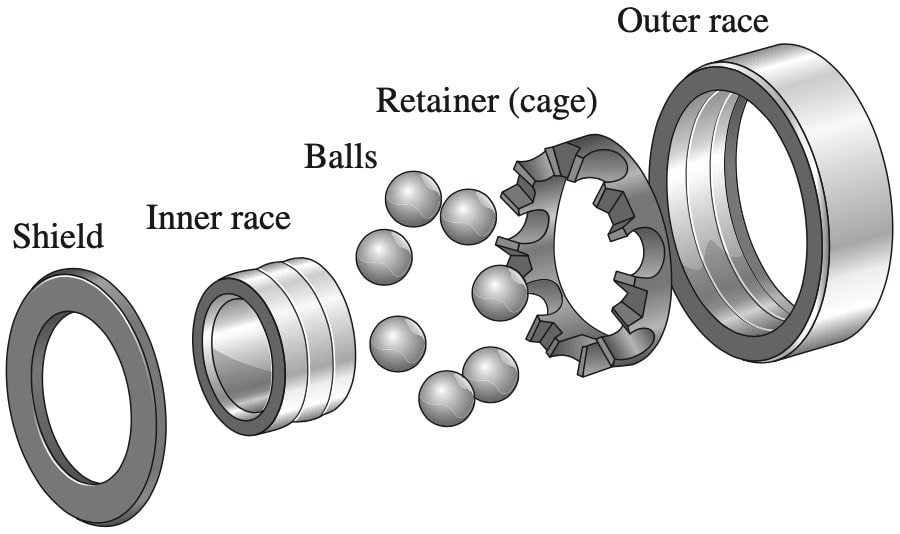
The components of the bearing assembly used in the fidget spinner are shown.
 

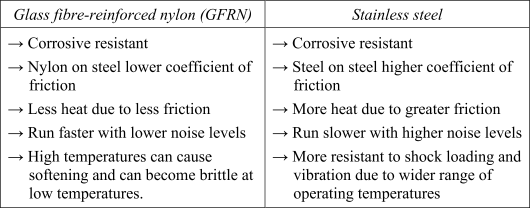
The retainer can be made from either glass fibre-reinforced nylon or stainless steel.

Compare the in-service properties of these materials for use in the retainer.   (4 marks)

--- 8 WORK AREA LINES (style=lined) ---
Show Answers Only

Show Worked Solution

Filed Under: Materials, Materials Tagged With: Band 4, smc-3725-20-Metal alloys, smc-3725-30-Polymers, smc-3725-50-Property comparison

ENGINEERING, PPT 2017 HSC 22a

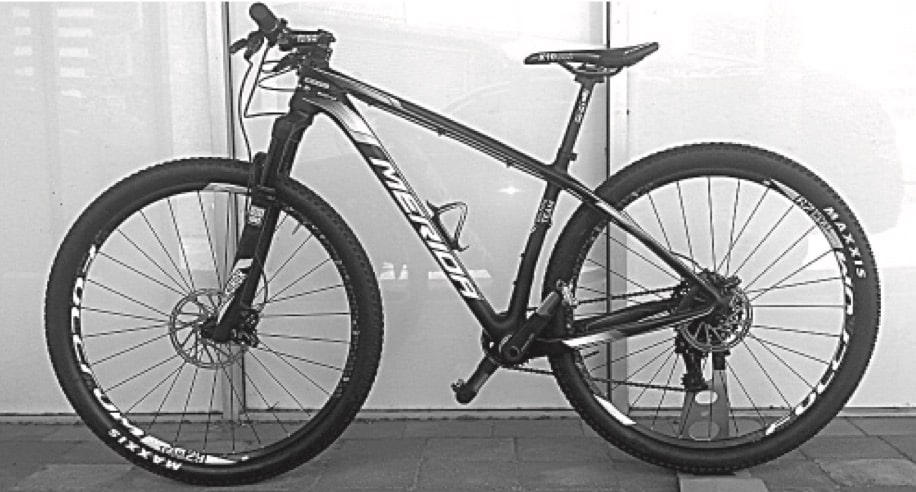
Carbon fibre was originally developed to produce aircraft bodies and high performance vehicles. Carbon fibre is now used in a wide range of applications, including the manufacture of the type of bicycle frame shown.
 

Outline the advantages of carbon fibre bicycle frames over steel bicycle frames.   (3 marks)

--- 6 WORK AREA LINES (style=lined) ---

Show Answers Only

Advantages of carbon fibre bicycle frames

  • Excellent strength to weight ratio, which is a preferred feature and is superior to that of steel.
  • More intricate shapes can be moulded with carbon fibre than steel.
  • Rigid and resistant to corrosion.
  • Wide colour selection available.
Show Worked Solution

Advantages of carbon fibre bicycle frames

  • Excellent strength to weight ratio, which is a preferred feature and is superior to that of steel.
  • More intricate shapes can be moulded with carbon fibre than steel.
  • Rigid and resistant to corrosion.
  • Wide colour selection available.

Filed Under: Historical and Societal Influences, Materials Tagged With: Band 4, smc-3717-20-Innovation, smc-3725-20-Metal alloys, smc-3725-40-Composites, smc-3725-50-Property comparison

ENGINEERING, AE 2019 HSC 25b

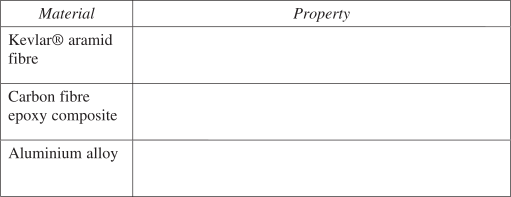
Some materials have properties that allow them to be used in the manufacture of both modern racing yachts and aircraft. These materials include Kevlar® aramid fibre, carbon fibre epoxy composites and aluminium alloys.

Complete the table by providing a property which makes each of these materials suitable for the manufacture of both yachts and aircraft.   (3 marks)
 

--- 0 WORK AREA LINES (style=lined) ---

Show Answers Only

Include one of the properties in the second column:

Show Worked Solution

Include one of the properties in the second column:

Filed Under: Materials Tagged With: Band 4, smc-3725-20-Metal alloys, smc-3725-30-Polymers, smc-3725-40-Composites, smc-3725-50-Property comparison

ENGINEERING, AE 2019 HSC 24a

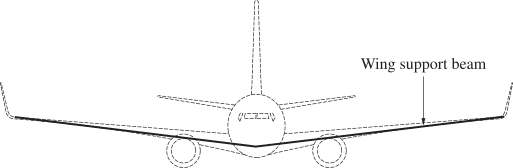
An image of an aeroplane is shown with the position of the wing support beam indicated.
 

Assume the engines are supported by the single beam. The beam runs through the plane, wing tip to wing tip.

Compare the use of composite materials with the use of metals for the manufacture of the beam.   (3 marks)

--- 8 WORK AREA LINES (style=lined) ---

Show Answers Only

Answers could include 3 of the following comparisons:

Composite materials vs Metals 

  • Composite materials are lighter than metals.
  • Manufacture: Carbon fibre epoxy composite beams requires specialised equipment whereas metal based inputs can be manufactured using readily accessible tools such as welders, gas torches and plasma cutters.
  • Composite materials are easier to lift due to lighter weight. This allows workers to position them more easily during the construction process.
  • Equipment used for making carbon fibre epoxy moulds likely to be more accurate than in metal fabrication. However, it is possible to achieve similar accuracy in machining metals compared to that of composite materials.
  • Due to the nature of the wing support beam and the stresses placed on it, a metal beam is subject to stress weaknesses (such as scratches and corners of drilled holes) and flaws in welds that create fatigue. Carbon fibre not affected by fatigue cracking.
Show Worked Solution

Answers could include 3 of the following comparisons:

Composite materials vs Metals 

  • Composite materials are lighter than metals.
  • Manufacture: Carbon fibre epoxy composite beams requires specialised equipment whereas metal based inputs can be manufactured using readily accessible tools such as welders, gas torches and plasma cutters.
  • Composite materials are easier to lift due to lighter weight. This allows workers to position them more easily during the construction process.
  • Equipment used for making carbon fibre epoxy moulds likely to be more accurate than in metal fabrication. However, it is possible to achieve similar accuracy in machining metals compared to that of composite materials.
  • Due to the nature of the wing support beam and the stresses placed on it, a metal beam is subject to stress weaknesses (such as scratches and corners of drilled holes) and flaws in welds that create fatigue. Carbon fibre not affected by fatigue cracking.

Filed Under: Materials Tagged With: Band 4, smc-3725-20-Metal alloys, smc-3725-40-Composites, smc-3725-50-Property comparison

ENGINEERING, AE 2019 HSC 15 MC

Titanium is used to manufacture aircraft undercarriages that support landing wheels.

Why is titanium used in preference to alloy steel for this purpose?

  1. It has lower density and lower strength.
  2. It has lower density and higher strength.
  3. It has higher density and lower strength.
  4. It has higher density and higher strength.
Show Answers Only

`B`

Show Worked Solution
  • Lower density and higher strength, means the material has a very high strength to weight ratio, or specific strength.
  • This is one of the most beneficial characteristics associated with titanium alloys.

`=>B`

Filed Under: Materials Tagged With: Band 4, smc-3725-20-Metal alloys, smc-3725-40-Composites, smc-3725-50-Property comparison

ENGINEERING, AE 2020 HSC 22b

Describe the use of different types of materials for the wings of aircraft over the last 100 years.  (3 marks)

--- 8 WORK AREA LINES (style=lined) ---

Show Answers Only
  • The skin of aircraft wings were originally made from fabric.
  • Sheet metal alloys were then used to replace the fabric as they provided strength to the skins’ structure that the fabric did not.
  • These sheet metals primarily included aluminium, titanium and steel alloys.
  • More recently composite materials have been used for their high strength to weight ratios.
  • These include carbon fibre epoxy resin, GLARE and other fibre reinforced metal laminates. 

Other answers could include:

  • Material developments regarding the frame of the wing where timber was originally used, followed by steel, aluminium/titanium alloys and modern day composite materials.
Show Worked Solution
  • The skin of aircraft wings were originally made from fabric.
  • Sheet metal alloys were then used to replace the fabric as they provided strength to the skins’ structure that the fabric did not.
  • These sheet metals primarily included aluminium, titanium and steel alloys.
  • More recently composite materials have been used for their high strength to weight ratios.
  • These include carbon fibre epoxy resin, GLARE and other fibre reinforced metal laminates. 

Other answers could include:

  • Material developments regarding the frame of the wing where timber was originally used, followed by steel, aluminium/titanium alloys and modern day composite materials.

Filed Under: Materials, Scope, Historical and Societal Influences Tagged With: Band 4, smc-3722-40-Historical development, smc-3725-50-Property comparison

Copyright © 2014–2025 SmarterEd.com.au · Log in