SmarterEd

Aussie Maths & Science Teachers: Save your time with SmarterEd

  • Login
  • Get Help
  • About

ENGINEERING, TE 2024 HSC 17 MC

Why is single-mode cable used for long distance telecommunications rather than other fibre optic cables?

  1. It has lower power consumption.
  2. It has greater attenuation over distance.
  3. It has a higher transmission rate and bandwidth.
  4. It has a greater change to the index of refraction.
Show Answers Only

\(C\)

Show Worked Solution
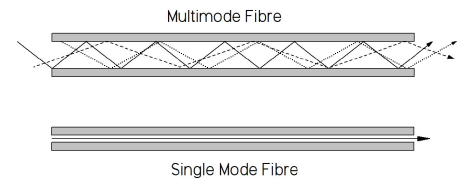
  • Single-mode fibre optic cable only allows one path for light to travel, reducing signal dispersion and allowing for faster, clearer transmission over long distances.
  • This results in a higher transmission rate and bandwidth compared to multi-mode cables which allow multiple light paths.

\(\Rightarrow C\)

♦♦ Mean mark 35%.

Filed Under: Materials Tagged With: Band 5, smc-3729-25-Fibre optics

ENGINEERING, TE 2024 HSC 7 MC

Which row of the table correctly identifies the types of cables?

Show Answers Only

\(A\)

Show Worked Solution
  • 1st column is coaxial cable: cross-section has a central copper wire, surrounded by an insulating material, which is then encased in a aluminium braiding (Eliminate B and D).
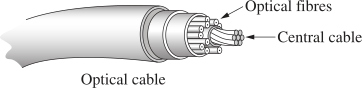
  • 2nd column is fibre optic cable: cross-section has a central glass core (carrying light signals) surrounded by a glass cladding with a lower refractive index and an outer protective jacket (diagram shows multiple-fibre cable).

\(\Rightarrow A\)

Filed Under: Materials Tagged With: Band 4, smc-3729-15-Insulation/Polymers, smc-3729-25-Fibre optics

ENGINEERING, TE 2023 HSC 5 MC

Why does signal loss occur in optical glass fibres?

  1. Flaws in the glass fibres scatter the light.
  2. Twisted cables affect the transmission of light.
  3. External electromagnetic noise affects signal quality.
  4. Pressure affects signal transmission in submarine cables.
Show Answers Only

\( A \)

Show Worked Solution
  • Signal loss in optical glass fibres can be caused by factors such as scattering, absorption, and bending of the fibre.
  • Given the possible options, the most common reason for signal loss is the scattering of light due to flaws in the glass fibre, notwithstanding that excessive bending (twisting) of the fibre may also cause some signal loss.

\(\Rightarrow A \)

Filed Under: Materials Tagged With: Band 4, smc-3729-25-Fibre optics

ENGINEERING, TE 2018 HSC 22b

Explain why optical fibre is used in preference to traditional copper cable in telecommunication networks.   (2 marks)
 

--- 5 WORK AREA LINES (style=lined) ---

Show Answers Only

Advantages of fibre optic cables over copper cables:

  • Higher bandwidth capability over long distances.
  • Lower loss of signal strength (signal attenuation).
  • Data can be transmitted at the speed of light.
Show Worked Solution

Advantages of fibre optic cables over copper cables:

  • Higher bandwidth capability over long distances.
  • Lower loss of signal strength (signal attenuation).
  • Data can be transmitted at the speed of light.

Filed Under: Materials Tagged With: Band 4, smc-3729-25-Fibre optics

ENGINEERING, TE 2022 HSC 14 MC

What feature of fibre optic cables has made them a suitable replacement for traditional copper-based cables?

  1. Lower bandwidth
  2. Higher attenuation
  3. Do not need repeaters over long distances
  4. Not susceptible to electromagnetic interference
Show Answers Only

`D`

Show Worked Solution

By Elimination:

  • `A` and `B` are both negative impacts
  • `C` may not be true over long enough distances

`=>D`


♦ Mean mark 49%.

Filed Under: Materials Tagged With: Band 5, smc-3729-25-Fibre optics

ENGINEERING, TE 2020 HSC 13 MC

Which of the following can be safely transmitted by fibre optic cables?

  1. Microwaves
  2. Radio waves
  3. Gamma rays
  4. Infrared waves
Show Answers Only

`D`

Show Worked Solution
  • Optical fibres transmit light along their length.
  • Since gamma, radio and microwaves are not light waves and infrared is a light wave, infrared is the only possible answer.

`=>D`


Mean mark 52%.

Filed Under: Materials Tagged With: Band 5, smc-3729-25-Fibre optics

ENGINEERING, TE 2021 HSC 26d

Compare multimode optical fibre and single mode optical fibre in terms of light paths taken and materials used. Drawings may be included to support your answer.   (4 marks)

--- 8 WORK AREA LINES (style=lined) ---

Show Answers Only

Multimode optical fibre:

  • Used to transmit data short distances.
  • It can be manufactured using glass or acrylic and is surrounded by a cladding.
  • Light can take many modes, or paths, through this fibre, including internally refracting/bouncing off the cladding. 

Single mode optical fibre:

  • Has a single central core made of glass, and light can only take one path along the centre.
  • This means single mode fibres do not internally refract along their length, decreasing attenuation (signal loss) as each refraction slightly decreases signal strength.

Show Worked Solution

Multimode optical fibre:

  • Used to transmit data short distances.
  • It can be manufactured using glass or acrylic and is surrounded by a cladding.
  • Light can take many modes, or paths, through this fibre, including internally refracting/bouncing off the cladding. 

Single mode optical fibre:

  • Has a single central core made of glass, and light can only take one path along the centre.
  • This means single mode fibres do not internally refract along their length, decreasing attenuation (signal loss) as each refraction slightly decreases signal strength.


♦♦ Mean mark 38%.

Filed Under: Materials Tagged With: Band 5, smc-3729-25-Fibre optics

Copyright © 2014–2025 SmarterEd.com.au · Log in