SmarterEd

Aussie Maths & Science Teachers: Save your time with SmarterEd

  • Login
  • Get Help
  • About

ENGINEERING, TE 2023 HSC 23d

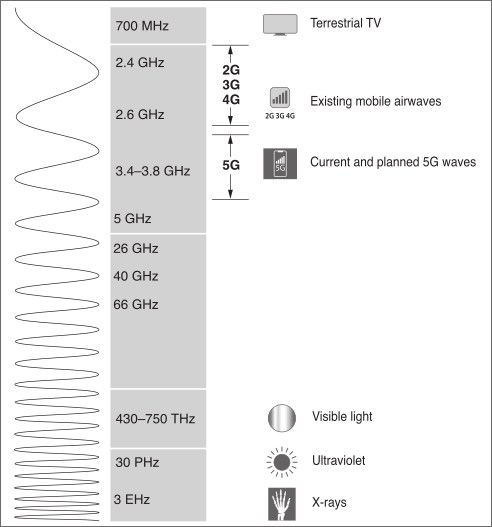
The diagram shows the relative placement of 4G and 5G telecommunication bands within the electromagnetic spectrum.
 

With reference to the diagram, explain why 5G networks need more cellular antennae and closer positioning of antennae than 4G networks.   (3 marks)

--- 6 WORK AREA LINES (style=lined) ---
Show Answers Only

  • The diagram shows that 5G networks use shorter wavelengths and are subsequently on a higher frequency bandwidth than 4G networks.
  • The short wavelength means that the signal cannot travel as far as the signal in the 4G Network.
  • Given that there is shorter signal range and the signal cannot travel as far there needs to be antennae positioned closer together.
  • Since the antennae are closer together, they require more antennae to cover the same distances.

Show Worked Solution

  • The diagram shows that 5G networks use shorter wavelengths and are subsequently on a higher frequency bandwidth than 4G networks.
  • The short wavelength means that the signal cannot travel as far as the signal in the 4G Network.
  • Given that there is shorter signal range and the signal cannot travel as far there needs to be antennae positioned closer together.
  • Since the antennae are closer together, they require more antennae to cover the same distances.

Filed Under: Electricity/Electronics Tagged With: Band 4, smc-3730-20-Telephony

ENGINEERING, TE 2019 HSC 22b

A telecommunications engineer has designed a tower that is to support two mobile repeater transmitters. It is to be located in an urban community.
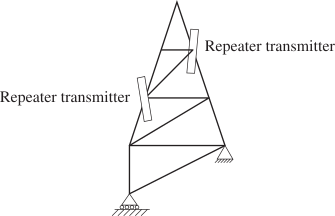
 

Explain why the engineer has positioned the repeater transmitters as indicated on the diagram.   (3 marks)

--- 8 WORK AREA LINES (style=lined) ---

Show Answers Only
  • Transmitters are positioned on different stanchions at different levels so incoming signals produce minimal interference with each other.
  • The line-of-sight path of incoming and outgoing signals to the transmitter need to be considered.
Show Worked Solution
  • Transmitters are positioned on different stanchions at different levels so incoming signals produce minimal interference with each other.
  • The line-of-sight path of incoming and outgoing signals to the transmitter need to be considered.
Mean mark 58%.

Filed Under: Electricity/Electronics Tagged With: Band 4, smc-3730-20-Telephony

ENGINEERING, TE 2020 HSC 26c

Discuss methods for increasing the signal strength of a receiving antenna.   (3 marks)

--- 9 WORK AREA LINES (style=lined) ---

Show Answers Only
  • Amplification: Amplifies the sound, however this could include unwanted background noise.
  • Antenna tuning: The antenna can be tuned to the frequency of interest. This can be done by adjusting the length of the antenna, however this may not be practical in some scenarios.
  • Directional antenna can focus the signal to increase strength however misalignment could result in losing the signal entirely.
Show Worked Solution
  • Amplification: Amplifies the sound, however this could include unwanted background noise.
  • Antenna tuning: The antenna can be tuned to the frequency of interest. This can be done by adjusting the length of the antenna, however this may not be practical in some scenarios.
  • Directional antenna can focus the signal to increase strength however misalignment could result in losing the signal entirely.

Mean mark (c) 52%.

Filed Under: Electricity/Electronics Tagged With: Band 5, smc-3730-10-Radio, smc-3730-15-Television, smc-3730-20-Telephony

ENGINEERING, TE 2021 HSC 26c

Explain how a mobile phone maintains a communication link with the network as the user moves location while making a call.   (3 marks)

--- 8 WORK AREA LINES (style=lined) ---

Show Answers Only
  • A mobile phone transmits an ID code to base stations.
  • The base station that receives the strongest signal then transmits the phones location throughout the network.
  • The network routes received calls from one base station to the next as the user gets closer to a new station.
  • Throughout this process, the phone maintains the strongest possible communication link dynamically as the user changes location.
Show Worked Solution
  • A mobile phone transmits an ID code to base stations.
  • The base station that receives the strongest signal then transmits the phones location throughout the network.
  • The network routes received calls from one base station to the next as the user gets closer to a new station.
  • Throughout this process, the phone maintains the strongest possible communication link dynamically as the user changes location.

♦♦ Mean mark 41%.

Filed Under: Electricity/Electronics Tagged With: Band 5, smc-3730-20-Telephony

ENGINEERING, TE 2021 HSC 24c

Describe the basic principles of low orbit satellite telecommunication systems.   (3 marks)

--- 9 WORK AREA LINES (style=lined) ---

Show Answers Only

Successful answers would cover one of the following:

Low orbit Satellites

  • Low orbit satellites orbit the earth at altitudes below 2000 km.
  • Low orbit telecommunication systems have many satellites that pass overhead as these satellites are not geostationary and move in and out of range of the handset.
  • These satellites take around 90 minutes to orbit earth and are only in range for 5 minutes maximum.
  • When one satellite is about to disappear from the reception range, another comes into range and takes over communication.  

Satellite telephones

  • Satellite telephones broadcast their individual ID numbers to satellites to identify which are in range.
  • Once a satellite receives the signal it is passed onto a base station, then its destination.
  • The phone signal is passed between satellites until one in contact with the base station is in range.
  • The phone signal is modulated using phase shift keying due to long transmission distances.
Show Worked Solution

Successful answers would cover one of the following:

Low orbit Satellites

  • Low orbit satellites orbit the earth at altitudes below 2000 km.
  • Low orbit telecommunication systems have many satellites that pass overhead as these satellites are not geostationary and move in and out of range of the handset.
  • These satellites take around 90 minutes to orbit earth and are only in range for 5 minutes maximum.
  • When one satellite is about to disappear from the reception range, another comes into range and takes over communication.  

Satellite telephones

  • Satellite telephones broadcast their individual ID numbers to satellites to identify which are in range.
  • Once a satellite receives the signal it is passed onto a base station, then its destination.
  • The phone signal is passed between satellites until one in contact with the base station is in range.
  • The phone signal is modulated using phase shift keying due to long transmission distances.

♦ Mean mark 49%.

Filed Under: Electricity/Electronics Tagged With: Band 5, smc-3730-20-Telephony, smc-3730-40-Satellites/GPS

Copyright © 2014–2025 SmarterEd.com.au · Log in