SmarterEd

Aussie Maths & Science Teachers: Save your time with SmarterEd

  • Login
  • Get Help
  • About

Right-angled Triangles, SM-Bank 053

  1. Use Pythagoras' Theorem to calculate the length of the hypotenuse in the isosceles triangle below. Give your answer correct in exact surd form.  (2 marks)


    --- 4 WORK AREA LINES (style=lined) ---

  2. Using your result from part (a) above, calculate the perimeter of the shape below, correct to 1 decimal place.  (2 marks)
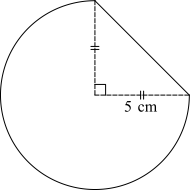


    --- 4 WORK AREA LINES (style=lined) ---

Show Answers Only

a.    \(\sqrt{50}\ \text{cm (exact surd form)}\)

b.    \(30.6\ \text{cm (1 d.p.)}\)

Show Worked Solution

a.    \(\text{Pythagoras’ Theorem states:  }c^2=a^2+b^2\)

\(\text{Let }a=5\ \text{and }b=5\)

\(\text{Then}\ \ c^2\) \(=5^2+5^2\)
\(c^2\) \(=50\)
\(c\) \(=\sqrt{50}\ \text{cm (exact surd form)}\)


b.    \(\text{Perimeter}\) \(=\text{chord (a)}\ +\dfrac{3}{4}\times\text{circumference}\)
    \(=\sqrt{50}+\dfrac{3}{4}\times 2\pi r\)
    \(=\sqrt{50}+\dfrac{3}{4}\times 2\pi\times 5\)
    \(=30.633\dots\)
    \(\approx 30.6\ \text{cm (1 d.p.)}\)

Filed Under: Right-angled Triangles Tagged With: num-title-ct-core, smc-4218-30-Hypotenuse, smc-4218-40-Perimeter

Right-angled Triangles, SM-Bank 052

Use Pythagoras' Theorem to calculate the perimeter of the isosceles triangle below, correct to the nearest centimetre.  (3 marks)

--- 6 WORK AREA LINES (style=lined) ---

Show Answers Only

\(29\ \text{cm}\ (\text{nearest cm})\)

Show Worked Solution

\(\text{Find length of the equal sides of the triangle.}\)
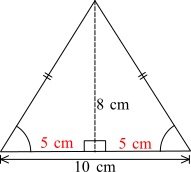
\(\text{Pythagoras’ Theorem states:  }c^2=a^2+b^2\)

\(\text{Let }a=5\ \text{and }b=8\)

\(\text{Then}\ \ c^2\) \(=5^2+8^2\)
\(c^2\) \(=89\)
\(c\) \(=\sqrt{89}\)
\(c\) \(=9.433\dots\)

 
\(\text{Perimeter}\)

\(=2\times 9.433\dots+10\)

\(=28.867\dots\approx 29\ \text{cm}\ (\text{nearest cm})\)

Filed Under: Right-angled Triangles Tagged With: num-title-ct-core, smc-4218-30-Hypotenuse, smc-4218-40-Perimeter

Right-angled Triangles, SM-Bank 051

Use Pythagoras' Theorem to calculate the perimeter of the trapezium below, correct to 1 decimal place.  (3 marks)
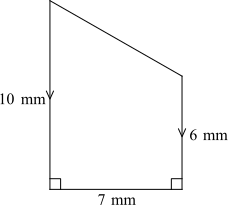
--- 6 WORK AREA LINES (style=lined) ---

Show Answers Only

\(31.1\ \text{mm}\ (1\ \text{d.p.})\)

Show Worked Solution

\(\text{Find length of sloped side of trapezium.}\)

\(\text{Pythagoras’ Theorem states:  }c^2=a^2+b^2\)

\(\text{Let }a=4\ \text{and }b=7)

\(\text{Then}\ \ c^2\) \(=4^2+7^2\)
\(c^2\) \(=65\)
\(c\) \(=\sqrt{65}\)
\(c\) \(=8.062\dots\)

 
\(\text{Perimeter}\)

\(=6+7+10+8.062\dots\)

\(=31.062\dots\approx 31.1\ \text{mm}\ (1\ \text{d.p.})\)

Filed Under: Right-angled Triangles Tagged With: num-title-ct-core, smc-4218-30-Hypotenuse, smc-4218-40-Perimeter

Right-angled Triangles, SM-Bank 050

Use Pythagoras' Theorem to calculate the perimeter of the rectangle below, correct to 1 decimal place.  (3 marks)
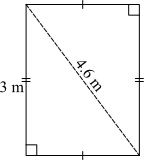
--- 6 WORK AREA LINES (style=lined) ---

Show Answers Only

\(13.0\ \text{m}\ (1\ \text{d.p.})\)

Show Worked Solution

\(\text{Find side length of rectangle.}\)

\(\text{Pythagoras’ Theorem states:  }a^2+b^2=c^2\)

\(\text{Let }b=3\ \text{and }c=4.6\)

\(\text{Then}\ \ a^2+3^2\) \(=4.6^2\)
\(a^2\) \(=4.6^2-3^2\)
\(a\) \(=\sqrt{12.16}\)
\(a\) \(=3.487\dots\)

 
\(\text{Perimeter}\)

\(=2\times 3.487\dots+ 2\times 3\)

\(=12.974\dots\approx 13.0\ \text{m}\ (1\ \text{d.p.})\)

Filed Under: Right-angled Triangles Tagged With: num-title-ct-core, smc-4218-35-Short side, smc-4218-40-Perimeter

Right-angled Triangles, SM-Bank 049

  1. Calculate the length of the hypotenuse in the following right-angled triangle. Give your answer correct to the nearest metre.   (2 marks)
     

  2. Find the perimeter of the triangle.  (1 mark)

--- 4 WORK AREA LINES (style=lined) ---

Show Answers Only

a.    \(7\ \text{m}\)

b.    \(18\ \text{m}\)

Show Worked Solution

a.    \(\text{Pythagoras’ Theorem states:  }c^2=a^2+b^2\)

\(\text{Let }a=5\ \text{and }b=6\)

\(\text{Then}\ \ c^2\) \(=5^2+6^2\)
\(c^2\) \(=61\)
\(c\) \(=\sqrt{61}\)
\(c\) \(=7.141\dots\approx 7\)

 
\(\text{The hypotenuse is }7\ \text{metres (nearest metre})\)

b.    \(\text{Perimeter}\)

\(=7+5+6\)

\(=18\ \text{m}\)

Filed Under: Right-angled Triangles Tagged With: num-title-ct-core, smc-4218-30-Hypotenuse, smc-4218-40-Perimeter

Copyright © 2014–2025 SmarterEd.com.au · Log in