SmarterEd

Aussie Maths & Science Teachers: Save your time with SmarterEd

  • Login
  • Get Help
  • About

Polynomials, SMB-012

`h(x)=x^3+3x^2+x-5`.

  1. Show  `h(1)=0`  (1 mark)

    --- 1 WORK AREA LINES (style=lined) ---

  2. Express `h(x)` in the form `h(x)=(x-1)*g(x)` where `g(x)` is a quadratic factor.  (2 marks)

    --- 5 WORK AREA LINES (style=lined) ---

  3. Justify that `h(x)` only has one zero.  (2 marks)

    --- 4 WORK AREA LINES (style=lined) ---

Show Answers Only

i.    `text{Proof (See worked solutions)}`

ii.    `h(x)=(x-1)(x^2+4x+5)`

iii.   `text{Proof (See worked solutions)}`

Show Worked Solution

i.   `h(x)=x^3+3x^2+x-5`.

`h(1) = 1+3+1-5=0`
 

ii.   `h(x)=(x-1)*g(x)`

`text{By long division:}`
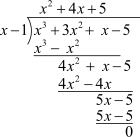
 

`h(x)=(x-1)(x^2+4x+5)`
 

iii.   `text{Consider the roots of}\ \ y=x^2+4x+5`

`Δ = b^2-4ac=4^2-4*1*5=-4<0`

`text{Since}\ \ Δ<0\ \ =>\ \ text{No zeros (roots)}`

`:. h(x)\ text{only has 1 zero at}\ x=1\ (h(1)=0)`
Filed Under: Polynomials Tagged With: num-title-ct-patha, smc-4242-10-Factor Theorem, smc-4242-40-Long division, smc-4242-50-Discriminant

Polynomials, SMB-011

`g(x)=(x-1)(x^2-2x+8)`.

Justify that `g(x)` only has one zero.  (2 marks)

--- 5 WORK AREA LINES (style=lined) ---

Show Answers Only

`text{Proof (See worked solutions)}`

Show Worked Solution

`g(x)=(x-1)(x^2-2x+8)`.

`g(1)=0\ \ =>\ \ text{one zero at}\ \ x=1`

`text{Consider the roots of}\ \ y=x^2-2x+8`

`Δ = b^2-4ac=(-2)^2-4*1*8=-28<0`

`text{Since}\ \ Δ<0\ \ =>\ \ text{No zeros (roots)}`

`:. g(x)\ text{only has 1 zero}`

Filed Under: Polynomials Tagged With: num-title-ct-patha, smc-4242-10-Factor Theorem, smc-4242-50-Discriminant

Polynomials, SMB-010 MC

`P(x)` is a monic polynomial of degree 4.

The maximum number of zeros that `P(x)` can have is

  1. `0`
  2. `1`
  3. `3`
  4. `4`
Show Answers Only

`D`

Show Worked Solution

`text{A polynomial of degree 4 has a leading term}\ ax^4`

`text{A monic polynomial of degree 4 has a leading term}\ x^4`

`:.\ text{Maximum number of zeroes}\ = 4`

`=>D`

Filed Under: Polynomials Tagged With: num-title-ct-patha, smc-4242-10-Factor Theorem

Polynomials, SMB-009

Let  `P(x) = x^3+5x^2+2x-8`.

  1. Show that  `P(-2) = 0`.  (1 mark)

    --- 2 WORK AREA LINES (style=lined) ---

  2. Hence, factor the polynomial  `P(x)`  as  `A(x)B(x)`, where  `B(x)`  is a quadratic polynomial.  (2 marks)

    --- 5 WORK AREA LINES (style=lined) ---

Show Answers Only
  1. `text(See Worked Solutions)`
  2. `P(x)=(x+2)(x^2+3x-4)`
Show Worked Solution
i.    `P(-2)` `= (-2)^3+ 5(-2)^2+2(-2)-8`
    `=-8+20-4-8`
    `= 0`


ii.  `text{Since}\ \ P(-2)=0\ \ =>\ \ (x+2)\ text{is a factor of}\ P(x)`

`P(x)=A(x)B(x)=(x+2)*B(x)`

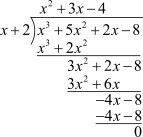
`text{Using long division:}\ P(x)-:(x+2)=B(x)`
 

`:.P(x)=(x+2)(x^2+3x-4)`

Filed Under: Polynomials Tagged With: num-title-ct-patha, smc-4242-10-Factor Theorem, smc-4242-40-Long division

Polynomials, SMB-008

Consider the polynomial  `P(x) = 2x^4+3x^3-12x^2-7x+6`.

Fully factorised, `P(x) = (2x-1)(x+3)(x+a)(x-b)`

Find the value of `a` and `b` where `a,b>0`.  (3 marks)

Show Answers Only

`a=1, b=2`

Show Worked Solution

`text{Test for factors (by trial and error):}`

`P(1) = 2+3-12-7+6 = -8`

`P(-1) = 2-3-12+7+6 = 0\ \ =>\ \ (x+1)\ \ text{is a factor}`

`P(2) = 32+24-48-14+6 = 0\ \ =>\ \ (x-2)\ \ text{is a factor}`

`:. a=1, b=2`

Filed Under: Polynomials Tagged With: num-title-ct-patha, smc-4242-10-Factor Theorem

Polynomials, SMB-007

Consider the polynomial  `P(x) = 3x^3+x^2-10x-8`.

Is `(x+2)` a factor of `P(x)`? Justify your answer.  (2 marks)

Show Answers Only

`P(-2) = -24+4+20-8=-8`

`:. (x+2)\ \ text(is not a factor of)\ P(x)`

Show Worked Solution

`P(-2) = -24+4+20-8=-8`

`:. (x+2)\ \ text(is not a factor of)\ P(x)`

Filed Under: Polynomials Tagged With: num-title-ct-patha, smc-4242-10-Factor Theorem

Polynomials, SMB-006

Consider the polynomial  `P(x) = 2x^3-7x^2-7x+12`.

  1. Show that  `(x-1)`  is a factor of  `P(x)`.  (1 mark)

    --- 2 WORK AREA LINES (style=lined) ---

  2. Fully factorise `P(x)`.  (2 marks)

    --- 5 WORK AREA LINES (style=lined) ---

Show Answers Only
  1. `text(See Worked Solution)`
  2. `P(x)=(x-1)(2x+3)(x-4)`
Show Worked Solution

i.   `P(1) = 2-7-7+12=0`

`:. (x-1)\ \ text(is a factor of)\ P(x)`


ii.   `text{Using part (i)} \ => (x-1)\ text{is a factor of}\ P(x)`

`P(x) = (x-1)*Q(x)`
 

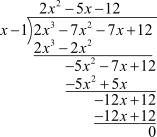
`text(By long division:)`
 

`P(x)` `= (x-1) (2x^2-5x-12)`
  `= (x-1)(2x+3)(x-4)`

Filed Under: Polynomials Tagged With: num-title-ct-patha, smc-4242-10-Factor Theorem, smc-4242-40-Long division

Polynomials, SMB-005

Consider the polynomial  `P(x) = x^3-4x^2+x+6`.

  1. Show that  `x = -1`  is a zero of  `P(x)`.  (1 mark)

    --- 1 WORK AREA LINES (style=lined) ---

  2. Find the other zeros.  (2 marks)

    --- 4 WORK AREA LINES (style=lined) ---

Show Answers Only
  1. `text(See Worked Solution)`
  2. `x = 2 and 3`
Show Worked Solution

i.   `P(-1) = -1-4-1+6 = 0`

`:. x=-1\ \ text(is a zero)`


ii.   `text{Using part (i)} \ => (x+1)\ text{is a factor of}\ P(x)`

`P(x) = (x+1)*Q(x)`
 

`text(By long division:)`

`P(x)` `= (x+1) (x^2-5x+6)`
  `= (x+1)(x-2)(x-3)`

 
`:.\ text(Other zeroes are:)`

`x = 2 and x = 3`

Filed Under: Polynomials Tagged With: num-title-ct-patha, smc-4242-10-Factor Theorem

Polynomials, SMB-003 MC

If  `x + a`  is a factor of  `8x^3-14x^2-a^2 x`, then the value of  `a`  is

  1.  7
  2.  4
  3.  1
  4. –2
Show Answers Only

`D`

Show Worked Solution
`f(-a)` `= 8(-a)^3-14(-a)^2-a^2(-a)`
`0` `= -8a^3-14a^2 + a^3`
`0` `= -7a^3-14a^2`
`0` `= -7a^2 (a + 2)`
`a` `= -2`

 
`=>D`

Filed Under: Polynomials Tagged With: num-title-ct-patha, smc-4242-10-Factor Theorem

Functions, EXT1 F2 2020 HSC 11a

Let  `P(x) = x^3 + 3x^2-13x + 6`.

  1. Show that  `P(2) = 0`.  (1 mark)

    --- 2 WORK AREA LINES (style=lined) ---

  2. Hence, factor the polynomial  `P(x)`  as  `A(x)B(x)`, where  `B(x)`  is a quadratic polynomial.  (2 marks)

    --- 8 WORK AREA LINES (style=lined) ---

Show Answers Only
  1. `text(See Worked Solutions)`
  2. `P(x) = (x-2)(x^2 + 5x – 3)`
Show Worked Solution
i.    `P(2)` `= 8 + 12-26 + 6`
    `= 0`


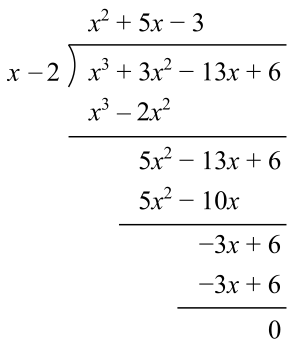
ii.   

`:. P(x) = (x-2)(x^2 + 5x – 3)`

Filed Under: Polynomials, Remainder and Factor Theorems (Ext1) Tagged With: Band 2, Band 3, num-title-ct-patha, num-title-qs-hsc, smc-1031-10-Factor Theorem, smc-4242-10-Factor Theorem, smc-4242-40-Long division

Functions, EXT1 F2 2019 HSC 11d

Find the polynomial  `Q(x)`  that satisfies  `x^3 + 2x^2-3x-7 = (x-2) Q(x) + 3`.  (2 marks)

--- 6 WORK AREA LINES (style=lined) ---

Show Answers Only

`Q(x ) = x^2 + 4x + 5`

Show Worked Solution
`(x-2) ⋅ Q(x) + 3` `= x^3 + 2x^2-3x-7`
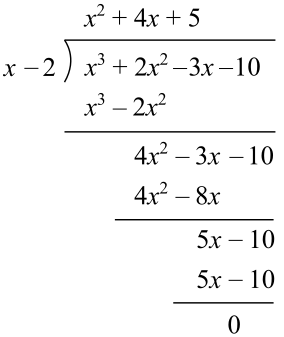
`(x-2) ⋅ Q(x)` `= x^3 + 2x^2-3x-10`


`:. Q(x ) = x^2 + 4x + 5`

Filed Under: Polynomials, Remainder and Factor Theorems (Ext1) Tagged With: Band 3, num-title-ct-patha, num-title-qs-hsc, smc-1031-20-Remainder Theorem, smc-4242-10-Factor Theorem, smc-4242-20-Remainder Theorem

Functions, EXT1 F2 2018 HSC 11a

Consider the polynomial  `P(x) = x^3-2x^2-5x + 6`.

  1. Show that  `x = 1`  is a zero of  `P(x)`.  (1 mark)

    --- 2 WORK AREA LINES (style=lined) ---

  2. Find the other zeros.  (2 marks)

    --- 5 WORK AREA LINES (style=lined) ---

Show Answers Only
  1. `text(See Worked Solution)`
  2. `x = -2 and x = 3`
Show Worked Solution

i.   `P(1) = 1-2-5 + 6 = 0`

`:. x=1\ \ text(is a zero)`


ii.   `text{Using part (i)} \ => (x-1)\ text{is a factor of}\ P(x)`

`P(x) = (x-1)*Q(x)`
 

`text(By long division:)`

`P(x)` `= (x-1) (x^2-x-6)`
  `= (x-1) (x-3) (x + 2)`

 
`:.\ text(Other zeroes are:)`

`x = -2 and x = 3`

Filed Under: Polynomials, Remainder and Factor Theorems (Ext1), Roots, Remainders and Factors Tagged With: Band 1, Band 3, num-title-ct-patha, num-title-qs-hsc, smc-1031-10-Factor Theorem, smc-4242-10-Factor Theorem

Functions, EXT1 F2 2016 HSC 2 MC

What is the remainder when  `2x^3-10x^2 + 6x + 2`  is divided by  `x-2`?

  1. `-66`
  2. `-10`
  3. `-x^3 + 5x^2-3x-1`
  4. `x^3-5x^2 + 3x + 1`
Show Answers Only

`B`

Show Worked Solution
`P(2)` `= 2 · 2^3-10 · 2^2 + 6 · 2 + 2`
  `= -10`

 
`=>   B`

Filed Under: Polynomials, Remainder and Factor Theorems (Ext1), Roots, Remainders and Factors Tagged With: Band 2, num-title-ct-patha, num-title-qs-hsc, smc-1031-20-Remainder Theorem, smc-4242-10-Factor Theorem

Functions, EXT1 F2 2007 HSC 2c

The polynomial  `P(x) = x^2 + ax + b`  has a zero at  `x = 2`. When  `P(x)`  is divided by  `x + 1`, the remainder is `18`.

Find the values of  `a`  and  `b`.  (3 marks)

--- 7 WORK AREA LINES (style=lined) ---

Show Answers Only

`a = -7\ \ text(and)\ \ b = 10`

Show Worked Solution

`P(x) = x^2 + ax + b`

`text(S)text(ince there is a zero at)\ \ x = 2,`

`P(2)` `=0`  
`2^2 + 2a + b` `= 0`  
`2a + b` `= -4`       `…\ (1)`

 
`P(-1) = 18,`

`(-1)^2-a + b` `= 18`  
`-a + b` `= 17`    `…\ (2)`

 
`text(Subtract)\ \ (1)-(2),`

`3a` `= -21`
`a` `= -7`

 
`text(Substitute)\ \ a = -7\ \ text{into (1),}`

`2(-7) + b` `= -4`
`b` `= 10`

 
`:.a = -7\ \ text(and)\ \ b = 10`

Filed Under: Polynomials, Remainder and Factor Theorems (Ext1), Roots, Remainders and Factors Tagged With: Band 3, num-title-ct-patha, num-title-qs-hsc, smc-1031-10-Factor Theorem, smc-1031-20-Remainder Theorem, smc-4242-10-Factor Theorem

Functions, EXT1 F2 2015 HSC 11f

Consider the polynomials  `P(x) = x^3-kx^2 + 5x + 12`  and  `A(x) = x - 3`.

  1. Given that  `P(x)`  is divisible by  `A(x)`, show that  `k = 6`.  (1 mark)

    --- 4 WORK AREA LINES (style=lined) ---

  2. Find all the zeros of  `P(x)`  when  `k = 6`.  (2 marks)

    --- 6 WORK AREA LINES (style=lined) ---

Show Answers Only
  1. `text(See Worked Solutions)`
  2. `3, 4, −1`
Show Worked Solution
i.    `P(x)` `= x^3-kx^2 + 5x + 12`
  `A(x)` `= x-3`

 
`text(If)\ P(x)\ text(is divisible by)\ A(x)\ \ =>\ \ P(3) = 0`

`3^3-k(3^2) + 5 xx 3 + 12` `= 0`
`27-9k + 15 + 12` `= 0`
`9k` `= 54`
`:.k` `= 6\ \ …\ text(as required)`


ii.  `text(Find all roots of)\ P(x)`

`P(x)=(x-3)*Q(x)`

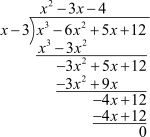
`text{Using long division to find}\ Q(x):`
 

`:.P(x)` `= x^3-6x^2 + 5x + 12`
  `= (x-3)(x^2-3x − 4)`
  `= (x-3)(x-4)(x + 1)`

 
`:.\ text(Zeros at)\ \ \ x = -1, 3, 4`

Filed Under: Polynomials, Remainder and Factor Theorems (Ext1), Roots, Remainders and Factors Tagged With: Band 2, Band 3, num-title-ct-patha, num-title-qs-hsc, smc-1031-10-Factor Theorem, smc-4242-10-Factor Theorem, smc-4242-40-Long division

Functions, EXT1 F2 2011 HSC 2a

Let  `P(x) = x^3-ax^2 + x`  be a polynomial, where  `a`  is a real number.

When  `P(x)`  is divided by  `x-3`  the remainder is  `12`.

Find the remainder when  `P(x)`  is divided by  `x + 1`.    (3 marks)

--- 7 WORK AREA LINES (style=lined) ---

Show Answers Only

`-4`

Show Worked Solution

`P(x) = x^3 – ax^2 + x`

`text(S)text(ince)\ \ P(x) -: (x – 3)\ \ text(has remainder 12,)`

`P(3) = 3^3-a xx 3^2 + 3` `=12`
`27-9a + 3` `= 12`
`9a` `= 18`
`a` `=2`

 
`:.\ P(x) = x^3-2x^2 + x`


`text(Remainder)\ \ P(x) -: (x + 1)\ \ text(is)\ \ P(–1)`

`P(-1)` `= (-1)^3-2(-1)^2-1`
  `= – 4`

Filed Under: Polynomials, Remainder and Factor Theorems (Ext1), Roots, Remainders and Factors Tagged With: Band 3, num-title-ct-patha, num-title-qs-hsc, smc-1031-20-Remainder Theorem, smc-4242-10-Factor Theorem, smc-4242-20-Remainder Theorem

Copyright © 2014–2025 SmarterEd.com.au · Log in