SmarterEd

Aussie Maths & Science Teachers: Save your time with SmarterEd

  • Login
  • Get Help
  • About

CHEMISTRY, M1 EQ-Bank 12

Explain the trend in electronegativity across a period (from left to right) and down a group in the Periodic Table. Use your knowledge of atomic structure to support your answer.   (4 marks)

--- 12 WORK AREA LINES (style=lined) ---

Show Answers Only

Across a period (left to right):

  • Electronegativity increases because nuclear charge (proton number) increases.
  • As a result, atoms have stronger pull on bonding electrons.
  • This occurs because electrons are added to the same shell, not further away.
  • In this way, atoms become smaller from left to right due to extra protons attracting electrons more strongly and reducing their radii.

Down a group:

  • Electronegativity decreases despite increasing nuclear charge (more protons).
  • This occurs because atoms gain additional electron shells, leading to increased distance between nucleus and bonding electrons.
  • Extra shells provide shielding, which means that outer electrons feel less nuclear attraction.
  • Therefore, the shell effect outweighs the increased nuclear charge and electronegativity decreases down a group.
Show Worked Solution

Across a period (left to right):

  • Electronegativity increases because nuclear charge (proton number) increases.
  • As a result, atoms have stronger pull on bonding electrons.
  • This occurs because electrons are added to the same shell, not further away.
  • In this way, atoms become smaller from left to right due to extra protons attracting electrons more strongly and reducing their radii.

Down a group:

  • Electronegativity decreases despite increasing nuclear charge (more protons).
  • This occurs because atoms gain additional electron shells, leading to increased distance between nucleus and bonding electrons.
  • Extra shells provide shielding, which means that outer electrons feel less nuclear attraction.
  • Therefore, the shell effect outweighs the increased nuclear charge and electronegativity decreases down a group.

Filed Under: Periodicity Tagged With: Band 5, smc-4257-20-Electronegativity

CHEMISTRY, M1 EQ-Bank 11

Explain the relationship between electronegativity and atomic radius with non-metal reactivity down Group 17 (the halogens) of the Periodic Table.   (4 marks)

--- 8 WORK AREA LINES (style=lined) ---

Show Answers Only
  • Atomic radius increases down Group 17 because each element gains more electron shells.
  • This leads to weaker nuclear attraction for incoming electrons, due to greater distance from the nucleus and increased shielding by inner shells.
  • As a result, electronegativity decreases down the group, and consequently decreasing reactivity down Group 17
  • For instance, fluorine (small radius, high electronegativity) is most reactive while in contrast, iodine (large radius, low electronegativity) is least reactive.
  • Therefore, smaller atoms with higher electronegativity are more reactive non-metals.
Show Worked Solution
  • Atomic radius increases down Group 17 because each element gains more electron shells.
  • This leads to weaker nuclear attraction for incoming electrons, due to greater distance from the nucleus and increased shielding by inner shells.
  • As a result, electronegativity decreases down the group, and consequently decreasing reactivity down Group 17
  • For instance, fluorine (small radius, high electronegativity) is most reactive while in contrast, iodine (large radius, low electronegativity) is least reactive.
  • Therefore, smaller atoms with higher electronegativity are more reactive non-metals.

Filed Under: Periodicity Tagged With: Band 4, Band 5, smc-4257-10-Atomic Radii, smc-4257-20-Electronegativity, smc-4257-40-Reactivity

CHEMISTRY, M1 EQ-Bank 4 MC

The graph shows the trend in a particular property across the second period of elements.
 

Property A increases steadily from left to right across the period.

Property A is most likely:

  1. Atomic radius
  2. Electronegativity
  3. Metallic character
  4. Reactivity of metals
Show Answers Only

\(B\)

Show Worked Solution
  • Across a period, electronegativity increases as nuclear charge increases and atomic radius decreases.
  • Metallic character/reactivity of metals decreases across the period, not increases.

\(\Rightarrow B\)

Filed Under: Periodicity Tagged With: Band 4, smc-4257-20-Electronegativity

CHEMISTRY, M1 EQ-Bank 3 MC

Which is the most electronegative element?

  1. Caesium
  2. Tellurium
  3. Chlorine
  4. Thallium
Show Answers Only

\(C\)

Show Worked Solution
  • Electronegativity is the tendency of an atom to attract electrons and the most electronegative elements are found in the top right corner of the periodic table (excluding noble gases).
  • Hence chlorine is the most electronegative element from the choices.

\(\Rightarrow C\)

Filed Under: Periodicity Tagged With: Band 4, smc-4257-20-Electronegativity

CHEMISTRY, M1 EQ-Bank 8

Using your understanding of periodic trends, explain and predict the differences in the properties of the elements lithium \(\ce{(Li)}\) and fluorine \(\ce{(F)}\) regarding their:

    • atomic radii
    • first ionisation energy
    • electronegativity

Give reasons for your predictions based on their positions in the periodic table and electronic configurations.   (4 marks)

--- 8 WORK AREA LINES (style=lined) ---

Show Answers Only

Atomic Radii:

  • Lithium, being in the same period but a different group than fluorine, has fewer protons and a less effective nuclear charge, resulting in a larger atomic radius.

First Ionisation Energy:

  • Fluorine has a higher first ionisation energy due to its greater nuclear charge and smaller radius, which strongly attracts electrons.

Electronegativity:

  • Fluorine, being one of the most electronegative elements, has a strong ability to attract bonding electrons.
Show Worked Solution

Atomic Radii:

  • Lithium, being in the same period but a different group than fluorine, has fewer protons and a less effective nuclear charge, resulting in a larger atomic radius.

First Ionisation Energy:

  • Fluorine has a higher first ionisation energy due to its greater nuclear charge and smaller radius, which strongly attracts electrons.

Electronegativity:

  • Fluorine, being one of the most electronegative elements, has a strong ability to attract bonding electrons.

Filed Under: Periodicity Tagged With: Band 5, smc-4257-10-Atomic Radii, smc-4257-20-Electronegativity, smc-4257-30-Ionisation Energy

CHEMISTRY, M1 EQ-Bank 5

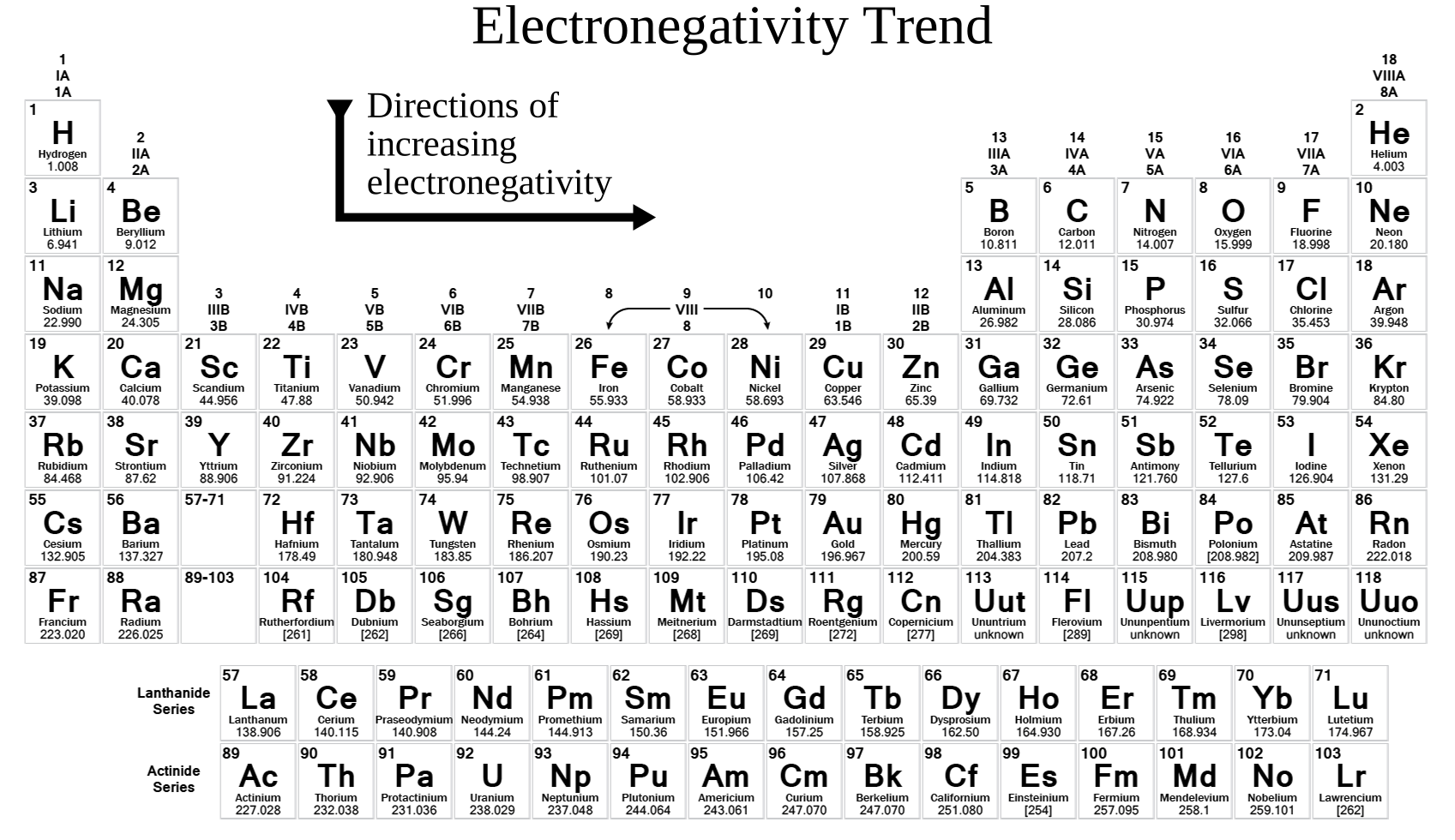
"Electronegativity increases as you move across periods left to right and decreases as you move down groups".

Explain this trend with reference to the following periodic table.   (4 marks)
  

Show Answers Only

Moving from left to right:

  • As you move across a period from left to right in the same row, the number of protons in the nucleus of elements increases in accordance with their atomic number.
  • eg. \(\ce{Li}\) (far left) has 3 protons in its nucleus whereas \(\ce{F}\) (far right) has 9 protons in its nucleus.
  • This leads to a greater attractive force and thus higher electronegativity. 

Moving down within a group (column):

  • Adding electron shells to a nucleus decreases electronegativity.
  • This is due to an increase in atomic radius and the effect that extra electron shells have in shielding the attractive forces of protons.
  • All the elements in a period (row) further down the periodic table have an extra electron shell than the period directly above them, decreasing electronegativity as you move down.
Show Worked Solution

Moving from left to right:

  • As you move across a period from left to right in the same row, the number of protons in the nucleus of elements increases in accordance with their atomic number.
  • eg. \(\ce{Li}\) (far left) has 3 protons in its nucleus whereas \(\ce{F}\) (far right) has 9 protons in its nucleus.
  • This leads to a greater attractive force and thus higher electronegativity. 

Moving down within a group (column):

  • Adding electron shells to a nucleus decreases electronegativity.
  • This is due to an increase in atomic radius and the effect that extra electron shells have in shielding the attractive forces of protons.
  • All the elements in a period (row) further down the periodic table have an extra electron shell than the period directly above them, decreasing electronegativity as you move down.

Filed Under: Periodicity Tagged With: Band 4, Band 5, smc-4257-10-Atomic Radii, smc-4257-20-Electronegativity

CHEMISTRY, M1 EQ-Bank 4

Describe two factors which affect the degree of electronegativity of an atom.   (2 marks)

--- 4 WORK AREA LINES (style=lined) ---

Show Answers Only

Number of Protons in the Nucleus:

  • The greater the number of protons in the nucleus of an atom, the greater the attractive force exerted on electrons and therefore the greater the electronegativity.

Atomic Radius:

  • The smaller the atomic radius, the larger the attractive force that can be exerted on electrons (due to lack of shielding).
Show Worked Solution

Number of Protons in the Nucleus:

  • The greater the number of protons in the nucleus of an atom, the greater the attractive force exerted on electrons and therefore the greater the electronegativity.

Atomic Radius:

  • The smaller the atomic radius, the larger the attractive force that can be exerted on electrons (due to lack of shielding).

Filed Under: Periodicity Tagged With: Band 4, smc-4257-10-Atomic Radii, smc-4257-20-Electronegativity

CHEMISTRY, M1 EQ-Bank 3

What is electronegativity and how is it measured?   (2 marks)

Show Answers Only
  • Electronegativity is a measure of the attractive force an atom can exert on an electron to bond to it.
  • It is measured using the Pauling scale.
Show Worked Solution
  • Electronegativity is a measure of the attractive force an atom can exert on an electron to bond to it.
  • It is measured using the Pauling scale.

Filed Under: Periodicity Tagged With: Band 4, smc-4257-20-Electronegativity

CHEMISTRY, M1 2009 HSC 30c

The graph shows the first ionisation energy of some elements.
 

Account for the trends in the graph in terms of the electron configuration of the elements.  (3 marks)

Show Answers Only


Show Worked Solution
  • The increase in ionisation energy from Z=2 to 10 and Z=11 to 18 relates to the increase in effective nuclear charge across periods 1 and 2 respectively.
  • The same valence shell is being filled across a period, hence inner shell shielding and nucleus – shell distance is approximately constant while the nuclear charge increases.
  • Hence the electron binding force increases, requiring greater energy to remove a valence shell electron. Therefore, the ionisation energy increases across a period.
  • When the next valence shell begins to fill, as occurs at Z=3, 11 and 19 , the ionisation energy drops substantially because the electron experiences increased inner shell nuclear shielding and is further from the nucleus.
  • The generally lower ionisation energies for the second period elements compared to the first period elements also reflects the filling of higher valence shells.
  • This reflects the decrease in ionisation energy down a group in the periodic table.

Filed Under: Periodicity Tagged With: Band 5, smc-4257-10-Atomic Radii, smc-4257-20-Electronegativity, smc-4257-30-Ionisation Energy

CHEMISTRY, M1 2013 HSC 20 MC

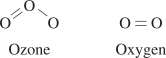
The structures of ozone and molecular oxygen are shown.
 

Ozone is more easily decomposed than molecular oxygen because

  1. it is polar.
  2. it is a bent molecule.
  3. it has a greater molecular mass.
  4. it has a lower average bond energy.
Show Answers Only

`D`

Show Worked Solution
  • The presence of the single bond in the ozone molecule lowers the average bond energy.
  • Bond breaking is an endothermic process and so requires energy. As ozone has a lower average bond energy, less energy is required to break the bonds and thus decomposes more easily than molecular oxygen.

`=>D`

Filed Under: Periodicity Tagged With: Band 4, smc-4257-10-Atomic Radii, smc-4257-20-Electronegativity, smc-4257-30-Ionisation Energy

Copyright © 2014–2025 SmarterEd.com.au · Log in