SmarterEd

Aussie Maths & Science Teachers: Save your time with SmarterEd

  • Login
  • Get Help
  • About

CHEMISTRY, M3 EQ-Bank 11

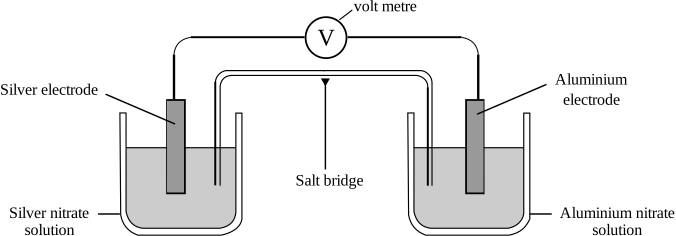
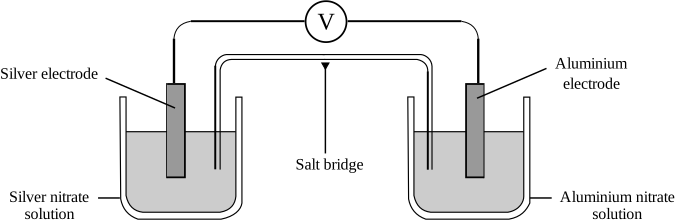
A student set up two half-cells: one with an aluminium nitrate solution and an aluminium metal electrode, and the other with silver nitrate solution and a silver metal electrode. The two solutions were connected by a salt bridge soaked in potassium nitrate, and the electrodes were linked to a volt-meter using electrical wires.

  1. Draw a labelled diagram of the student's setup.   (3 marks)

--- 10 WORK AREA LINES (style=blank) ---

  1. Complete the following table.   (3 marks)

    --- 0 WORK AREA LINES (style=lined) ---

\begin{array} {|c|c|}
\hline
\rule{0pt}{2.5ex} \text{anode half equation} \rule[-1ex]{0pt}{0pt} & \qquad \qquad\qquad \qquad \qquad \\
\hline
\rule{0pt}{2.5ex} \text{cathode half equation} \rule[-1ex]{0pt}{0pt} & \\
\hline
\rule{0pt}{2.5ex} \text{net ionic equation} \rule[-1ex]{0pt}{0pt} &  \\
\hline
\end{array}

  1. Determine the theoretical cell potential of the students galvanic cell.   (2 marks)

--- 4 WORK AREA LINES (style=lined) ---

Show Answers Only

a.   
       

b.   

\begin{array} {|c|c|}
\hline
\rule{0pt}{2.5ex} \text{anode half equation} \rule[-1ex]{0pt}{0pt} & \ce{Al(s) -> Al^{3+}(aq) + 3e^-}\\
\hline
\rule{0pt}{2.5ex} \text{cathode half equation} \rule[-1ex]{0pt}{0pt} & \ce{Ag+(aq) + e^- -> Ag(s)} \\
\hline
\rule{0pt}{2.5ex} \text{net ionic equation} \rule[-1ex]{0pt}{0pt} & \ce{Al(s) + Ag+(aq) -> Al^{3+}(aq) + Ag(s)} \\
\hline
\end{array}

 
c.    
\(E^{\circ}_{\text{cell}}=E^{\circ}_{\text{cathode}}-E^{\circ}_{\text{anode}}=0.8-(-1.68)=2.48\ \text{V}\)
Show Worked Solution

a.  


b.   

\begin{array} {|c|c|}
\hline
\rule{0pt}{2.5ex} \text{anode half equation} \rule[-1ex]{0pt}{0pt} & \ce{Al(s) -> Al^{3+}(aq) + 3e^-}\\
\hline
\rule{0pt}{2.5ex} \text{cathode half equation} \rule[-1ex]{0pt}{0pt} & \ce{Ag+(aq) + e^- -> Ag(s)} \\
\hline
\rule{0pt}{2.5ex} \text{net ionic equation} \rule[-1ex]{0pt}{0pt} & \ce{Al(s) + Ag+(aq) -> Al^{3+}(aq) + Ag(s)} \\
\hline
\end{array}


c.    \(E^{\circ}_{\text{cell}}=E^{\circ}_{\text{cathode}}-E^{\circ}_{\text{anode}}=0.8-(-1.68)=2.48\ \text{V}\)
Filed Under: Predicting Reactions of Metals Tagged With: Band 4, smc-4264-25-Redox, smc-4264-40-Cell Potentials, smc-4264-45-Galvanic Cells

CHEMISTRY, M3 EQ-Bank 10

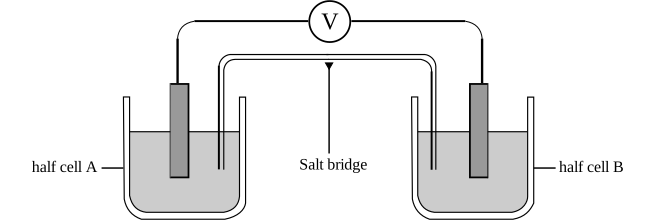
A student conducted an experiment to measure the voltage generated by using various combinations of metals in an electrolyte solution.


  1. Complete the table below.   (2 marks)

    --- 0 WORK AREA LINES (style=lined) ---

\begin{array} {|c|c|c|c|}
\hline
\rule{0pt}{2.5ex} \textbf{Experiment} \rule[-1ex]{0pt}{0pt} & \textbf{Half cell A} & \textbf{Half cell B} & \textbf{Cell Potential (V)}\\
\hline
\rule{0pt}{2.5ex} \textbf{1} \rule[-1ex]{0pt}{0pt} & \ce{Zn(s) | Zn^{2+}(aq)} & \ce{Pb(s) | Pb^{2+}(aq)} &  \\
\hline
\rule{0pt}{2.5ex} \textbf{2} \rule[-1ex]{0pt}{0pt} & \ce{Cu(s) | Cu^{2+}(aq)} & \ce{Pb(s) | Pb^{2+}(aq)} &  \\
\hline
\end{array}

  1. Explain whether the Zinc electrode is the anode or the cathode.   (2 marks)

--- 3 WORK AREA LINES (style=lined) ---

  1. Write the net ionic equation for Experiment 2.   (2 marks)

--- 3 WORK AREA LINES (style=lined) ---

Show Answers Only

a.  Cell potential of Experiment 1:

\(\ce{Zn(s) -> Zn^{2+} + 2e^-} \quad V=0.76\ \text{V}\)

\(\ce{Pb^{2+} + 2e^- -> Pb(s)} \quad V=-0.13\ \text{V}\)

\(E^{\circ}_{\text{cell}}=0.76 + -0.13 =0.63\ \text{V}\)
 

Cell potential of Experiment 2:

\(\ce{Pb(s) -> Pb^{2+} + 2e^-} \quad V=0.13\ \text{V}\)

\(\ce{Cu^{2+} + 2e^- -> Cu(s)} \quad V=0.34\ \text{V}\)

\(E^{\circ}_{\text{cell}}=0.13 + 0.34 =0.47\ \text{V}\)
 

b.    Zinc electrode is the anode.

  • Zinc is a more reactive metal than lead and therefore will undergo oxidation while lead undergoes reduction.
  • Since oxidation occurs at the anode, the zinc electrode will be the anode in this cell.

 
c.    
\(\ce{Pb(s) + Cu^{2+}(aq) -> Pb^{2+}(aq) + Cu(s)}\)

Show Worked Solution

a.  Cell potential of experiment 1:

\(\ce{Zn(s) -> Zn^{2+} + 2e^-} \quad V=0.76\ \text{V}\)

\(\ce{Pb^{2+} + 2e^- -> Pb(s)} \quad V=-0.13\ \text{V}\)

\(E^{\circ}_{\text{cell}}=0.76 + -0.13 =0.63\ \text{V}\)
 

Cell potential of experiment 2:

\(\ce{Pb(s) -> Pb^{2+} + 2e^-} \quad V=0.13\ \text{V}\)

\(\ce{Cu^{2+} + 2e^- -> Cu(s)} \quad V=0.34\ \text{V}\)

\(E^{\circ}_{\text{cell}}=0.13 + 0.34 =0.47\ \text{V}\)
 

b.    Zinc electrode is the anode.

  • Zinc is a more reactive metal than lead and therefore will undergo oxidation while lead undergoes reduction.
  • Since oxidation occurs at the anode, the zinc electrode will be the anode in this cell.

 
c.    
\(\ce{Pb(s) + Cu^{2+}(aq) -> Pb^{2+}(aq) + Cu(s)}\)

Filed Under: Predicting Reactions of Metals Tagged With: Band 4, Band 5, smc-4264-40-Cell Potentials, smc-4264-45-Galvanic Cells

CHEMISTRY, M3 EQ-Bank 9

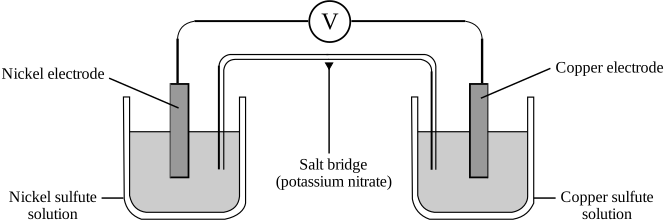
A galvanic cell was created as seen below:


  1. State the direction that the electrons run through the conducting wire.   (1 mark)

--- 1 WORK AREA LINES (style=lined) ---

  1. State which electrode is the anode and which electrode is the cathode.   (1 mark)

--- 2 WORK AREA LINES (style=lined) ---

  1. Explain the direction of the anion flow from the salt bridge.   (2 marks)

--- 4 WORK AREA LINES (style=lined) ---

Show Answers Only

a.    The electrons will run from the nickel electrode to the copper electrode.

  • The electrons run from the more active metal (oxidises) to the less active metal (reduces).

b.    Nickel electrode  \(\Rightarrow\)  is the anode (undergoes oxidation).

Copper electrode  \(\Rightarrow\)  cathode (undergoes reduction).
 

c.    The nitrate ions in the salt bridge will flow to the nickel solution. 

  • At the anode, oxidation occurs, producing positive ions (cations) that increase the positive charge.
  • To balance this, anions move to the nickel solution, neutralising the excess positive charge and maintaining electrical neutrality in the solution.
Show Worked Solution

a.    The electrons will run from the nickel electrode to the copper electrode.

  • The electrons run from the more active metal (oxidises) to the less active metal (reduces).

b.    Nickel electrode  \(\Rightarrow\)  is the anode (undergoes oxidation).

Copper electrode  \(\Rightarrow\)  cathode (undergoes reduction).
 

c.    The nitrate ions in the salt bridge will flow to the nickel solution. 

  • At the anode, oxidation occurs, producing positive ions (cations) that increase the positive charge.
  • To balance this, anions move to the nickel solution, neutralising the excess positive charge and maintaining electrical neutrality in the solution.

Filed Under: Predicting Reactions of Metals Tagged With: Band 4, Band 5, smc-4264-45-Galvanic Cells

Copyright © 2014–2025 SmarterEd.com.au · Log in