SmarterEd

Aussie Maths & Science Teachers: Save your time with SmarterEd

  • Login
  • Get Help
  • About

CHEMISTRY, M4 EQ-Bank 25

In an experiment, 1.40 g of pure sucrose, \(\ce{C12H22O11}\), underwent complete combustion, heating 350 mL of water from 19.6 °C to 35.8 °C.

\(\ce{MM(C12H22O11)}\) = 342 g mol\(^{−1}\)

Assuming there was no heat lost to the surroundings, calculate the experimental heat of combustion of pure sucrose, in joules per gram.   (2 marks)

--- 4 WORK AREA LINES (style=lined) ---
Show Answers Only

\(1.65 \times 10^{4}\ \text{J g}^{-1} \)

Show Worked Solution

\(\text{Energy absorbed} \ce{(H2O)}\ = mC \Delta T = 0.350 \times 4.18 \times 10^{3} \times (35.8-19.6) = 23\ 070.6\ \text{J} \)

\(\text{Energy (sucrose)}\ = \dfrac{23\ 070.6}{1.40} = 1.65 \times 10^{4}\ \text{J g}^{-1} \)

Filed Under: Energy Changes in Chemical Reactions Tagged With: Band 4, smc-4266-20-Heat of combustion, smc-4266-50-Calorimetry

CHEMISTRY, M4 2017 VCE 23 MC

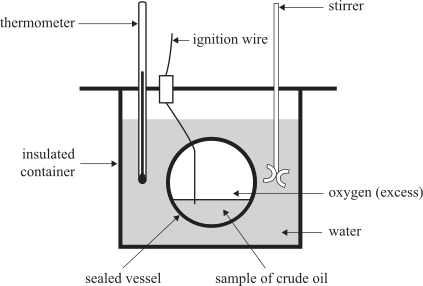
The heat of combustion of a sample of crude oil is to be determined using a bomb calorimeter. All of the students in a class are given the same method to follow. The apparatus used by the students is shown below.
 

For this experiment, the students could maximise

  1. precision by using a digital thermometer \(\pm\)0.2 °C.
  2. validity by calculating the heat of combustion per mole.
  3. accuracy by taking samples from three different sources.
  4. uncertainty by having all students closely follow the same experimental procedure.
Show Answers Only

\(\A\)

Show Worked Solution

Consider each option:

  • Option A: Error involved in reading the thermometer would be improved by this measure.
  • Option B: Energy per mole is inappropriate as crude oil is used.
  • Option C: Accuracy dependent on process technique, not the source of samples.
  • Option D: If the procedure itself creates inaccuracy, this is incorrect. 

\(\Rightarrow A\)

♦ Mean mark 49%.

Filed Under: Energy Changes in Chemical Reactions Tagged With: Band 5, smc-4266-50-Calorimetry

CHEMISTRY, M4 EQ-Bank 30

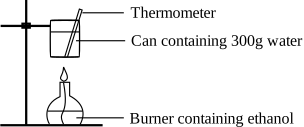
A student used the apparatus shown to determine the molar heat of combustion of ethanol.
 

The following results were obtained.

\begin{array} {|l|c|}
\hline
\rule{0pt}{2.5ex}\text{Initial mass of burner}\rule[-1ex]{0pt}{0pt} & \text{133.20 g} \\
\hline
\rule{0pt}{2.5ex}\text{Final mass of burner}\rule[-1ex]{0pt}{0pt} & \text{132.05 g}\\
\hline
\rule{0pt}{2.5ex}\text{Initial temperature of water}\rule[-1ex]{0pt}{0pt} & \text{25.0°C}\\
\hline
\rule{0pt}{2.5ex}\text{Final temperature of water}\rule[-1ex]{0pt}{0pt} & \text{45.5°C}\\
\hline
\end{array}

Calculate ethanol's molar heat of combustion from this data?   (3 marks)

Show Answers Only

\(1030\ \text{kJ mol}^{-1} \)

Show Worked Solution

\(\ce{Ethanol \ \Rightarrow \ C2H6O }\)

\(\ce{m(C2H6O) = 133.20-132.05=1.15\ \text{grams}}\)

\(\ce{MM(C2H6O) = 2 \times 12.01 + 6 \times 1.008 + 16 = 46.068\ \text{g mol}^{-1}} \)

\(\ce{n(C2H6O) = \dfrac{\text{m}}{\text{MM}} = \dfrac{1.15}{46.068} = 0.02496\ \text{mol}}\)

\(\Delta H = mC\Delta T = 0.300 \times 4.18 \times 10^{3} \times (45.5-25) = 25\ 707\ \text{J} = 25.707\ \text{kJ} \)

\(\ce{C2H6O \text{molar heat of combustion}}\)

\(=\dfrac{25.707}{0.02496}\)

\(=1030\ \text{kJ mol}^{-1} \)

Filed Under: Energy Changes in Chemical Reactions Tagged With: Band 4, smc-4266-20-Heat of combustion, smc-4266-50-Calorimetry

Copyright © 2014–2025 SmarterEd.com.au · Log in