SmarterEd

Aussie Maths & Science Teachers: Save your time with SmarterEd

  • Login
  • Get Help
  • About

PHYSICS, M1 EQ-Bank 6 MC

A drag racer must accelerate from rest to a speed of 80 m/s. If the car accelerates uniformly at 4.0 m/s², what is the minimum track length required to reach this speed?

  1. 750 m
  2. 800 m
  3. 850 m
  4. 900 m
Show Answers Only

\(B\)

Show Worked Solution
\(v^2\) \(=u^2 + 2as\)  
\(s\) \(=\dfrac{v^2-u^2}{2a}\)  
  \(=\dfrac{80^2-0^2}{2 \times 4}\)  
  \(=800\ \text{m}\)  


\(\Rightarrow B\)

Filed Under: Motion in a Straight Line Tagged With: Band 4, smc-4273-25-Displacement, smc-4273-60-v^2=u^2+2as

PHYSICS, M1 EQ-Bank 5 MC

A stone is tossed vertically upward from the edge of a canyon. It rises 9 meters above the rim before falling down to the canyon floor, which is 27 meters below the rim.

What is the total distance travelled by the stone?

  1. 36 m
  2. 42 m
  3. 45 m
  4. 48 m
Show Answers Only

\(C\)

Show Worked Solution
  • The distance the stone travels from the edge of the canyon up into the air and back down to the edge of the canyon is 9 m + 9 m = 18 m.
  • The distance travelled by the stone from the edge of the canyon to the bottom of the canyon is 27 m.
  • The total distance travelled by the stone is 18 m + 27 m = 45 m.

\(\Rightarrow C\)

Filed Under: Motion in a Straight Line Tagged With: Band 3, smc-4273-25-Displacement

PHYSICS, M1 EQ-Bank 11

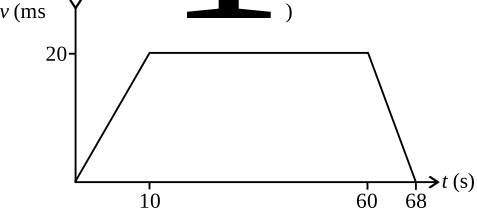
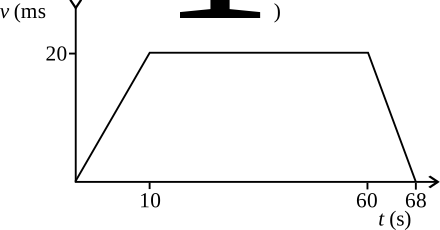
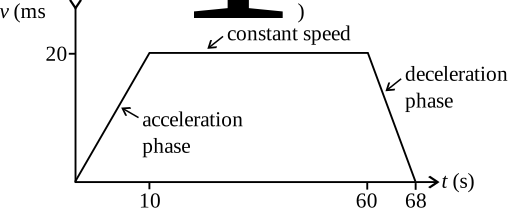
A bus departs from its depot, starting from rest and accelerating uniformly at 2.0 ms\(^{-2}\) for 10 seconds until it reaches a speed of 20 ms\(^{-1}\). It then travels at this constant speed for 50 seconds before decelerating uniformly at – 2.5 ms\(^{-2}\) until coming to a complete stop at the next bus stop.

  1. In the space provided, sketch a velocity–time graph of the bus's journey, clearly marking the acceleration phase, the constant speed phase, and the deceleration phase with all key values.   (3 marks)

    --- 6 WORK AREA LINES (style=blank) ---

  1. Calculate the total distance the bus covers during this trip.   (2 marks)

    --- 4 WORK AREA LINES (style=lined) ---

Show Answers Only

a.    


b.    \(1180\ \text{m}\)

Show Worked Solution

a.   
           

b.    Total distance travelled by the bus is equal to the area under the velocity-time graph.

\(\text{Distance}\) \(=(\dfrac{1}{2} \times 10 \times 20) + (50 \times 20) + (\dfrac{1}{2} \times 8 \times 20) \)  
  \(=1180\ \text{m} \)  

Filed Under: Motion in a Straight Line Tagged With: Band 4, smc-4273-25-Displacement, smc-4273-70-Velocity-Time Graphs

PHYSICS, M1 EQ-Bank 2-3 MC

Using the velocity-time graph below


Part 1

Determine the magnitude of the displacement:

  1. \(32\ \text{m}\)
  2. \(40\ \text{m}\)
  3. \(48\ \text{m}\)
  4. \(64\ \text{m}\)

 
Part 2

Determine the average acceleration between 4 and 8 seconds:
  1. \(-4\ \text{ms}^{-2}\)
  2. \(-2\ \text{ms}^{-2}\)
  3. \(-1\ \text{ms}^{-2}\)
  4. \(2\ \text{ms}^{-2}\)
Show Answers Only

Part 1: \(C\)

Part 2: \(B\)

Show Worked Solution

Part 1

  • The displacement for the motion can be calculated by finding the area under the velocity time graph. 
  • By splitting the graph up into the square and triangle, the area under the curve is:

\(\text{Area}\ =(4 \times 8) + (\dfrac{1}{2} \times 4 \times 8) = 32 +16 = 48\ \text{m}\)

\(\Rightarrow C\)
 

Part 2

  • Average acceleration between t=4 and t=8 is:

\(a= \dfrac{\Delta v}{\Delta t} = \dfrac{0-8}{8-4} = -2\ \text{ms}^{-2}\)

\(\Rightarrow B\)

Filed Under: Motion in a Straight Line Tagged With: Band 3, Band 4, smc-4273-25-Displacement, smc-4273-30-Acceleration

Copyright © 2014–2025 SmarterEd.com.au · Log in