SmarterEd

Aussie Maths & Science Teachers: Save your time with SmarterEd

  • Login
  • Get Help
  • About

PHYSICS, M2 EQ-Bank 13 MC

A 75 kg mountain biker and bicycle of mass 15 kg descends a hill with a vertical drop of 40 m. Due to friction and air resistance, only 80% of the gravitational potential energy is converted to kinetic energy. If the biker starts from rest at the top of the hill, what is the biker's speed at the bottom of the hill?

  1. \(22\ \text{ms}^{-1}\)
  2. \(25\ \text{ms}^{-1}\)
  3. \(28\ \text{ms}^{-1}\)
  4. \(32\ \text{ms}^{-1}\)
Show Answers Only

\(B\)

Show Worked Solution
  • Total mass \((m) = 75 + 15 = 90\ \text{kg}\).
  • Initial gravitational potential energy:  \(U = mgh = 90 \times 9.8 \times 40 = 35\,280\ \text{J}\)
  • With 80% efficiency, the useful kinetic energy at the bottom is:
  •    \(E_k = 0.8 \times 35\,280 = 28\,224\ \text{J}\)
  • Using the kinetic energy equation:
  • \(E_k\) \(=\dfrac{1}{2}mv^2\)  
    \(28\,224\) \(=\dfrac{1}{2} \times 90 \times v^2\)  
    \(v\) \(=\sqrt{\dfrac{2 \times 28224}{90}}=25\ \text{ms}^{-1}\)  

     
    \(\Rightarrow B\)

Filed Under: Forces, Acceleration and Energy Tagged With: Band 4, smc-4276-10-Conservation of energy, smc-4276-60-Kinetic Energy

PHYSICS, M2 EQ-Bank 12 MC

A 200 g tennis ball is dropped from a height of 2.0 m onto a hard surface. After the first bounce, it reaches a height of 1.4 m. After a second bounce, it reaches a height of 0.98 m.

What is the percentage of mechanical energy lost in the second bounce?

  1. 30%
  2. 42%
  3. 70%
  4. 80%
Show Answers Only

\(A\)

Show Worked Solution
  • Energy lost (2nd bounce) = difference in potential energy before and after the second bounce:
\(\Delta PE\) \(=mgh_1-mgh_2\)  
  \(=0.2 \times 9.8 \times 1.4-0.2 \times 9.8 \times 0.98\)  
  \(=0.8232\ \text{J}\)  


\(\text{Energy loss (%)}\) \(=\dfrac{0.8232}{0.2 \times 9.8 \times 1.4} \times 100=30\%\)  

 
\(\Rightarrow A\)

Filed Under: Forces, Acceleration and Energy Tagged With: Band 5, smc-4276-10-Conservation of energy

PHYSICS, M2 EQ-Bank 4

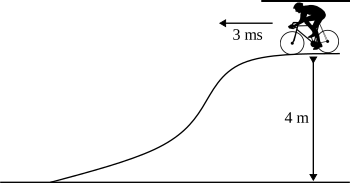
A 65 kg rider is on a 15 kg bicycle, moving across the top of a 4 metre high hill with a horizontal speed of 3 ms\(^{-1}\).
 

  1. The bicycle descends the hill, dropping a vertical distance of 4.0 meters before reaching level ground. Assuming no energy is lost to friction or air resistance, calculate the speed of the bicycle and rider at the bottom of the hill.   (3 marks)

--- 6 WORK AREA LINES (style=lined) ---

  1. At the bottom, the rider applies the brakes. The bike skids 15 metres across flat ground before coming to a stop. Calculate the magnitude of the frictional force acting on the bike during this motion.   (2 marks)

--- 5 WORK AREA LINES (style=lined) ---

Show Answers Only

a.    \(9.35\ \text{ms}^{-1}\)

b.    \(233\ \text{N}\)

Show Worked Solution

a.    By applying the Law of Conservation of Energy:

\(E_{\text{after}}\) \(=E_{\text{before}}\)  
\(\dfrac{1}{2}mv^2\) \(=\dfrac{1}{2}mu^2+mgh\)  
\(v^2\) \(=u^2 +2gh\)  
\(v\) \(=\sqrt{3^2+2 \times 9.8 \times 4}\)  
  \(=9.35\ \text{ms}^{-1}\)  


  • The velocity of the rider at the bottom of the hill is 9.35 ms\(^{-1}\).

b.    At the bottom of the hill:

  • Work done to slow rider = change in rider’s kinetic energy
\(W\) \(=\Delta KE\)  
\(Fs\) \(=\dfrac{1}{2}mv^2-\dfrac{1}{2}mu^2\)  
\(F \times 15\) \(=\dfrac{1}{2} \times 80 \times 0^2-\dfrac{1}{2} \times 80 \times 9.35^2\)  
\(F\) \(=-\dfrac{3496.9}{15}\)  
  \(=-233\ \text{N}\)  


  • The braking force acting on the bike is \(233\ \text{N}\).

Filed Under: Forces, Acceleration and Energy Tagged With: Band 4, Band 5, smc-4276-10-Conservation of energy, smc-4276-40-Work done, smc-4276-60-Kinetic Energy

PHYSICS, M2 EQ-Bank 8 MC

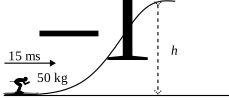
A skier with a mass of 50 kg is moving toward a hill at a speed of 15 ms\(^{-1}\).
 

Assuming there is no friction between the skis and the hill, calculate the maximum vertical height, \(h\), that the skier can reach.

  1. \(10.0\ \text{m}\)
  2. \(10.5\ \text{m}\)
  3. \(11.0\ \text{m}\)
  4. \(11.5\ \text{m}\)
Show Answers Only

\(D\)

Show Worked Solution
  • Using the Law of Conservation of Energy, the initial kinetic energy of the skier will be equal to the final gravitational potential energy. Hence:
\(\dfrac{1}{2}mv^2\) \(=mgh\)  
\(\dfrac{1}{2}v^2\) \(=gh\)  
\(h\) \(=\dfrac{v^2}{2g}=\dfrac{15^2}{2 \times 9.8}=11.5\ \text{m}\)  

 
\(\Rightarrow D\)

Filed Under: Forces, Acceleration and Energy Tagged With: Band 4, smc-4276-10-Conservation of energy

PHYSICS, M2 2021 VCE 9a

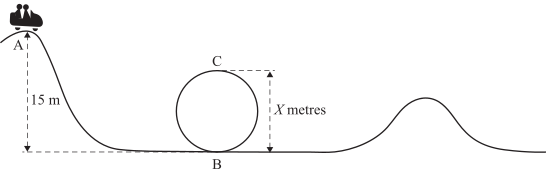
Abbie and Brian are about to go on their first loop-the-loop roller-coaster ride. As competent Physics students, they are working out if they will have enough speed at the top of the loop to remain in contact with the track while they are upside down at point \(\text{C}\), shown in diagram. 
 

The highest point of the roller-coaster (point \(\text{A}\)) is 15 m above point \(\text{B}\) and the car starts at rest from point \(\text{A}\). Assume that there is negligible friction between the car and the track.

What is the speed of the car at point \(\text{B}\) at the bottom of the loop? Show your working.  (2 marks)

--- 4 WORK AREA LINES (style=lined) ---

Show Answers Only

\(17.1\ \text{ms}^{-1}\)

Show Worked Solution

Using the Law of Conservation of Energy: 

\(mgh\) \(=\dfrac{1}{2}mv^2\)  
\(v\) \(=\sqrt{2gh}\)  
  \(=\sqrt{2 \times 9.8 \times 15}\)  
  \(=17.1\ \text{ms}^{-1}\)  

Filed Under: Forces, Acceleration and Energy Tagged With: Band 4, smc-4276-10-Conservation of energy

PHYSICS, M2 2018 HSC 23a

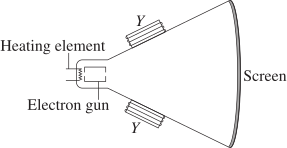
The diagram shows a cathode ray tube in a television.
 

Outline energy changes associated with the electrons passing through the gun, and when they strike the screen.   (2 marks)

--- 4 WORK AREA LINES (style=lined) ---

Show Answers Only
  • As the electrons pass through the gun, they experience an acceleration and so have their kinetic energy increased and the electrical potential energy decreased.
  • When the electrons hit the screen, their kinetic energy is converted into light and heat energy by the law of conservation of energy.
Show Worked Solution
  • As the electrons pass through the gun, they experience an acceleration and so have their kinetic energy increased and the electrical potential energy decreased.
  • When the electrons hit the screen, their kinetic energy is converted into light and heat energy by the law of conservation of energy.
Mean mark 54%.

Filed Under: Forces, Acceleration and Energy Tagged With: Band 5, smc-4276-10-Conservation of energy

Copyright © 2014–2025 SmarterEd.com.au · Log in