SmarterEd

Aussie Maths & Science Teachers: Save your time with SmarterEd

  • Login
  • Get Help
  • About

PHYSICS, M2 EQ-Bank 6

A crate, initially at rest, is pushed across a horizontal, frictionless floor by a constant force of 60 N for 8 seconds. During this time, the crate accelerates at a rate of 3.0 ms\(^{-2}\) (assume the force is parallel to the direction of motion).

What is the average power exerted on the crate at the end during the 8 seconds?   (2 marks)

Show Answers Only

\(720\ \text{W}\)

Show Worked Solution
  • Find the distance that the crate travels:
  •    \(s=ut +\dfrac{1}{2}at^2=0 \times 3 +\dfrac{1}{2} \times 3 \times 8^2=96\ \text{m}\)
  • Work Done on crate \(=Fs = 60 \times 96 = 5760\ \text{J}\)
  • Find average power exerted on the crate:
  •    \(P_{\text{avg}} = \dfrac{\text{Work Done}}{t}= \dfrac{5760}{8} = 720\ \text{W}\).

Filed Under: Forces, Acceleration and Energy Tagged With: Band 4, smc-4276-40-Work done, smc-4276-70-Power

PHYSICS, M2 EQ-Bank 11 MC

A 1600 kg car experiences a force of 1000 N acting in the same direction as its motion.

The car travels 500 m along flat ground while the force is applied.

The car’s initial speed is 10.0 m/s and its final speed is 22.0 m/s.
 

From these data, it can be concluded that:

  1. The car’s kinetic energy increased by 204,800 \(\text{J}\).
  2. The car’s acceleration was 4.0 ms\(^{-2}\).
  3. The work done on the car by the 1000 N force was \((1000 \times 12)\ \text{J}\).
  4. The work done on the car by the 1000 N force was \((1000 \times 500)\ \text{J}\).
Show Answers Only

\(D\)

Show Worked Solution
  • The work done on an object is given by:  \(W=Fs\).
  • The work done on the car by the 1000 N force will be \((1000 \times 500)\ \text{J}\).

\(\Rightarrow D\)

Filed Under: Forces, Acceleration and Energy Tagged With: Band 4, smc-4276-40-Work done

PHYSICS, M2 EQ-Bank 4

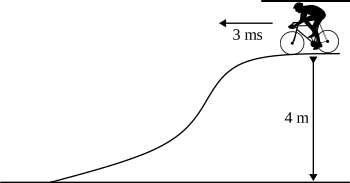
A 65 kg rider is on a 15 kg bicycle, moving across the top of a 4 metre high hill with a horizontal speed of 3 ms\(^{-1}\).
 

  1. The bicycle descends the hill, dropping a vertical distance of 4.0 meters before reaching level ground. Assuming no energy is lost to friction or air resistance, calculate the speed of the bicycle and rider at the bottom of the hill.   (3 marks)

--- 6 WORK AREA LINES (style=lined) ---

  1. At the bottom, the rider applies the brakes. The bike skids 15 metres across flat ground before coming to a stop. Calculate the magnitude of the frictional force acting on the bike during this motion.   (2 marks)

--- 5 WORK AREA LINES (style=lined) ---

Show Answers Only

a.    \(9.35\ \text{ms}^{-1}\)

b.    \(233\ \text{N}\)

Show Worked Solution

a.    By applying the Law of Conservation of Energy:

\(E_{\text{after}}\) \(=E_{\text{before}}\)  
\(\dfrac{1}{2}mv^2\) \(=\dfrac{1}{2}mu^2+mgh\)  
\(v^2\) \(=u^2 +2gh\)  
\(v\) \(=\sqrt{3^2+2 \times 9.8 \times 4}\)  
  \(=9.35\ \text{ms}^{-1}\)  


  • The velocity of the rider at the bottom of the hill is 9.35 ms\(^{-1}\).

b.    At the bottom of the hill:

  • Work done to slow rider = change in rider’s kinetic energy
\(W\) \(=\Delta KE\)  
\(Fs\) \(=\dfrac{1}{2}mv^2-\dfrac{1}{2}mu^2\)  
\(F \times 15\) \(=\dfrac{1}{2} \times 80 \times 0^2-\dfrac{1}{2} \times 80 \times 9.35^2\)  
\(F\) \(=-\dfrac{3496.9}{15}\)  
  \(=-233\ \text{N}\)  


  • The braking force acting on the bike is \(233\ \text{N}\).

Filed Under: Forces, Acceleration and Energy Tagged With: Band 4, Band 5, smc-4276-10-Conservation of energy, smc-4276-40-Work done, smc-4276-60-Kinetic Energy

PHYSICS, M2 EQ-Bank 5 MC

A boy pulls a box to the right along a horizontal surface using a constant force of 25 \(\text{N}\).

In each of the three cases below \((1, 2\) and \(3)\), the displacement of the box is identical.

Rank the three situations based on the amount of work done by the 25 \(\text{N}\) force, from the least to the greatest.

  1. \(2, 3, 1\)
  2. \(3, 2, 1\)
  3. \(3, 1, 2\)
  4. \(1, 2, 3\)
Show Answers Only

\(B\)

Show Worked Solution
  • The work done on an object is given by the equation  \(W=Fs\ \cos\theta\), where \(\theta\) is the angle between the force and direction of the displacement.
  • When the force is parallel to the direction of motion (see case 1), \(\theta = 0\ \Rightarrow\ \cos \theta = 1\). Therefore the work done on the box will be the greatest.
  • Similarly, when the force is perpendicular to the direction of motion (see case 3),  \(\theta = 90\ \Rightarrow\ \cos \theta = 0\). Therefore the work done on the box will be 0 \(\text{Nm}\).

\(\Rightarrow B\)

Filed Under: Forces, Acceleration and Energy Tagged With: Band 3, smc-4276-40-Work done

PHYSICS, M2 2020 VCE 9-10 MC

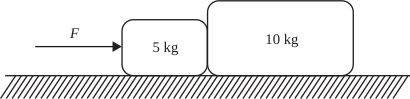
Two blocks of mass 5 kg and 10 kg are placed in contact on a frictionless horizontal surface, as shown in the diagram below. A constant horizontal force, \(F\), is applied to the 5 kg block.


Question 9

Which one of the following statements is correct?

  1. The net force on each block is the same.
  2. The acceleration experienced by the 5 kg block is twice the acceleration experienced by the 10 kg block.
  3. The magnitude of the net force on the 5 kg block is half the magnitude of the net force on the 10 kg block.
  4. The magnitude of the net force on the 5 kg block is twice the magnitude of the net force on the 10 kg block.

 
Question 10

If the force \(F\) has a magnitude of 250 N, what is the work done by the force in moving the blocks in a straight line for a distance of 20 m?

  1. \(5 \text{ kJ}\)
  2. \(25 \text{ kJ}\)
  3. \(50 \text{ kJ}\)
  4. \(500 \text{ kJ}\)
Show Answers Only

\(\text{Question 9:}\ C\)

\(\text{Question 10:}\ A\)

Show Worked Solution

\(\text{Question 9}\)

Using Newton’s second Law:  \(F=ma\ \ \Rightarrow\ \ a=\dfrac{F}{m}\).

  • The blocks will experience the same acceleration.
  • Both blocks will have the same force to mass ratio. Since the 5 kg block is half the mass of the 10 kg block, it will experience half the magnitude of the net force as the 10 kg block.

\(\Rightarrow C\)

♦ Mean mark 49%.

 
\(\text{Question 10}\)

\(W\) \(=F_{\parallel}s\)  
  \(=250 \times 20\)  
  \(=5000\ \text{J}\)  
  \(=5\ \text{kJ}\)  

 
\(\Rightarrow A\)

Filed Under: Forces Tagged With: Band 3, Band 5, smc-4275-10-Using Newton's laws, smc-4275-30-Newton's 2nd Law, smc-4276-40-Work done

Copyright © 2014–2025 SmarterEd.com.au · Log in