SmarterEd

Aussie Maths & Science Teachers: Save your time with SmarterEd

  • Login
  • Get Help
  • About

PHYSICS, M3 EQ-Bank 11 MC

Which of the following is always true when light undergoes refraction as it passes from one transparent medium into another?

  1. The light will always bend away from the normal.
  2. The frequency of the light will increase.
  3. The angle of incidence will always equal the angle of refraction.
  4. The speed and wavelength of light will change.
Show Answers Only

\(D\)

Show Worked Solution
  • A is incorrect as the light will bend towards or away from the normal depending on whether the light is a denser and less dense medium respectively.
  • B is incorrect as the frequency of light is independent of the medium the light is travelling through.
  • C is incorrect as this is only true if the two media have the same refractive index.
  • D is correct as light slows down or speeds up depending on the refractive index of the medium. Since frequency remains constant, a change in speed causes the wavelength to change.

\(\Rightarrow D\)

Filed Under: Ray Model of Light Tagged With: Band 4, smc-4281-10-Snell's Law, smc-4281-20-Snell's Law and TIR

PHYSICS, M3 EQ-Bank 1

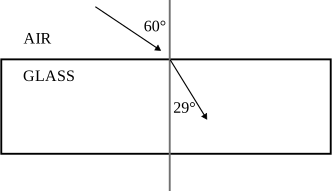
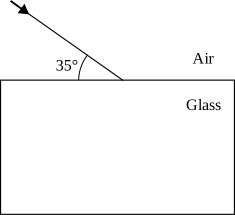
A ray of light of wavelength 4 \(\times\) 10\(^{-7}\) metres crosses from air into a block of glass as shown below. The refractive index of the glass is 1.6.
 

  1. What will be the angle of refraction in the glass?   (2 marks)

--- 4 WORK AREA LINES (style=lined) ---

  1. What is the speed of the light within the glass?   (1 mark)

--- 2 WORK AREA LINES (style=lined) ---

  1. What is the frequency of the light within the glass?   (2 marks)

--- 4 WORK AREA LINES (style=lined) ---

Show Answers Only

a.    \(30.8^{\circ}\)

b.    \(1.88 \times 10^8\ \text{ms}^{-1}\)

c.    \(7.5 \times 10^{14}\)

Show Worked Solution

a.    Using Snell’s Law:

\(n_1 \sin\theta_1\) \(=n_2 \sin \theta_2\)  
\(\theta_2\) \(=\sin^{-1}\left(\dfrac{n_1 \sin\theta_1}{n_2}\right)\)  
\(\theta_2\) \(=\sin^{-1}\left(\dfrac{1 \times \sin 55}{1.6}\right)\), where the angle of incidence is between the ray and the normal.   
  \(=30.8^{\circ}\)  


b.   \(v_g=\dfrac{c}{n_g}=\dfrac{3 \times 10^8}{1.6}=1.88 \times 10^8\ \text{ms}^{-1}\)
 

c.    The frequency of light is independent of the medium it is travelling through.

  • The frequency of the light in the glass will be the same as the frequency of the light in air.
  •    \(f=\dfrac{c}{\lambda_{\text{air}}} = \dfrac{3 \times 10^8}{4 \times 10^{-7}} = 7.5 \times 10^{14}\)

Filed Under: Ray Model of Light Tagged With: Band 4, Band 5, smc-4281-10-Snell's Law, smc-4281-20-Snell's Law and TIR, smc-4281-40-Speed of light in medium

PHYSICS, M3 EQ-Bank 2 MC

The diagram shows light refracting in a glass prism.

What is the refractive index of the glass?

  1. \(1.3\)
  2. \(1.5\)
  3. \(1.8\)
  4. \(2.0\)
Show Answers Only

\(C\)

Show Worked Solution

Using Snell’s Law:

\(n_2\) \(=\dfrac{n_1 \sin \theta_1}{\sin \theta_2}\)  
  \(=\dfrac{1 \times \sin 60}{\sin 29}\)  
  \(=1.786\)  

 
\(\Rightarrow C\)

Filed Under: Ray Model of Light Tagged With: Band 3, smc-4281-10-Snell's Law

PHYSICS, M3 2021 VCE 12

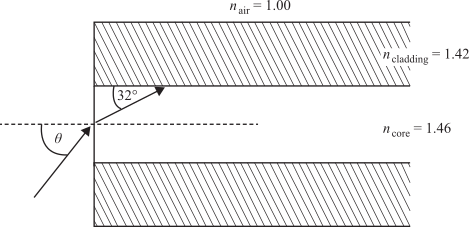
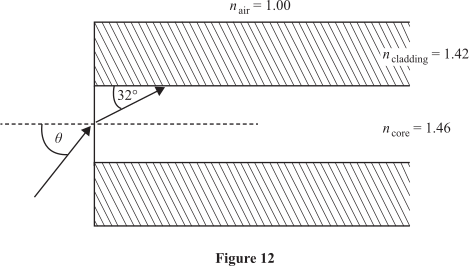
A Physics teacher is conducting a demonstration involving the transmission of light within an optical fibre. The optical fibre consists of an inner transparent core with a refractive index of 1.46 and an outer transparent cladding with a refractive index of 1.42. A single monochromatic light ray is incident on the optical fibre, as shown in diagram below.
 

  1. Determine the angle of incidence, \(\theta\), at the air-core boundary. Show your working.  (2 marks)

    --- 4 WORK AREA LINES (style=lined) ---

  2. Will any of the initial light ray be transmitted into the cladding? Explain your answer and show any supporting working.  (3 marks)

    --- 6 WORK AREA LINES (style=lined) ---

Show Answers Only

a.   \(\theta=51^{\circ}\)

b.    Find the critical angle for Total Internal Reflection (TIR):

\(\sin\theta_c\) \(=\dfrac{n_2}{n_1}\)  
\(\theta_c\) \(=\sin^{-1}\Big{(}\dfrac{n_2}{n_1}\Big{)} =\sin^{-1} \Big{(}\dfrac{1.42}{1.46} \Big{)}=76.6^{\circ}\)  
  • The angle of incidence \(=90^{\circ}-32^{\circ}=58^{\circ}\).
  • As the angle of incidence is less than the critical angle, TIR will not occur and light will be transmitted into the cladding.
Show Worked Solution

a.    Using Snell’s Law:

\(n_1\sin\theta_1\) \(=n_2\sin\theta_2\)  
\(\theta_1\) \(=\sin^{-1} \Big{(}\dfrac{n_2\sin\theta_2}{n_1} \Big{)} \)  
  \(=\sin^{-1}\Big{(}\dfrac{1.46 \times \sin32^{\circ}}{1.0}\Big{)} \)  
  \(=51^{\circ}\)  
     

b.    Find the critical angle for Total Internal Reflection (TIR):

\(\sin\theta_c\) \(=\dfrac{n_2}{n_1}\)  
\(\theta_c\) \(=\sin^{-1}\Big{(}\dfrac{n_2}{n_1}\Big{)} =\sin^{-1} \Big{(}\dfrac{1.42}{1.46} \Big{)}=76.6^{\circ}\)  
  • The angle of incidence \(=90^{\circ}-32^{\circ}=58^{\circ}\).
  • As the angle of incidence is less than the critical angle, TIR will not occur and light will be transmitted into the cladding. 
♦ Mean mark (b) 45%.

Filed Under: Ray Model of Light Tagged With: Band 4, Band 5, smc-4281-10-Snell's Law, smc-4281-20-Snell's Law and TIR

PHYSICS, M3 2022 VCE 13

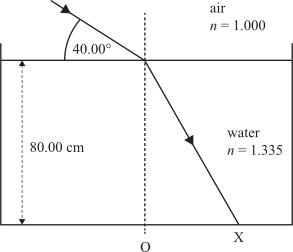
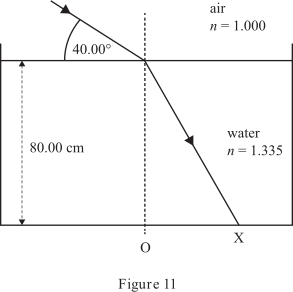
A ray of green light from a light-emitting diode (LED) strikes the surface of a tank of water at an angle of 40.00° to the surface of the water, as shown in diagram below. The ray arrives at the base of the tank at point \(\text{X}\). The depth of the water in the tank is 80.00 cm. The refractive index of green LED light in water is 1.335
 

  1. Calculate the distance \(\text{OX}\). Outline your reasoning and show all your working. Give your answer in centimetres.   (4 marks)

    --- 8 WORK AREA LINES (style=lined) ---

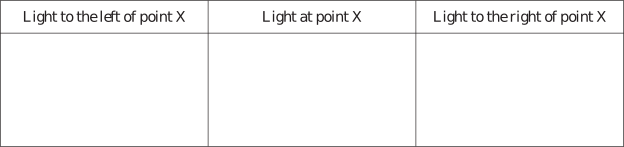
  2. The green LED light is replaced with a narrow beam of white sunlight.
  3. Describe the colour of the light that arrives to the left of point \(\text{X}\), at point \(\text{X}\) and to the right of point \(\text{X}\).   (3 marks)
     
  4. --- 0 WORK AREA LINES (style=lined) ---

Show Answers Only

a.  \(OX=56\ \text{cm}\)

b.

\begin{array} {|c|c|c|}
\hline
\rule{0pt}{2.5ex}\text{Light to the left of point X}\rule[-1ex]{0pt}{0pt} & \text{Light at point X} & \text{Light to the right of point X} \\
\hline
\rule{0pt}{2.5ex}\text{Blue/Purple}\rule[-1ex]{0pt}{0pt} & \text{Green} & \text{Red} \\ \text{(lower wavelength)} & & \text{(higher wavelength)} \\
\hline
\end{array}

Show Worked Solution

a.  \(\text{Using Snell’s Law:}\)

\(n_1 \sin \theta_1\) \(=n_2 \sin \theta_2\)  
\(\sin \theta_2\) \(=\dfrac{n_1 \sin \theta_1}{n_2}\)  
\( \theta_2\) \(= \sin^{-1}\Big{(}\dfrac{1 \times \sin 50^{\circ}}{1.335} \Big{)}=35^{\circ}\)  


\(\tan35^{\circ}\) \(=\dfrac{OX}{80}\)  
\(OX\) \(=80\times \tan35^{\circ}=56\ \text{cm}\)  

♦ Mean mark 48%.

b. 

\begin{array} {|c|c|c|}
\hline
\rule{0pt}{2.5ex}\text{Light to the left of point X}\rule[-1ex]{0pt}{0pt} & \text{Light at point X} & \text{Light to the right of point X} \\
\hline
\rule{0pt}{2.5ex}\text{Blue/Purple}\rule[-1ex]{0pt}{0pt} & \text{Green} & \text{Red} \\ \text{(lower wavelength)} & & \text{(higher wavelength)} \\
\hline
\end{array}

Filed Under: Ray Model of Light Tagged With: Band 4, Band 5, smc-4281-10-Snell's Law, smc-4281-30-Light dispersion

Copyright © 2014–2025 SmarterEd.com.au · Log in