SmarterEd

Aussie Maths & Science Teachers: Save your time with SmarterEd

  • Login
  • Get Help
  • About

PHYSICS, M3 EQ-Bank 3

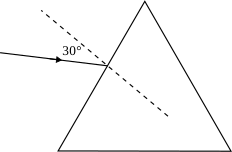
A light beam enters a glass prism with a refractive index \((n)\) of 1.60.
 

  1. What happens to the speed of the light as it enters the glass prism from air?   (1 mark)

--- 3 WORK AREA LINES (style=lined) ---

  1. A beam of green light with a frequency of 5.2 \(\times\) 10\(^{14}\) enters the glass. Calculate the wavelength of this light inside the prism.   (1 mark)

--- 2 WORK AREA LINES (style=lined) ---

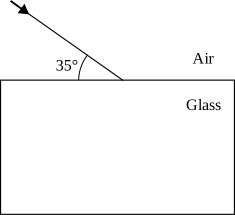
  1. The beam strikes the surface of the prism at an angle of incidence of 30\(^{\circ}\). Calculate the angle of refraction for the beam as it enters the prism, and draw a line on the diagram (above) to show the direction of the beam inside the prism.    (2 marks)

    --- 4 WORK AREA LINES (style=lined) ---

  2. Define the term critical angle, and calculate the critical angle for the glass-to-air boundary of the prism.   (2 marks)

--- 4 WORK AREA LINES (style=lined) ---

Show Answers Only

a.    The speed of the light will slow down.

b.    \(3.6 \times 10^{-7}\ \text{m}\)

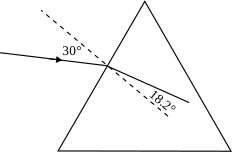
c.    \(18.2^{\circ}\)
d.   Critical angle definition:

  • The minimum angle of incidence in a denser medium (like glass) at which light is refracted along the boundary between two media (i.e. refracted at 90° to the normal).
  • If the angle of incidence is greater than the critical angle, total internal reflection occurs. i.e. the light is reflected back entirely into the denser medium.
  • The critical angle for the glass to air boundary is 38.7°.
Show Worked Solution

a.    Using  \(n = \dfrac{c}{v}:\)

\(v_g = \dfrac{c}{n_g} = \dfrac{3 \times 10^8}{1.6} = 1.875 \times 10^8\ \text{ms}^{-1}\)

  • The speed of the light will slow down.
     

b.    Using  \(v=f \times \lambda\):

\(\lambda_g = \dfrac{v_g}{f} = \dfrac{1.875 \times 10^8}{5.2 \times 10^{14}} = 3.6 \times 10^{-7}\ \text{m}\)
 

c.    Using Snell’s Law:

\(n_1 \sin \theta_1\) \(=n_2 \sin\theta_2\)  
\(\theta_2\) \(=\sin^{-1}\left(\dfrac{n_1 \sin\theta_1}{n_2}\right)=\sin^{-1}\left(\dfrac{1 \times \sin30}{1.60}\right)=18.2^{\circ}\)  


d.   Critical angle definition:

  • The minimum angle of incidence in a denser medium (like glass) at which light is refracted along the boundary between two media (i.e. refracted at 90° to the normal).
  • If the angle of incidence is greater than the critical angle, total internal reflection occurs. i.e. the light is reflected back entirely into the denser medium.
  • Using  \(\sin \theta_c=\dfrac{n_2}{n_1}\)
  •    \(\theta_c= \sin^{-1}\left(\dfrac{n_2}{n_1}\right) = \sin^{-1}\left(\dfrac{1}{1.6}\right) = 38.7^{\circ}\)
  • The critical angle for the glass to air boundary is 38.7°.
Filed Under: Ray Model of Light Tagged With: Band 3, Band 4, smc-4281-20-Snell's Law and TIR, smc-4281-40-Speed of light in medium

PHYSICS, M3 EQ-Bank 1

A ray of light of wavelength 4 \(\times\) 10\(^{-7}\) metres crosses from air into a block of glass as shown below. The refractive index of the glass is 1.6.
 

  1. What will be the angle of refraction in the glass?   (2 marks)

--- 4 WORK AREA LINES (style=lined) ---

  1. What is the speed of the light within the glass?   (1 mark)

--- 2 WORK AREA LINES (style=lined) ---

  1. What is the frequency of the light within the glass?   (2 marks)

--- 4 WORK AREA LINES (style=lined) ---

Show Answers Only

a.    \(30.8^{\circ}\)

b.    \(1.88 \times 10^8\ \text{ms}^{-1}\)

c.    \(7.5 \times 10^{14}\)

Show Worked Solution

a.    Using Snell’s Law:

\(n_1 \sin\theta_1\) \(=n_2 \sin \theta_2\)  
\(\theta_2\) \(=\sin^{-1}\left(\dfrac{n_1 \sin\theta_1}{n_2}\right)\)  
\(\theta_2\) \(=\sin^{-1}\left(\dfrac{1 \times \sin 55}{1.6}\right)\), where the angle of incidence is between the ray and the normal.   
  \(=30.8^{\circ}\)  


b.   \(v_g=\dfrac{c}{n_g}=\dfrac{3 \times 10^8}{1.6}=1.88 \times 10^8\ \text{ms}^{-1}\)
 

c.    The frequency of light is independent of the medium it is travelling through.

  • The frequency of the light in the glass will be the same as the frequency of the light in air.
  •    \(f=\dfrac{c}{\lambda_{\text{air}}} = \dfrac{3 \times 10^8}{4 \times 10^{-7}} = 7.5 \times 10^{14}\)

Filed Under: Ray Model of Light Tagged With: Band 4, Band 5, smc-4281-10-Snell's Law, smc-4281-20-Snell's Law and TIR, smc-4281-40-Speed of light in medium

PHYSICS, M3 EQ-Bank 4 MC

A transparent plastic has a refractive index of 1.5. What is the speed of light in the plastic?

  1. \(2.0 \times 10^8\ \text{m/s}\)
  2. \(4.5 \times 10^8\ \text{m/s}\)
  3. \(1.5 \times 10^8\ \text{m/s}\)
  4. \(3.0 \times 10^8\ \text{m/s}\)
Show Answers Only

\(A\)

Show Worked Solution

Calculate the speed using  \(n_x=\dfrac{c}{v_x}\):

\(v_x=\dfrac{c}{n_x}=\dfrac{3 \times 10^8}{1.5}=2 \times 10^8\)

\(\Rightarrow A\)

Filed Under: Ray Model of Light Tagged With: Band 3, smc-4281-40-Speed of light in medium

PHYSICS, M3 2018 VCE 12

Optical fibres are constructed using transparent materials with different refractive indices.

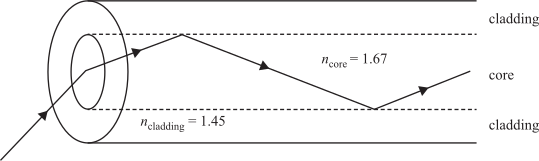
The diagram below shows one type of optical fibre that has a cylindrical core and surrounding cladding. Laser light of wavelength 565 nm is shone from air into the optical fibre (\(v=3 \times 10^8\)).
 

  1. Calculate the frequency of the laser light before it enters the optical fibre.  (1 mark)

    --- 2 WORK AREA LINES (style=lined) ---

  2. Calculate the critical angle for the laser light at the cladding-core boundary. Show your working.  (2 marks)

    --- 4 WORK AREA LINES (style=lined) ---

  3. Calculate the speed of the laser light once it enters the core of the optical fibre. Give your answer correct to three significant figures. Show your working.  (2 marks)

    --- 4 WORK AREA LINES (style=lined) ---

Show Answers Only

a.    \(f=5.31 \times 10^{14}\ \text{Hz}\)

b.    \(\theta_c=60.3^{\circ}\)

c.    \(v_{\text{x}}=1.80 \times 10^8\ \text{ms}^{-1}\)

Show Worked Solution

a.     \(f\) \(=\dfrac{v}{\lambda}\)
    \(=\dfrac{3\times 10^8}{565 \times 10^{-9}}\)
    \(=5.31 \times 10^{14}\ \text{Hz}\)

 
b.
  \(\theta_c=\sin^{-1}\Big{(}\dfrac{n_2}{n_1}\Big{)}=\sin^{-1} \Big{(}\dfrac{1.45}{1.67} \Big{)}=60.3^{\circ}\) 

c.     \(v_{\text{x}}\) \(=\dfrac{c}{n_{\text{x}}}\)
    \(=\dfrac{3 \times 10^8}{1.67}\)
    \(=1.80 \times 10^8\ \text{ms}^{-1}\)
♦ Mean mark (c) 50%.

Filed Under: Ray Model of Light Tagged With: Band 4, Band 5, smc-4281-20-Snell's Law and TIR, smc-4281-40-Speed of light in medium

PHYSICS, M3 2019 VCE 15

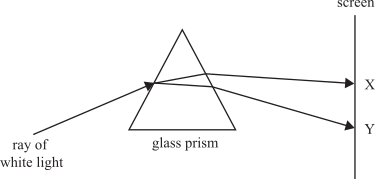
A student sets up an experiment involving a source of white light, a glass prism and a screen. The path of a single ray of white light when it travels through the prism and onto the screen is shown in Figure 14.
 

A spectrum of colours is observed by the student on the screen, which is positioned to the right of the prism.

  1. Name and explain the effect observed by the student.   (3 marks)

    --- 5 WORK AREA LINES (style=lined) ---

  2. Points \(\text{X}\) and \(\text{Y}\) on the diagram above represent either end of the visible spectrum observed by the student.
  3. Identify the two visible colours observed at point \(\text{X}\) and at point \(\text{Y}\).   (1 mark)

    --- 2 WORK AREA LINES (style=lined) ---

Show Answers Only

a.   The observed effect is dispersion.

  • As light enters the glass it slows down as it is entering a denser medium.
  • As the refractive index for different wavelengths of light differs, the angle at which individual wavelengths refract differs slightly.
  • This causes the white light to split up as each wavelength refracts differently through the glass resulting in a rainbow spectrum on the screen.

 b.   Point \(X\) is red.

        Point \(Y\) is blue/purple.

Show Worked Solution

a.   The observed effect is dispersion.

  • As light enters the glass it slows down as it is entering a denser medium.
  • As the refractive index for different wavelengths of light differs, the angle at which individual wavelengths refract differs slightly.
  • This causes the white light to split up as each wavelength refracts differently through the glass resulting in a rainbow spectrum on the screen.
♦ Mean mark 53%.

b.   Point \(X\) is red.

        Point \(Y\) is blue/purple.

Filed Under: Ray Model of Light Tagged With: Band 4, Band 5, smc-4281-30-Light dispersion, smc-4281-40-Speed of light in medium

PHYSICS, M3 2019 VCE 9 MC

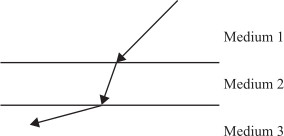
A monochromatic light ray passes through three different media, as shown in the diagram below.

Assume that \(v_1\) is the speed of light in Medium 1, \(v_2\) is the speed of light in Medium 2 and \(v_3\) is the speed of light in Medium 3.

Which one of the following would best represent the relative speeds in the media?

  1. \(v_1>v_2>v_3\)
  2. \(v_1>v_3>v_2\)
  3. \(v_3>v_2>v_1\)
  4. \(v_3>v_1>v_2\)
Show Answers Only

\(D\)

Show Worked Solution
  • From Medium 1 to Medium 2, the light bends towards the normal, this means the light is entering a denser medium and so the light will slow down (\(v_1>v_2\)).
  • From Medium 2 to Medium 3, the light bends away from the normal, this means the light is entering a less dense medium and so the light will speed up. Hence (\(v_2<v_3\)).
  • As the angle of the light as it enters medium 3 is greater than the original angle of incidence. Medium three must be less dense than Medium 1, hence the light would travel faster in medium 3, \(v_3>v_1\).

\(\Rightarrow D\)

Filed Under: Ray Model of Light Tagged With: Band 4, smc-4281-40-Speed of light in medium

Copyright © 2014–2025 SmarterEd.com.au · Log in